North Korea on Thursday unveiled a new uranium enrichment facility capable of producing fuel for nuclear bombs, with Kim Jong Un declaring the country would expand its nuclear arsenal at an ‘exponential rate’.” The disclosure, made on Thursday through state media, signals that Pyongyang has no intention of putting its weapons programme on the negotiating table anytime soon.
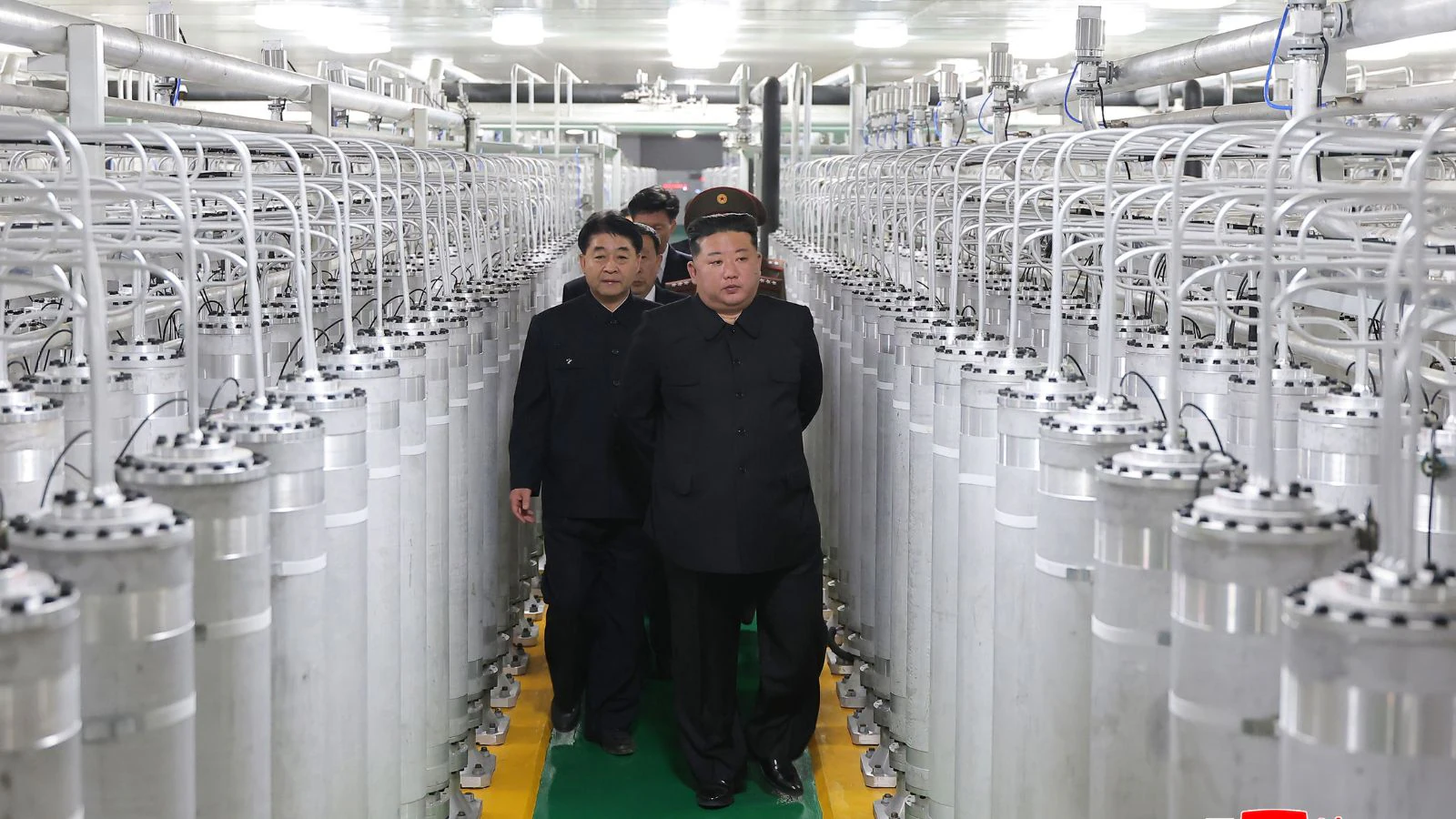
North Korea’s official Korean Central News Agency (KCNA) published photographs of Kim walking through narrow aisles edged by dense rows of silver tubes and pipes – consistent with the appearance of a centrifuge hall used in uranium enrichment. Another image showed him in a meeting room, where a blurred graphic depicting what appeared to be a cone-shaped object – possibly a warhead design – was laid out on a table.
🚨🇰🇵 Kim Jong-un inspects new nuclear materials production factory
During the inspection, Kim reviewed new production lines built with advanced technology.
The country’s nuclear materials production capacity has doubled in five years, KCNA said.
pic.twitter.com/4pj8adItn1— Sputnik India (@Sputnik_India) June 4, 2026
KCNA said the facility used “more sophisticated technology” but did not disclose its location. South Korea’s Joint Chiefs of Staff assessed the site as a uranium enrichment plant, and said it was “closely coordinating with the United States” to monitor North Korean nuclear activities.
This is the third time North Korea has publicly disclosed a uranium enrichment site. The previous disclosures came in 2010, when American scholars were shown one at the Yongbyon nuclear complex, and again in 2024, when photographs of another covert facility were released. Last September, South Korea’s Unification Minister had said the North was operating four such facilities in total, all running every day.
What Kim said
During his visit to the plant, Kim said the urgency of bolstering the country’s nuclear deterrent – “both in quality and quantity” – had grown because of confrontations with “the most ferocious enemies,” a reference widely understood to mean the United States and South Korea.
He also said that North Korea’s “nuclear materials production capacity has more than doubled compared with five years ago,” a claim that cannot be independently verified, according to the news agency AP.
Kim said exercising “the position of a nuclear weapons state” was his country’s “invariable” stand — language that suggests he wants international recognition of North Korea as a nuclear power rather than a path toward disarmament.
The larger strategic picture
Experts say Kim’s goal is to secure recognition as a nuclear state so that he can then push for the lifting of United Nations economic sanctions – and eventually seek arms reduction talks with Washington in exchange for a partial rollback of his nuclear capability.
Story continues below this ad
US President Donald Trump has repeatedly expressed a desire to resume diplomacy with Kim. But the North Korean leader has made his precondition clear: Washington must first drop its demand for denuclearisation before any talks begin, according to the reports.
Since diplomacy broke down in 2019, Pyongyang has conducted an extensive series of weapons tests. Kim has repeatedly vowed to expand his nuclear arsenal, leading many analysts to conclude that North Korea now likely possesses nuclear missiles capable of reaching the American mainland.
Sceptics remain
Not everyone is convinced North Korea has fully crossed that threshold. Some experts point out that Pyongyang has not publicly demonstrated that its warheads can survive the extreme conditions of atmospheric re-entry – a critical requirement for a functional intercontinental ballistic missile. There are also questions about whether the country has mastered the technology to place multiple nuclear warheads on a single missile, which would be necessary to defeat US missile defence systems.
On the arsenal’s size, estimates vary widely. A senior South Korean official told lawmakers in 2018 that North Korea was believed to have manufactured between 20 and 60 nuclear weapons. Some experts now put the figure at over 100
warheads.
Story continues below this ad
In 2023, North Korea unveiled what it described as tactical battlefield nuclear warheads, prompting speculation that a seventh nuclear test might follow. No such test has taken place. The last detonation was in September 2017, according to the reports.
(With inputs from AP)