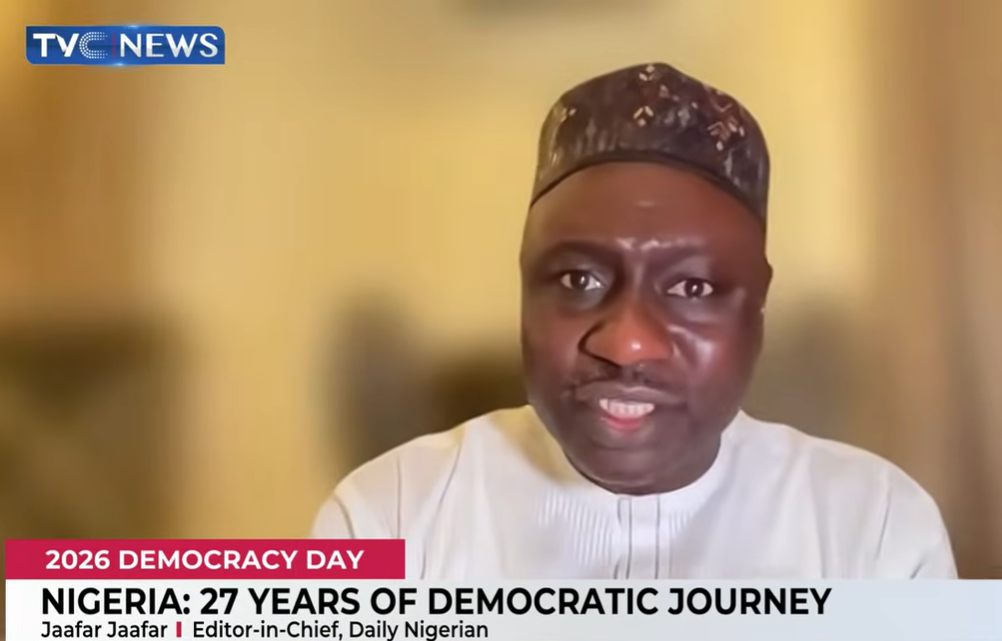
Editor-in-Chief of Daily Nigerian, Jaafar Jaafar, has said that while Nigeria’s democratic journey has witnessed growth in institutions and opportunities over the past 27 years, the quality of governance and public outcomes has continued to decline. Jaafar stated this during an interview on the June 12 Democracy Day Town Hall……
Editor-in-Chief of Daily Nigerian, Jaafar Jaafar, has said that while Nigeria’s democratic journey has witnessed growth in institutions and opportunities over the past 27 years, the quality of governance and public outcomes has continued to decline.
Jaafar stated this during an interview on the June 12 Democracy Day Town Hall edition of Journalists’ Hangout on TVC News, where he reflected on Nigeria’s democratic experience since 1999.
He argued that despite the expansion of democratic institutions, the quality of services and outcomes has not improved correspondingly.
He noted that while the number of universities had increased significantly since the return to democracy, the education sector still faces major challenges.
READ ALSO: JH Special: Journalist Urges National Consensus on Nigeria’s Future
“At the dawn of democracy in 1999, we had the first private university. Today, we have about 160 universities, but did the quality of education increase? How about the out-of-school children that are still roaming the streets?” he queried.
According to him, successive administrations have often been judged more favourably in retrospect as Nigerians compare their performances with those that followed.
“Who is the best Nigerian leader? I will say Obasanjo to me. But when Obasanjo was in power, we saw so many criticisms. Now we see some of the reforms he instituted which we are still gaining from,” he said.
The journalist cited banking sector recapitalisation, pension reforms, debt buyback initiatives and investments in power infrastructure as some of the enduring legacies of the Obasanjo administration.
“Look at the banking sector reform, the recapitalisation and then look at debt buyback, which is also a product of that administration. Look at pension reform. Obasanjo built a number of electricity stations that we are dependent on today. Without them, we would not have had any power in Nigeria,” he stated.
The media executive also expressed concern over the persistence of corruption despite the existence of anti-graft agencies such as the Economic and Financial Crimes Commission and the Independent Corrupt Practices and Other Related Offences Commission.
“Corruption is still deeply ingrained in the fabric of our nation. Corruption is systemic. We just don’t know how to tackle it because those who are even fighting corruption are also corrupt,” he said.
Jaafar further argued that democratic governance has created greater opportunities for citizens to express themselves but said some laws have narrowed civic participation.
“Democracy has given us a voice to speak up, to write and to do whatever we want without military decrees. But in the midst of that came the Cybercrime Act, which shrinks the civic space,” he stated.
He added that public confidence in law enforcement and governance institutions remains a challenge, alleging that political interests often influence the handling of certain cases.