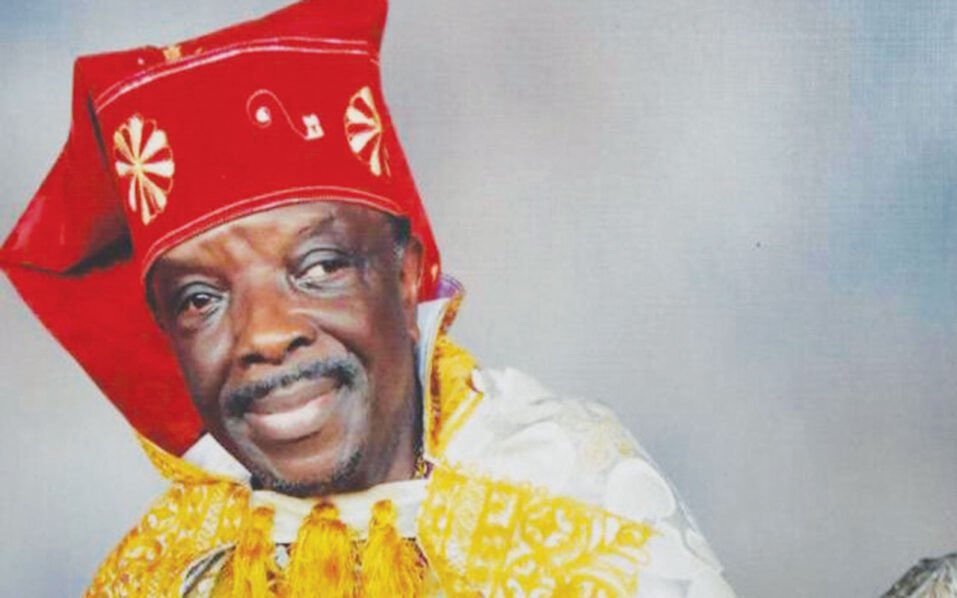
In the intricate architecture of Ijebu Ode’s traditional governance system, no non-royal office commands as much historical reverence, institutional authority, and cultural weight as the exalted title of Ogbeni-Oja.
Far beyond a ceremonial designation, the Ogbeni-Oja represents the very nerve center of palace administration—an office that has, for centuries, functioned as the operational backbone of the Awujale’s sovereignty.
The origin of the Ogbeni-Oja title predates the establishment of the Obanta dynasty itself, placing it among the most ancient political institutions in Ijebu history. It belongs to a distinguished cadre of primordial offices including Jaginrin, Apebi, Olotufure, and Ogbeni-Odi—titles that were already fully institutionalized before the consolidation of monarchical authority under Obanta.
This pre-dynastic existence is not merely symbolic; it demonstrates that the governance structure of Ijebu was already sophisticated, with clearly defined administrative hierarchies long before the emergence of centralized kingship. Within this framework, the Ogbeni-Oja evolved as a stabilizing force—an office designed to ensure continuity, discipline, and coordination within the palace system.
A critical misunderstanding in contemporary interpretations of the title lies in the word “Oja.” Modern usage often equates it with “market,” thereby wrongly suggesting that the Ogbeni-Oja is a figure tied to commerce or economic leadership. This interpretation is historically inaccurate.
In the classical Ijebu lexicon, Oja referred to the palace, while the monarch was known as Oloja—literally, “the lord of the palace.” Consequently, the Ogbeni-Oja was not a market authority but the principal officer of the palace, akin to a Chief of Staff or Prime Minister within a monarchical framework.
The responsibility for commerce and trade traditionally rested with the Parakoyi, further reinforcing that the Ogbeni-Oja’s jurisdiction was strictly within the realm of palace governance and statecraft.
The Ogbeni-Oja occupies a uniquely powerful position in the Ijebu traditional hierarchy. Although the title is non-hereditary, its occupant wields authority that is second only to the Awujale himself, particularly in matters concerning palace administration, ritual coordination, and executive decision-making.
Within the elite council of high chiefs known as the Ilamuren—often described by early European observers as a “House of Lords”—the Ogbeni-Oja stands as primus inter pares (first among equals). This council functioned as the highest deliberative body in Ijebu polity, comparable to executive cabinets in modern governance systems.
Parallels can be drawn with other Yoruba political institutions such as the Oyomesi of Oyo, the Iwarefa of Ile-Ife, and the Idejo chiefs of Lagos. However, what distinguishes the Ijebu system is the pronounced centrality of the Ogbeni-Oja as the coordinating authority within this council.
In the pre-colonial era, the Awujale was bound by sacred traditions that limited public appearances and physical mobility. As a result, governance required a trusted intermediary—one who could act with the authority of the crown without diminishing its sanctity. That intermediary was the Ogbeni-Oja.
– Acting as the official representative of the Awujale in both internal and external affairs
– Leading diplomatic missions and high-level delegations
– Serving as statutory regent during interregnums or periods of royal seclusion
– Presiding over general assemblies and high council deliberations
– Functioning as the chief spokesperson and policy executor of the palace
– Supervising ceremonial rites, festivals, and state functions
– Coordinating intelligence, conflict resolution, and strategic decision-making
The Ogbeni-Oja was, in effect, the engine room of governance—translating royal will into administrative action.
Before colonial intervention restructured indigenous institutions, the Ilamuren council—under the influential coordination of the Ogbeni-Oja—performed a wide range of governance functions:
– Adjudication of disputes and enforcement of customary law
– Codification and preservation of legal traditions
– Organization of festivals and religious observances
– Mobilization of communal labour and public works
– Strategic oversight of socio-economic development
These functions reveal a highly organized political system that rivaled many contemporary governance models in complexity and effectiveness.
The prominence of the Ogbeni-Oja is not confined to oral tradition; it is corroborated by colonial records and missionary accounts:
– In 1862, Captain Bedingfeld, during his diplomatic engagement with Ijebu Ode, identified the Ogbeni-Oja (recorded as “Ogh’hony’ogy”) as the principal authority representing the Awujale.
– In 1891, missionary Rev. Bryan Roe described the Ijebu governing structure as a “House of Lords,” affirming the central role of the Ilamuren and the leadership status of the Ogbeni-Oja.
– In 1964, Chief J.M. Ogunade, then aged 89, confirmed in an interview that the Ogbeni-Oja took precedence over all other chiefs in palace matters.
The influence of the Ogbeni-Oja is further illustrated through key historical interventions:
– 1790 – Represented the Awujale at the installation of the Oloja of Epe, reinforcing diplomatic ties.
– 1846 (circa) – Played a mediatory role in resolving the Egba civil conflict in Ijebu Igbo.
– 1886 – Acted on behalf of the Awujale during the signing of a critical treaty with colonial authorities.
– 1890 – Convened military leaders to resolve the Balogun Kuku and Ogunsigun war, demonstrating internal conflict management authority.
– 1892 – Led a high-stakes delegation to Lagos to negotiate trade route access under colonial pressure.
– 1897 – Headed royal emissaries to commemorate Queen Victoria’s Jubilee, symbolizing Ijebu’s diplomatic engagement with the British Crown.
The advent of British colonial rule disrupted the organic structure of Ijebu governance. The Ilamuren council was gradually reconfigured into a modern traditional council system, diluting the concentrated authority once held by offices such as the Ogbeni-Oja.
Despite this transformation, the historical memory and cultural significance of the title remain intact—serving as a testament to a time when governance was deeply rooted in tradition, discipline, and hierarchical precision.
The Ogbeni-Oja is not merely a title; it is an institution—one that embodies loyalty, administrative mastery, and political sophistication. As the closest authority to the Awujale, the office historically functioned as the unseen hand guiding the machinery of state.
In understanding the Ogbeni-Oja, one gains deeper insight into the genius of Ijebu civilization: a system where power was not only centralized in the monarch but intelligently distributed through trusted institutions capable of sustaining governance across generations.
Even today, the legacy of the Ogbeni-Oja stands as a powerful symbol of authority, continuity, and the enduring brilliance of indigenous African political systems.