I think it was April or May 1993 when the United States was seriously considering and publicly threatening Pakistan to place it on its list of state sponsors of international terrorism after concluding that Islamabad had failed to adequately address American concerns over Kashmir.
It coincided with my trip to Washington DC. At the time, I was a reporter with a leading Indian newspaper and had arranged an off-the-record meeting with a senior State Department official handling South Asia to gauge how serious the American threat really was.
Advertisement – Scroll to continue
I began by asking whether Washington genuinely intended to back its warnings with action. Quite unlike a typical diplomat, she was blunt. Her answer was an emphatic no. She then explained why the US could not afford to sanction Pakistan. Drawing an imaginary crescent on a map, she said the arc stretching from Central Asia to the Middle East formed an “Islamic crescent” because most of the countries were Muslim-majority states and Pakistan sat right in the middle of it. “It disrupts that crescent,” she said, arguing that Pakistan, as an old American ally, was more useful to Washington than any other Muslim country in the region.
“Then why threaten Pakistan? Was it only for India’s consumption?” I asked.
She replied that repeated American warnings had forced Pakistan to shut down some militant camps in Muzaffarabad, something she said was confirmed by satellite imagery. “The threats did work,” she added. According to her, Pakistan had also cut ties with certain suspected militants and removed a senior intelligence official linked to operations in Kashmir. Ye,t she admitted, doubts lingered, particularly over ‘possible Pakistani involvement in the March 1993 Bombay bombings’.
Pakistan thus escaped the immediate threat of sanctions and a serious rupture in relations with the US. But the episode revealed an unpalatable aspect about the nature of US-Pakistan ties: the US called the shots, and Pakistan acted not like an ally but a client state; it also revealed that Washington was simultaneously pressuring Pakistan, distrusting Pakistan and yet refusing to completely abandon Pakistan because of its geopolitical usefulness
Sycophancy As Diplomacy
More than three decades later, much has changed, and yet very little has.
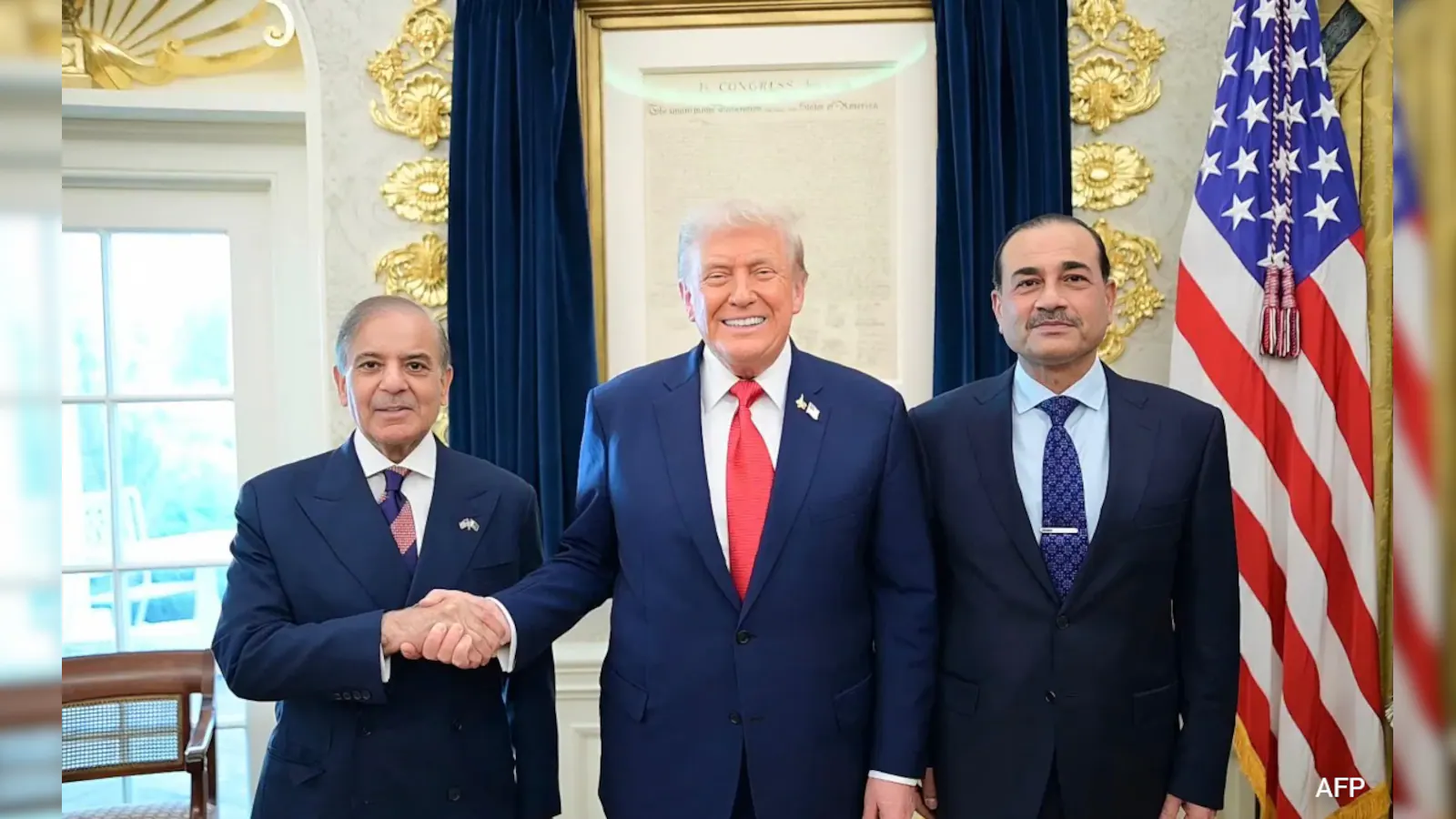
Pakistan has once again found a diplomatic sweet spot, courted simultaneously by the US, EU, China and key West Asian powers, even as India has tried hard to isolate it internationally, which, during President Trump’s first term, almost came true. But since the President’s return to the White House, Islamabad has skilfully exploited his idiosyncrasies and shifting geopolitical tensions to regain relevance.
The May 2025 India-Pakistan ceasefire was announced by Donald Trump, who often claims credit for stopping wars around the world. Pakistan cunningly seized the moment. Prime Minister Shehbaz Sharif publicly praised Trump’s role and later even backed him for a Nobel Peace Prize. So what if it smacked of cheap sycophancy? Before him, even British Prime Minister Keir Starmer had appeared to indulge Trump’s appetite for flattery.
Abraham Accords And Pak’s Other Challenges
But Pakistan’s renewed relevance comes with familiar dangers. Its first challenge is on its doorsteps already, and it relates to Donald Trump’s desire to revive and expand the Abraham Accords, the diplomatic framework that aims to encourage Muslim-majority countries to normalise relations with Israel. Trump named Pakistan among several other countries and hoped Islamabad would eventually move towards recognising Israel, alongside several Arab and Islamic nations America is already quietly persuading. Pakistan was stunned. It moved to reiterate its longstanding position: there can be no recognition of Israel without meaningful progress towards an independent Palestinian state. But that is just an excuse in the Trumpian world. He is yet to react to Pakistan’s pushback.
For Sharif and Munir, the normalisation of relations with Israel is political suicide, like stabbing the janata in its back. Support for the Palestinian cause runs deep across Pakistan’s political spectrum and is intertwined with religious sentiment, street opinion and national identity. Unlike some Gulf monarchies, Pakistan’s civilian and military leadership cannot easily ignore public anger. Any abrupt move towards Israel, especially at a time when Gaza remains devastated and Palestinian suffering dominates Muslim public opinion, would provoke fierce resistance from religious parties and large sections of society. Politically, it could become suicidal for any government in Islamabad.
Sandwiched Between Two Superpowers
Yet, openly resisting Trump also carries risks. Pakistan’s fragile economy remains heavily dependent on Western-backed financial institutions and continued American goodwill. Pakistan, therefore, finds itself trapped in a familiar dilemma: it cannot afford to alienate Washington, but neither can it afford to appear as though it is abandoning the Palestinian cause. That balancing act may become one of the most delicate and dangerous diplomatic tests Pakistan faces during Trump’s second presidency.
Trump’s remaining two-and-a-half years in the White House may ultimately prove far more complicated for Pakistani leaders than the current warmth suggests. Unlike traditional American administrations that often balanced pressure with institutional diplomacy, Trump personalises foreign policy. Loyalty matters enormously to him. And yes, symbolism matters too. But above all else, tickling his ego matters the most.
Pakistan already experienced this during Trump’s first term. Relations deteriorated sharply over Afghanistan and allegations that Pakistan was a safe haven for militants. In 2018, Trump publicly accused Pakistan of “lies and deceit” while suspending security assistance. Although relations later improved during negotiations with the Taliban, mistrust never fully disappeared. Pakistan’s leadership, therefore, must know that Trump’s praise can be conditional and temporary, and it has costs.
This unpredictability creates serious vulnerabilities for Pakistanis because its economy remains heavily exposed to Western influence. Its fragile financial system depends on IMF programmes, external financing, investment flows and broader international confidence linked closely to Washington’s geopolitical posture. Pakistan cannot easily afford a hostile relationship with the US at a time when inflation, debt pressures and political instability continue to weigh heavily on the country.
At the same time, Pakistan cannot afford to become excessively dependent on Washington, right? ‘Pak-Chini bhai, bhai’ has been going on for decades. After all, they are bound by their opposition to their common adversary, India. China remains Pakistan’s most important long-term strategic partner through defence cooperation, infrastructure investment and the China-Pakistan Economic Corridor (CPEC). Beijing is viewed in Islamabad not merely as an ally but as a critical strategic shield against India. If Washington eventually demands greater distance from China, especially in areas such as technology, infrastructure, defence ties or regional strategy, Pakistan could find itself trapped between two rival superpowers. That will be quite interesting to watch, as it’s in the realm of possibility
Other challenges
Iran presents another potentially dangerous fault line. Pakistan’s emerging role as a mediator between the United States and Iran has undoubtedly boosted its diplomatic profile, placing Islamabad at the centre of one of the world’s most volatile crises. But such visibility comes with risks. If the talks fail, or if either side begins suspecting Pakistan of leaning too heavily towards the other, Islamabad could quickly lose the trust of both Washington and Tehran. And with Trump, relationships often remain strictly transactional. Today’s valued intermediary can easily become tomorrow’s convenient target for blame.
It leaps to the eye that Trump’s hardline posture towards Tehran could place Pakistan in an extremely awkward position if tensions in West Asia escalate further. Pakistan shares a long and sensitive border with Iran and cannot afford instability spilling into Balochistan. Any overt alignment with an American anti-Iran strategy would carry enormous domestic and regional risks. Pakistan’s military establishment knows maintaining workable ties with Tehran is essential for internal security.
The US may use trade and economic leverage as tools of pressure against Pakistan. Trump has repeatedly demonstrated his willingness to weaponise tariffs, trade access and economic negotiations against both allies and adversaries. Pakistan’s exports, IMF-linked discussions or broader economic negotiations could quickly become bargaining chips if Trump feels Pakistan is not sufficiently cooperative on wider American objectives.
What makes the situation even more complicated is that Trump’s foreign policy often operates through personal relationships rather than predictable institutional frameworks. Europe, NATO allies and even close partners, such as Ukraine, have already experienced how rapidly his tone can shift. Leaders praised one month can suddenly find themselves publicly criticised the next if Trump feels they are not delivering enough in return. Ask Keir Starmer.
Pakistan may, therefore, discover that diplomatic attention from Trump comes with hidden costs. The current warmth between Washington and Islamabad may not necessarily translate into long-term stability. Instead, it could evolve into a relationship defined by constant bargaining, periodic pressure and strategic uncertainty.
In short, the current relationship appears transactional, with little depth or even heartfelt warmth in it. Depth in ties comes through compromises, standing by each other on the global stage and looking after each other’s interests. In US-Pakistan relations, one can say it’s decades old, but is it based on mutual respect and equality? Clearly not.
For now, Pakistan’s leadership may well feel it has regained international relevance. I could recall the State Department woman I met in 1993, and her Islamic crescent theory may hold true even now. But we are all aware of the Trumpian world. Trends suggest that managing relations with the US, especially under Donald Trump, is rarely straightforward. Pakistan’s real challenge may not be winning Trump’s attention. It may be surviving the consequences of that.
(Syed Zubair Ahmed is a London-based senior Indian journalist with three decades of experience with the Western media)
Disclaimer: These are the personal opinions of the author