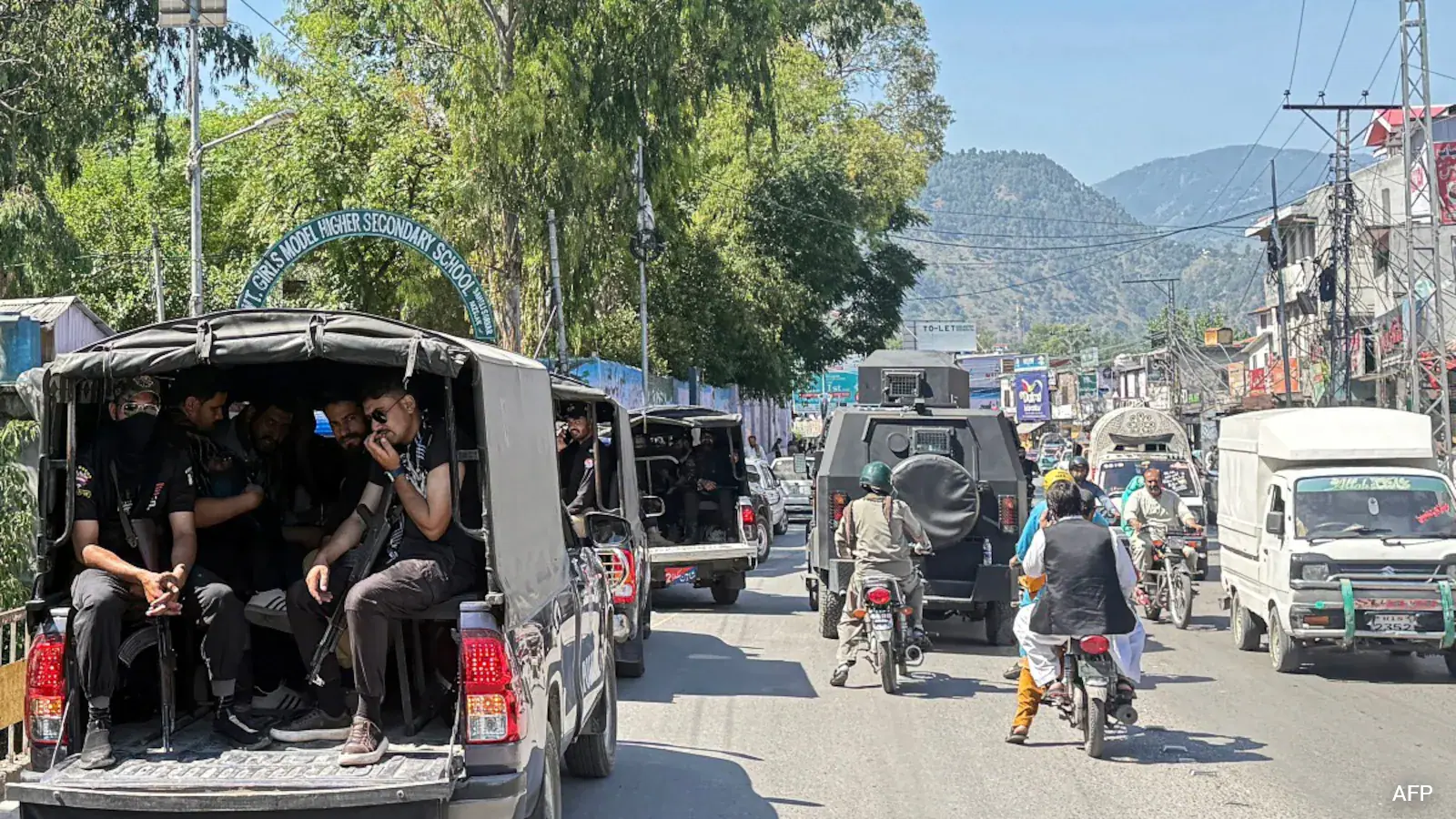
More than 30 people were killed, and around 200 injured after Pakistani security forces opened fire on protesters in Pakistan-occupied Kashmir (PoK) ahead of the region’s legislative elections scheduled for 27 July.
What Triggered The Protests
The immediate flashpoint was a decision to reserve 12 of the 45 assembly seats for refugees in the upcoming elections. The rights group, Joint Awami Action Committee (JAAC), had called for a demonstration against this move, arguing it amounted to political manipulation and a suppression of local voices. The clashes broke out a day before that planned gathering.
How PoK Came To Be?
To understand PoK, one must go back to 1947. When British India was partitioned, the Indian Independence Act gave princely states three choices: join India, join Pakistan, or remain independent.
Maharaja Hari Singh, the ruler of Jammu and Kashmir, signed the Instrument of Accession to India on October 26, 1947. The document was legally valid under the Government of India Act (1935), the Indian Independence Act (1947), and international law. More than 560 other princely states signed similar instruments without incident.
Also read: India Condemns “Severe Police Brutality” In PoK, Wants Pak To Be Held “Accountable”
The situation in Kashmir turned complicated because Pakistan sent tribal fighters into the region in October 1947, followed by its own regular troops in May 1948. The resulting conflict ended in 1949 with a United Nations-brokered ceasefire. The ceasefire line divided the territory, leaving Pakistan in occupation of roughly 35 per cent of Jammu and Kashmir.
In February 1994, both houses of the Indian Parliament unanimously passed a resolution reaffirming that Jammu and Kashmir was an integral part of India and demanding that Pakistan vacate the areas under its illegal occupation.
How PoK Is Administered?
PoK is divided into two parts: Azad Jammu and Kashmir (AJK) and Gilgit-Baltistan, which was referred to as the Northern Areas until August 2009. Muzaffarabad serves as the capital of AJK, which comprises ten districts across three divisions: Mirpur, Muzaffarabad and Poonch.
On paper, PoK has its own constitution, a unicameral legislative assembly, a prime minister, a cabinet and a Supreme Court. The assembly elects both the prime minister and the president, who serves as the constitutional head of the territory.
How ‘Azad’ Is Azad Kashmir?
The name “Azad Kashmir” translates to “Free Kashmir,” but the ground reality tells a different story. Pakistan officially does not treat PoK as part of its own territory. The country’s constitution lists four provinces: Punjab, Sindh, Balochistan and Khyber Pakhtunkhwa. AJK does not appear on that list. It also has no representation in Pakistan’s national parliament.
Real power rests with the Kashmir Council, a 14-member nominated body headed by Pakistan’s prime minister. Six members are appointed by the Pakistani federal government, while eight come from the AJK assembly and government. The governing framework, the Azad Kashmir Interim Constitution Act of 1974, leaves the local administration heavily reliant on Islamabad for even routine decisions.
The territory’s own constitution bars political parties or individuals from campaigning against the idea of Kashmir’s accession to Pakistan. Assembly members can be disqualified for doing so, and election candidates are required to sign an affidavit pledging allegiance to that position.
Article 257 in Pakistan’s constitution states that if the people of Jammu and Kashmir choose to join Pakistan, the terms of that relationship will be determined in accordance with their wishes. Article 1 includes a provision for territories that may be incorporated into Pakistan by accession or otherwise.
What Pakistan Gets From PoK?
PoK is resource-rich, and Pakistan draws considerable strategic and economic benefit from the territory while providing limited development in return. The region sits atop the Indus River system and is well-endowed with hydropower potential, forests and minerals, including graphite, bentonite, limonite, marble and gemstones.
According to available data, PoK supplies around 70 per cent of the irrigation water used in Pakistan’s Punjab and Sindh farmlands. Hydropower from the region accounts for between 10 and 15 per cent of Pakistan’s electricity supply. Local communities, however, have long complained that these resources are extracted for use in mainland Pakistan, with little economic benefit flowing back to the people of the region.
The Condition Of People On The Ground
A 2025 study published in the journal Nature revealed that around two-thirds of the population, roughly 66 per cent, depend on farming and livestock for their livelihoods. Nearly 29 per cent of residents face undernourishment, well above Pakistan’s national average of 19.9 per cent. Overall, 57.1 per cent of AJK residents live with some degree of food insecurity, comparable to the Pakistani national average of 58 per cent. However, in the region’s mountainous areas, that figure climbs to 90 per cent of households.
Data from the Voluntary National Review Report reveal that about 39 per cent of children under five in AJK are stunted, 14 per cent are underweight, and 4 per cent are wasted. The infant mortality rate stands at 47 deaths per 1,000 live births, and the maternal mortality ratio is 104 deaths per 100,000 live births.