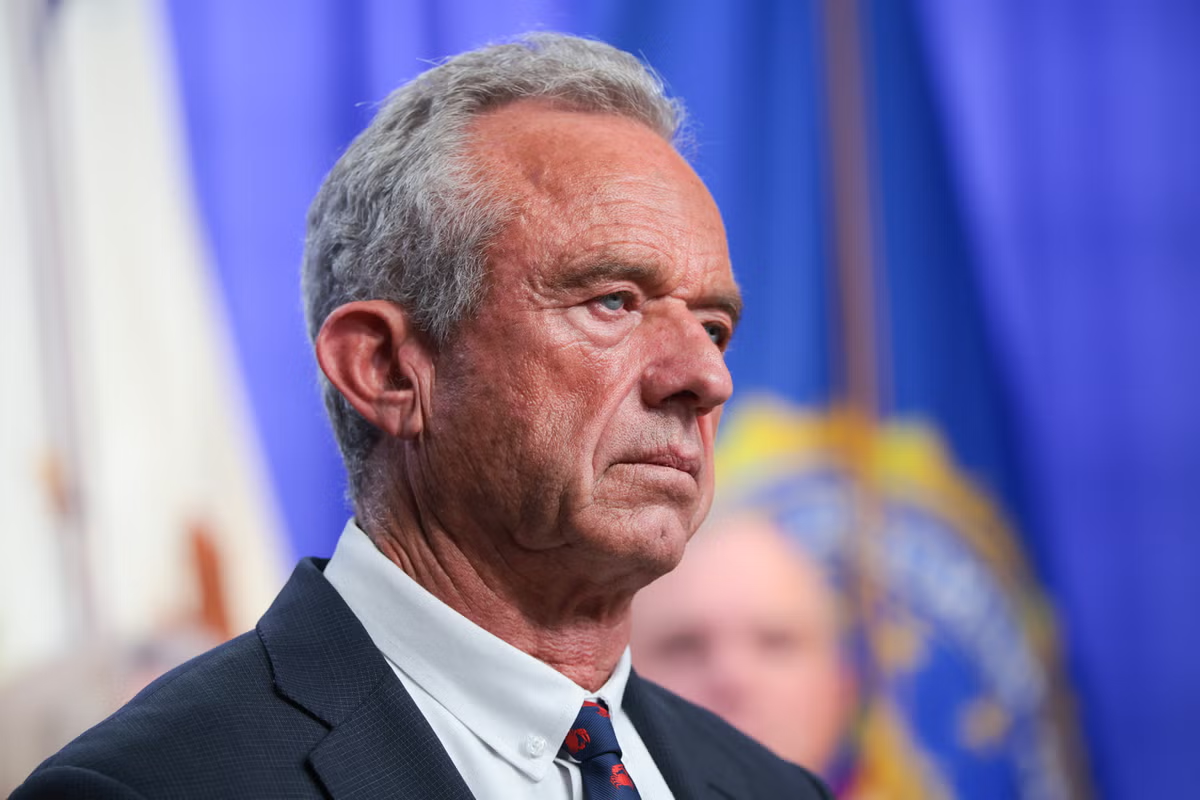
Republican senators with oversight over education in the United States plan to hold a vote to block Health and Human Services Secretary Robert F. Kennedy Jr. from overseeing the funding and management of the nation’s special education school programs.
Last week, the U.S. Department of Education announced it would “partner” with the Department of Health and Human Services, giving RFK Jr.’s HHS oversight of the Office of Special Education and Rehabilitative Services (OSERS). This was part of the Trump administration’s larger efforts to eliminate the Education Department, a long-held priority for conservative Republicans.
In addition, the department announced that the Office of Civil Rights would fall under the Department of Justice.
“It’s further, it’s further chaos in the system that started,” Katy Neas, the chief executive officer of the Arc and former acting secretary for the Office of Special Education and Rehabilitative Services, told The Independent.
“We have more kids with complex disabilities being successful, and we want those trends to continue,” Neas said. “And part of the reason that they, those things happened was the academic progress of kids needed to be measured and reported.”
Senate Health, Education, Labor and Pensions Committee Chairman Bill Cassidy told The Independent that he made an agreement with Sen. Tim Kaine (D-Va.), another member of the committee to have a vote on the matter.
“I gave Tim an agreement that we would have some sort of vote that he would like to have on the issue,” Cassidy said. Cassidy voted to confirm Kennedy last year as he sought favor with President Donald Trump while running for re-election. Cassidy had previously voted to convict Trump for his actions that led up to the January 6 assault on the U.S. Capitol in 2021.
But Trump endorsed one of Cassidy’s primary opponents, leading Cassidy to not even clear the runoff election.
OSERS focuses on helping students with education outcomes and with finding competitive integrated employment, which is to say jobs where people with disabilities are paid a competitive wage with roughly the same benefits as their peers and with non-disabled coworkers.
But the Individuals with Disabilities Education Act requires that the office be housed in the Department of Education.
“It’s concerning that the administration is doing things that are inconsistent with the requirements in federal law,” Neas said. “And that’s not a subjective statement, that’s a purely objective statement.”
Special Education has long been a policy supported by Republicans. President Gerald Ford signed the Education for Handicapped Children Act. President George H.W. Bush reauthorized it as the Individuals with Disabilities Education Act and his son, President George W. Bush signed another reauthorization in 2004.
Sens. Susan Collins (R-Maine) and Lisa Murkowski (R-Alaska) both voted for the reauthorization more than 20 years ago and despite voting to confirm Education Secretary Linda McMahon and Kennedy, both voiced concerns.
“Moving programs like IDEA, for example, to HHS risks separating special education from the broader education system and shifting the focus of the law to treating disability as a medical issue rather than ensuring all students, including those with disabilities, receive a free, appropriate public education,” Collins said in a statement.
Murkowski echoed the sentiment when asked by The Independent.
“I had expressed a concern that moving it to HHS was not the right place to go,” Murkowski, a member of the Health Education Labor and Pension Committee, said.
It’s part of a series of efforts by the Trump administration to weaken protections for people with disabilities.
Last week, the Office of Legal Counsel within the Justice Department released a memo saying that states do not need to provide home and community-based care for people with disabilities.