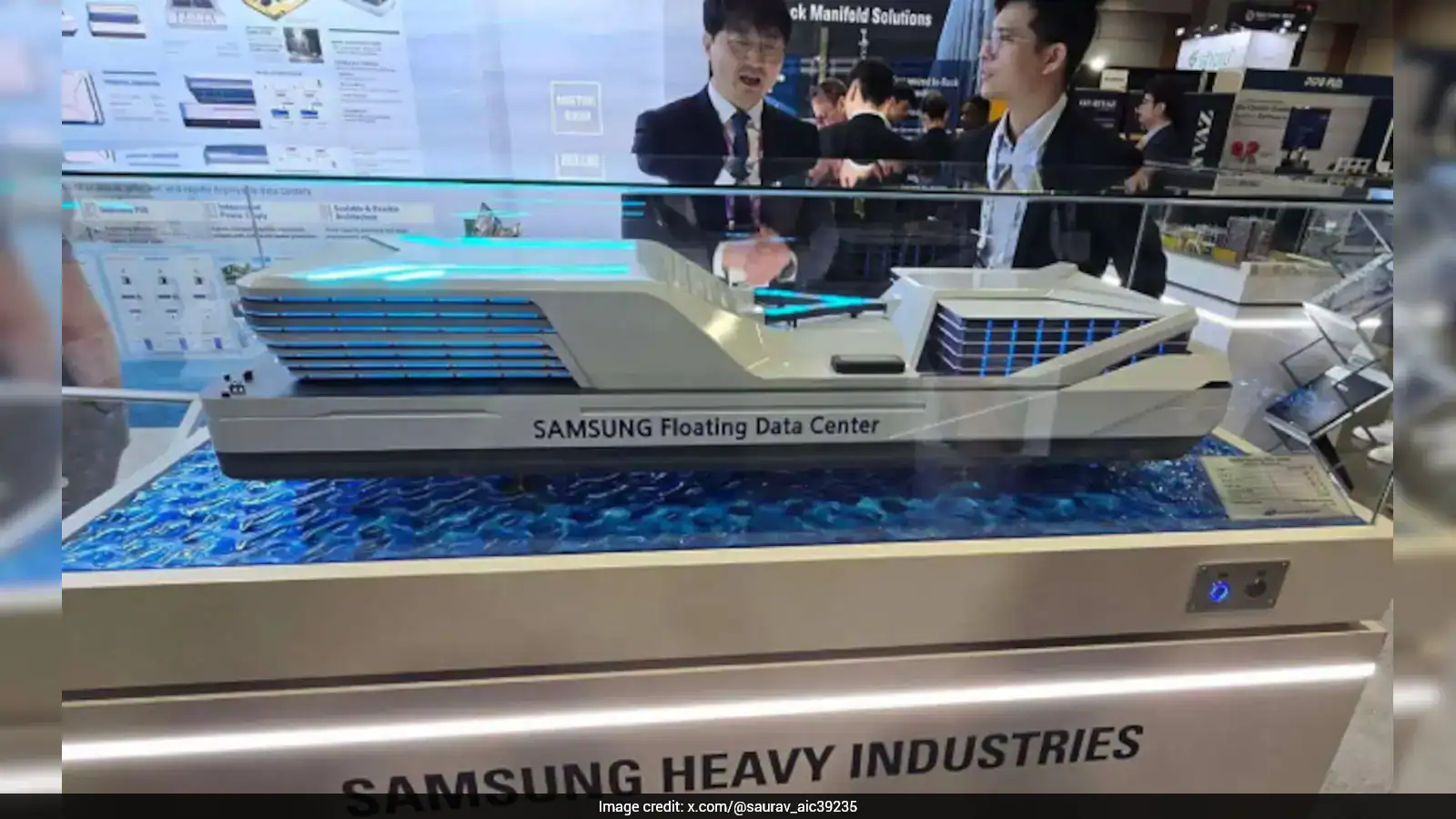
Samsung is planning to build floating AI data centres on ships as demand for artificial intelligence (AI) continues to grow.
The South Korean company has partnered with a global shipowner to develop floating data centres that can operate at sea instead of on land, according to Chosun Biz. These facilities will contain large numbers of servers used to run AI systems.
For the project, Samsung Heavy Industries will handle the technology and construction, Capital Clean Energy Carriers will lead project sourcing and investment, and Lloyd’s Register will oversee regulation and certification.
Samsung has also signed a separate agreement with Lloyd’s Register Advisory to conduct feasibility studies and assess opportunities in the North American market.
The idea is to help meet the growing need for data centres, which require large amounts of space, electricity and cooling. Building them on ships could reduce pressure on land and make use of seawater for cooling.
The planned facility will have a capacity of 50 megawatts (MW), which is enough to power tens of thousands of AI servers.
The 50-megawatt floating data centre can obtain electricity in two ways. When stationed near a port or coastline, it can connect to the power grid through underwater cables. It can also generate its own electricity using fuel cells powered by liquefied natural gas (LNG).
Capital Clean Energy Carriers CEO Jerry Kalogiratos told Tom’s Hardware, “Floating data centres offer a scalable and flexible solution, with the unique advantage of mobility.”
This project could create a new source of income for shipowners. Instead of only earning money by leasing ships for transport, they could lease floating data centres to technology companies and cloud service providers.
Meanwhile, Samsung Heavy Industries and Supermicro are working together to test whether AI servers can operate reliably at sea for years. The companies are studying how factors such as ship movement, vibration, saltwater, humidity and moisture could affect sensitive AI hardware.
Samsung is not the only company working on floating data centres. In Japan, the shipping company Mitsui OSK Lines (MOL) is building a 73-megawatt floating data centre in partnership with the Turkish energy company Karpowership, with plans to launch it in 2027.
In China, a 24-megawatt underwater data centre near Shanghai began full operations last month. Meanwhile, US-based Nautilus Data Technologies already operates a smaller 6.5-megawatt floating data centre on a barge at the Port of Stockton.