Nigeria’s Special Agro-Industrial Processing Zones (SAPZ) Programme is moving into a critical stage of implementation as the Federal Government and its development partners push to accelerate delivery of a project expected to create about 500,000 direct and indirect jobs in each project location and generate an estimated 2.5 million temporary jobs through infrastructure development and related economic activities.
The ambitious programme, which is being implemented by the Federal Ministry of Agriculture and Food Security in collaboration with international development finance institutions and participating state governments, is increasingly being positioned as one of the country’s most significant agricultural industrialisation initiatives.
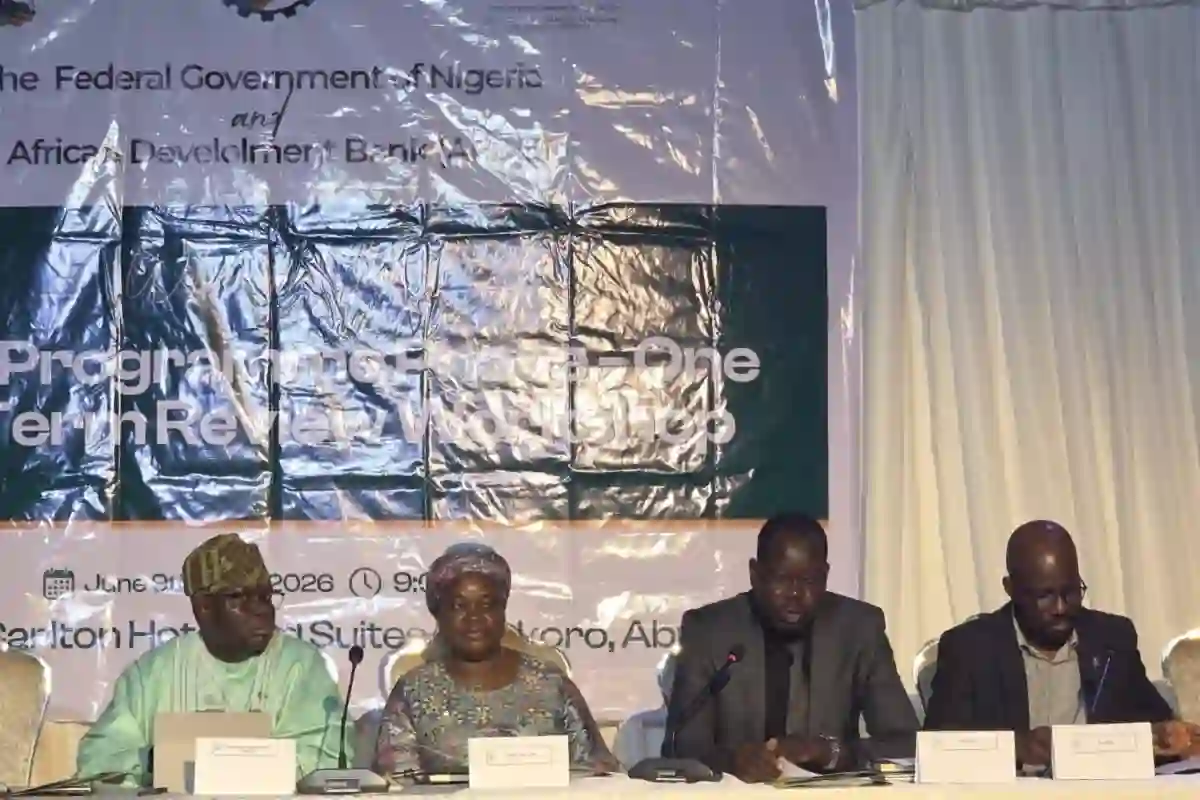
Discussions around the programme’s progress took centre stage during the SAPZ Programme Mid-Term Review Workshop in Abuja, where government officials, development partners and key stakeholders reviewed implementation milestones and assessed pathways for faster execution.
For Nigeria, the significance of the programme goes beyond agricultural production. The initiative is designed to transform agriculture from a largely commodity-based sector into an integrated agribusiness ecosystem that supports processing, logistics, storage, distribution and export-oriented value addition.
Speaking during the workshop, Permanent Secretary of the Federal Ministry of Agriculture and Food Security, Dr Marcus Ogunbiyi, said the SAPZ Programme aligns with President Bola Tinubu’s Renewed Hope Agenda, particularly its focus on food security, economic diversification, industrialisation, rural development and job creation.
According to him, the goal of the initiative is not limited to increasing agricultural output.
“The objective is not merely to increase agricultural output, but to transform agriculture into a modern, competitive and wealth-creating sector capable of driving economic diversification, generating employment opportunities, enhancing food security and boosting export earnings,” Ogunbiyi said.
The programme was designed to address some of the structural challenges that have limited the growth of Nigeria’s agricultural value chains for decades. These include inadequate processing infrastructure, weak market linkages, high post-harvest losses, limited value addition and inefficient connections between producers and markets.
Rather than treating production and processing as separate activities, SAPZ seeks to establish integrated agro-industrial hubs where production, storage, aggregation, processing, logistics and marketing activities can operate within the same economic ecosystem.
The expected employment impact is one of the programme’s most notable targets.
According to Ogunbiyi, each project location under the programme is expected to generate approximately 500,000 direct and indirect jobs. In addition, the construction of roads, power infrastructure, water facilities, processing centres and supporting services is projected to create about 2.5 million temporary jobs.
The projected employment opportunities span multiple segments of the agricultural economy, including farming, transportation, warehousing, processing, packaging, distribution, equipment maintenance, logistics and agribusiness services.
The government also expects the programme to improve productivity significantly across selected agricultural value chains.
Current crop yield levels, which in some cases range between five and 10 per cent of achievable productivity, are expected to increase to between 50 and 100 per cent under the SAPZ framework. At the same time, post-harvest losses are projected to decline from around 45 per cent to 20 per cent as improved storage, processing and transportation infrastructure become available.
For an agricultural economy that loses billions of naira annually through inefficient post-harvest systems, these improvements could have substantial implications for food availability, farmer incomes and agribusiness profitability.
Despite the programme’s ambitions, Ogunbiyi acknowledged that implementation has faced several obstacles.
He identified low disbursement rates, procurement bottlenecks, approval delays and slow infrastructure development as some of the challenges affecting project execution across participating states.
“We must critically examine areas where implementation has fallen below expectations, identify emerging risks and develop practical solutions to accelerate programme delivery,” he said.
Beyond employment and infrastructure development, SAPZ is also expected to strengthen Nigeria’s export competitiveness.
Ogunbiyi disclosed that more than 100 agribusiness companies and entrepreneurs recently received the SON/ARSO Quality Mark, while over 178 processed agricultural products obtained African Quality Standard Certification.
The certifications are expected to improve market access opportunities for Nigerian agricultural products across the continent through the African Continental Free Trade Area (AfCFTA).
By enabling producers and processors to meet recognised quality standards, the government hopes to position more Nigerian agricultural products for regional and international markets while increasing foreign exchange earnings from non-oil exports.
Further insight into the programme’s structure was provided by the National Programme Coordinator of SAPZ, Dr Kabir Yusuf.
According to Yusuf, the SAPZ Programme was jointly developed by the Federal Ministry of Agriculture and Food Security alongside the African Development Bank (AfDB), the International Fund for Agricultural Development (IFAD), the Islamic Development Bank (IsDB) and participating state governments.
The first phase currently covers seven states—Kano, Imo, Kaduna, Cross River, Kwara, Oyo and Ogun—as well as the Federal Capital Territory.
He explained that the programme’s central objective is to promote inclusive and sustainable agro-industrial development while helping Nigeria diversify its economy and reduce dependence on food imports.
“SAPZ is a cross-cutting platform to attract private sector investment into value-added agro processing to unlock opportunities for improved food security, job creation, export earnings, rural poverty reduction and increased contribution of agriculture to national GDP,” Yusuf said.
Private sector participation remains a key component of the programme’s long-term strategy.
The government and development partners expect agro-processing firms, logistics companies, infrastructure developers, investors and agribusiness operators to establish operations within designated SAPZ locations. This approach is intended to reduce infrastructure costs, improve operational efficiency and encourage investment in value-added agricultural activities.
Preparations are already underway for Phase II of the programme.
According to Yusuf, the expansion phase will be implemented through three separate tranches. The first tranche will focus on 10 states selected based on the quality of feasibility studies, demonstrated private sector interest and the availability of brownfield assets requiring limited additional infrastructure.
The remaining states are expected to be considered under subsequent tranches, subject to readiness assessments and investment availability.
Development partners have continued to strengthen financial support for the programme.
Representing IFAD, Isaac Mensah said interventions under the programme have already reached more than 17,000 smallholder farmers across Kano and Ogun states.
According to him, more than 14,000 farmers have received climate information services aimed at improving productivity and resilience, while over 9,000 farmers have benefited from agricultural inputs designed to enhance production outcomes.
He also noted that the programme has helped connect farmers with agro-industrial markets through the Multi-Stakeholder Agribusiness Forum.
Most significantly, IFAD has approved an additional $50 million investment in the programme, bringing its total commitment to $100 million.
“IFAD sees SAPZ as an important platform to connect producers to markets, reduce post-harvest losses, stimulate private investment, create jobs and strengthen food systems in ways that are commercially viable and socially inclusive,” Mensah said.
The African Development Bank has also maintained strong support for the initiative.
SAPZ Task Manager, Dr Orison Amu, described the programme as a transformative platform designed to improve rural incomes, strengthen food security and accelerate agro-industrial development.
According to him, SAPZ clusters agro-processing industries around areas with strong agricultural potential, creating an environment where production, aggregation, processing and distribution can occur within a coordinated infrastructure network.
Although the programme was approved by AfDB in December 2021, implementation experienced delays before gaining momentum.
Amu disclosed that implementation only commenced in March 2023 after required conditions were fulfilled, with project execution accelerating significantly during 2025.
As of March 31, 2026, the programme had achieved a commitment rate of 41 per cent, equivalent to $86 million, while disbursement reached 12 per cent or $25 million.
AfDB expects those figures to improve substantially before the end of 2026, with commitments projected to rise to 70 per cent and disbursement levels expected to reach 35 per cent.
The bank is also collaborating with partners on the development of Phase II, which is expected to attract additional investment into Nigeria’s agro-industrial sector.
For Nigeria, the SAPZ Programme represents more than another agricultural intervention. It is a large-scale attempt to build industrial ecosystems around agricultural production, strengthen value chains, attract private investment and create employment opportunities at a scale rarely seen within the sector.
If implementation targets are achieved, the programme could become one of the country’s most significant job creation and agro-industrial development initiatives, with the potential to reshape agricultural productivity, reduce food losses and expand opportunities for farmers, processors, agripreneurs and rural communities across multiple states.