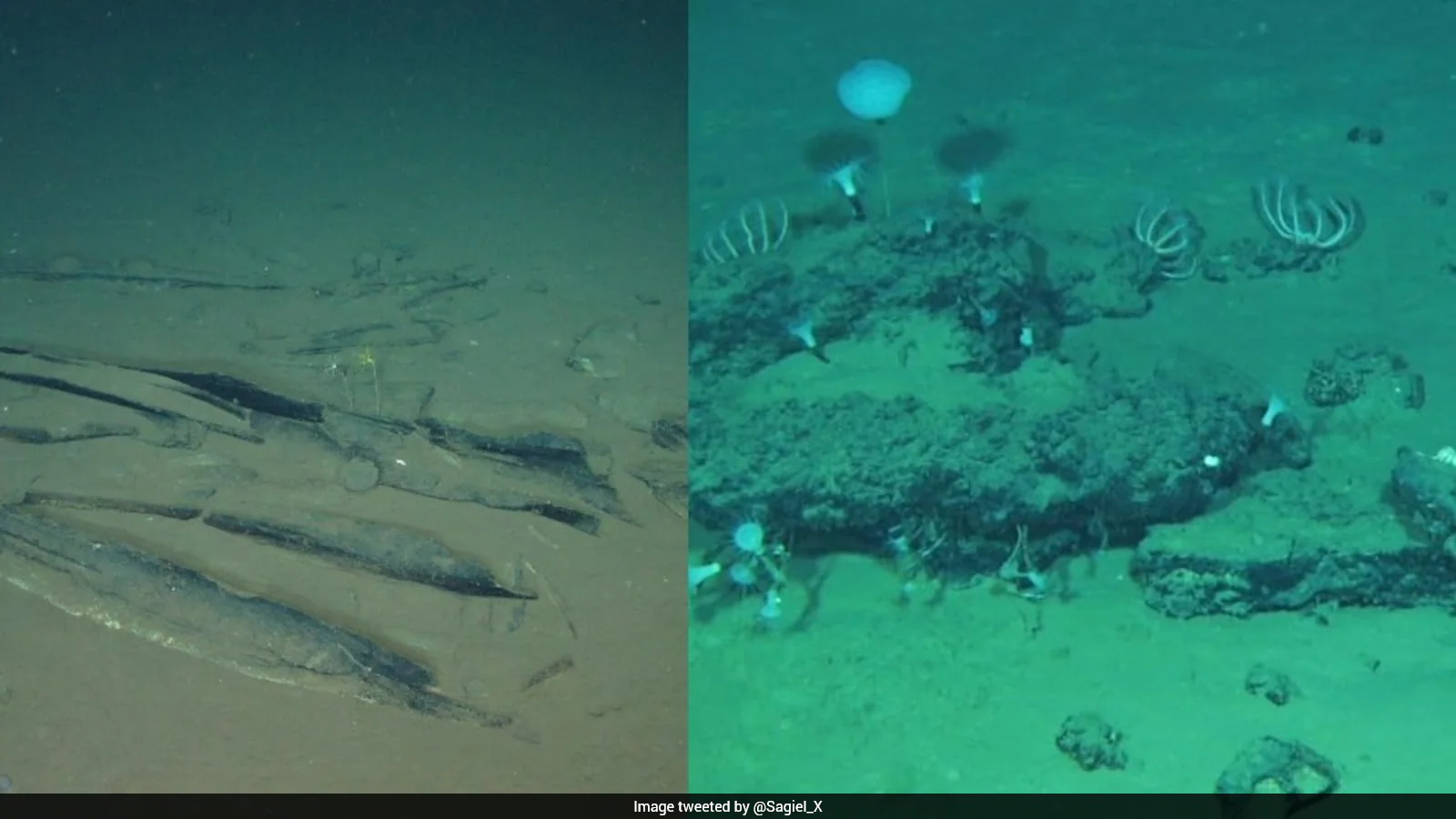
Chinese scientists have discovered what is believed to be the world’s largest, deepest, and oldest whale graveyard at the bottom of the southeastern Indian Ocean, uncovering an extraordinary underwater ecosystem sustained by hundreds of whale carcasses spanning millions of years. The discovery, detailed in the journal Nature, reveals a vast “whale necropolis” stretching roughly 1,200 kilometres across the Diamantina Fracture Zone, a rugged landscape of deep-sea ridges and trenches west of Australia. Some of the fossils recovered from the site date back as far as 5.3 million years, making it the oldest known whale graveyard ever documented.
Lead author Xiaotong Peng of the Chinese Academy of Sciences said the researchers were stunned by the scale of what they found. “Discovering a necropolis of this scale was completely unexpected. The size of distribution, the depth and the age range were far beyond anything we had imagined,” he said.
Researchers from China, Italy, and New Zealand made the discovery during 32 dives conducted in 2023 using China’s crewed deep-sea submersible Fendouzhe. Descending nearly 7,000 metres below the ocean surface, the team surveyed 485 whale-fossil sites and active whale falls, collecting samples with robotic arms and documenting an astonishing concentration of remains.
Discoveries like this make you wonder how much of our planet is yet to be explored. 🌊
The insane part is that this isn’t just a small area, it’s a 1,200 km corridor scattered with about 500 whale skeletons, 7 km deep in the ocean.
While it is an ancient graveyard of extinct… pic.twitter.com/xadtZXYhoH
— Sagiel | Earth & Universe (@Sagiel_X) June 10, 2026
The team recovered fossils from numerous whale species, particularly beaked whales, and identified both ancient and more recent carcasses. Among the most significant finds was a fossil skull belonging to the 5.3-million-year-old beaked whale species Pterocetus benguelae. Researchers also identified a previously unknown extinct whale species, which they named Pterocetus diamantinae after the discovery site.
The largest modern carcass found was that of a five-metre-long Antarctic minke whale.
Beyond the fossils themselves, the graveyard revealed thriving ecosystems built around the decaying remains. Scientists observed jellyfish, brittle stars, crustaceans, bivalves and bone-boring worms feeding on nutrients released by the carcasses. Many of the organisms appear to be previously undocumented and may represent species new to science.
From inside the submersible, researchers witnessed dense biological communities flourishing in an environment that would otherwise be dark, cold and largely devoid of food. Study co-author Peng Zhou described the experience as transformative, saying the vibrant ecosystems offered a completely different view of life on the deep ocean floor.
Whale falls are known to provide food and habitat for deep-sea organisms when dead whales sink to the seabed. However, scientists say nothing comparable to the Diamantina discovery has ever been recorded. Based on the density of bones observed, the team estimates that the region may contain more than 10 million whale carcasses.
Researchers believe so many whales accumulated in the area because it was historically a rich feeding ground. A V-shaped trench system may also have acted as a natural funnel, directing carcasses into the same deep-sea basin over millions of years.
The ecological significance of the site extends beyond its fossil record. According to the study, the soft tissues and lipids contained within the estimated number of carcasses represent roughly 6.7 million tonnes of sequestered carbon. This enormous reserve of organic matter has likely supported deep-sea ecosystems for millennia, much like hydrothermal vents and cold seeps sustain life in other parts of the ocean.
Scientists also noted that some species inhabiting the whale falls are commonly found around hydrothermal vents and cold seeps, suggesting that whale carcasses may serve as stepping stones linking otherwise isolated deep-sea communities.
Marine paleontologist Stephen J. Godfrey described the discovery as unique, saying the site is likely to yield many more important findings despite its extreme depth and limited accessibility.