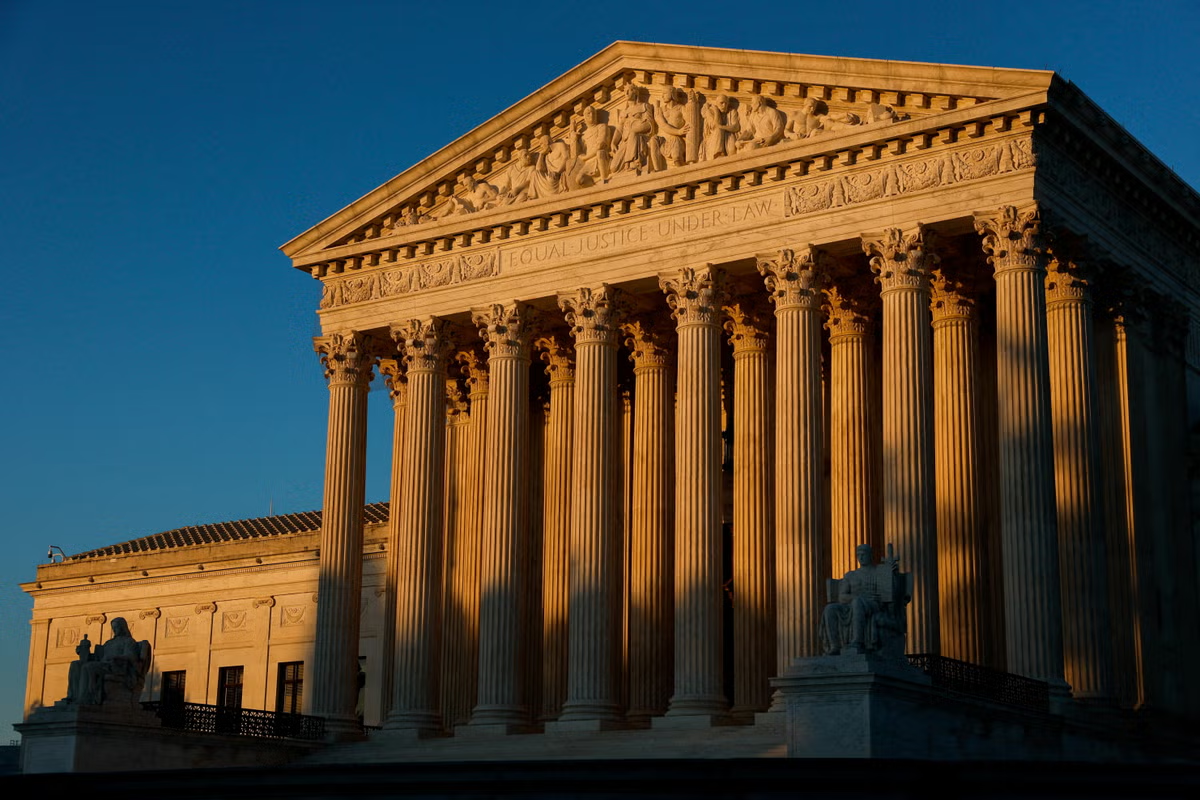
The U.S. Supreme Court announced Monday it will review an appeal from President Donald Trump’s administration concerning the legality of indefinitely detaining certain convicted immigrants. The case questions whether these individuals, facing deportation, can be held for extended periods without bond hearings that would allow them to seek release on bail.
The administration appealed a lower court’s ruling holding that the U.S. Constitution’s right to due process bars “unreasonably prolonged” detention without a hearing of non-U.S. citizens facing deportation after being convicted of certain crimes. That ruling involved two immigrants in New York – one who pleaded guilty to assault and the other convicted of sexually abusing a child.
The court is expected to hear arguments in the case during its next term, which begins in October.
At the core of the legal battle is the government’s detention of two lawful permanent residents, also known as green-card holders, who were convicted of aggravated felonies while living in the United States.
Federal immigration law requires authorities to detain and seek the deportation of non-U.S. citizens who are convicted of an aggravated felony and certain other serious crimes, or accused of terrorism.
After several months in detention, each man filed a legal action called a habeas corpus petition in federal court, challenging the legitimacy of their detention and arguing that they were entitled to hearings to determine whether they qualified to be released on bail. Both men were detained during Trump’s first presidential term.
One of the green-card holders, a Dominican man identified in court papers as G.M., became a lawful permanent resident in 2011 and four years later pleaded guilty in New York to assault, according to court papers. He was detained in 2020.
A federal judge in 2021 denied his habeas corpus petition. G.M. was later released in 2022, after 21 months in detention, due to concerns about the spread of COVID.
The other man, a Jamaican citizen named Carol Black, became a lawful permanent resident in 1983. In 2000, he was convicted in New York of sexually abusing a child younger than 11 years old, according to court papers. Citing his criminal record, federal immigration authorities took Black into custody in 2019.
A separate federal judge granted Black’s petition in 2020 and ordered a bail hearing. He was later released on a $15,000 bond.
After initially appealing a judge’s deportation order against him, Black and his wife left the United States in 2025 and have no intention of returning, according to court papers. For this reason, his lawyer argued in a filing to the Supreme Court, Black’s case should be considered moot.
During appeals of their cases, the Manhattan-based 2nd U.S. Circuit Court of Appeals said it was unreasonable that Black was detained for seven months and G.M. for nearly two years without a chance to qualify for bail, though that court stopped short of setting a strict time limit on such detentions. In these two cases, the 2nd Circuit said, the U.S. Constitution’s Fifth Amendment guarantee of due process entitled the men to a bond hearing.
The 2nd Circuit also said that if the government seeks to maintain its detention in these circumstances, it must prove by clear and convincing evidence that a detainee poses a risk of flight or a danger to the community.
American Civil Liberties Union attorney Cecillia Wang, who represents the two men, said: “The court of appeals got it right, and we will defend our fundamental due process principles at the Supreme Court.”
“The Constitution protects all of us, regardless of immigration status, from being locked away without due process,” Wang said. “(U.S. Immigration and Customs Enforcement) cannot detain immigrants – separating families and cutting people off from their communities – for months or even years on end without a bond hearing.”
The Supreme Court has backed Trump in several immigration-related rulings issued on an emergency basis since his return to the presidency, including allowing him to deport migrants to countries other than their own and to revoke temporary legal status for hundreds of thousands of Venezuelan immigrants.
The court is also expected to rule by the end of June on the legality of Trump’s directive to restrict birthright citizenship in the United States and the administration’s bid to revoke temporary legal protections for more than 350,000 Haitians and about 6,100 Syrians living in the United States.