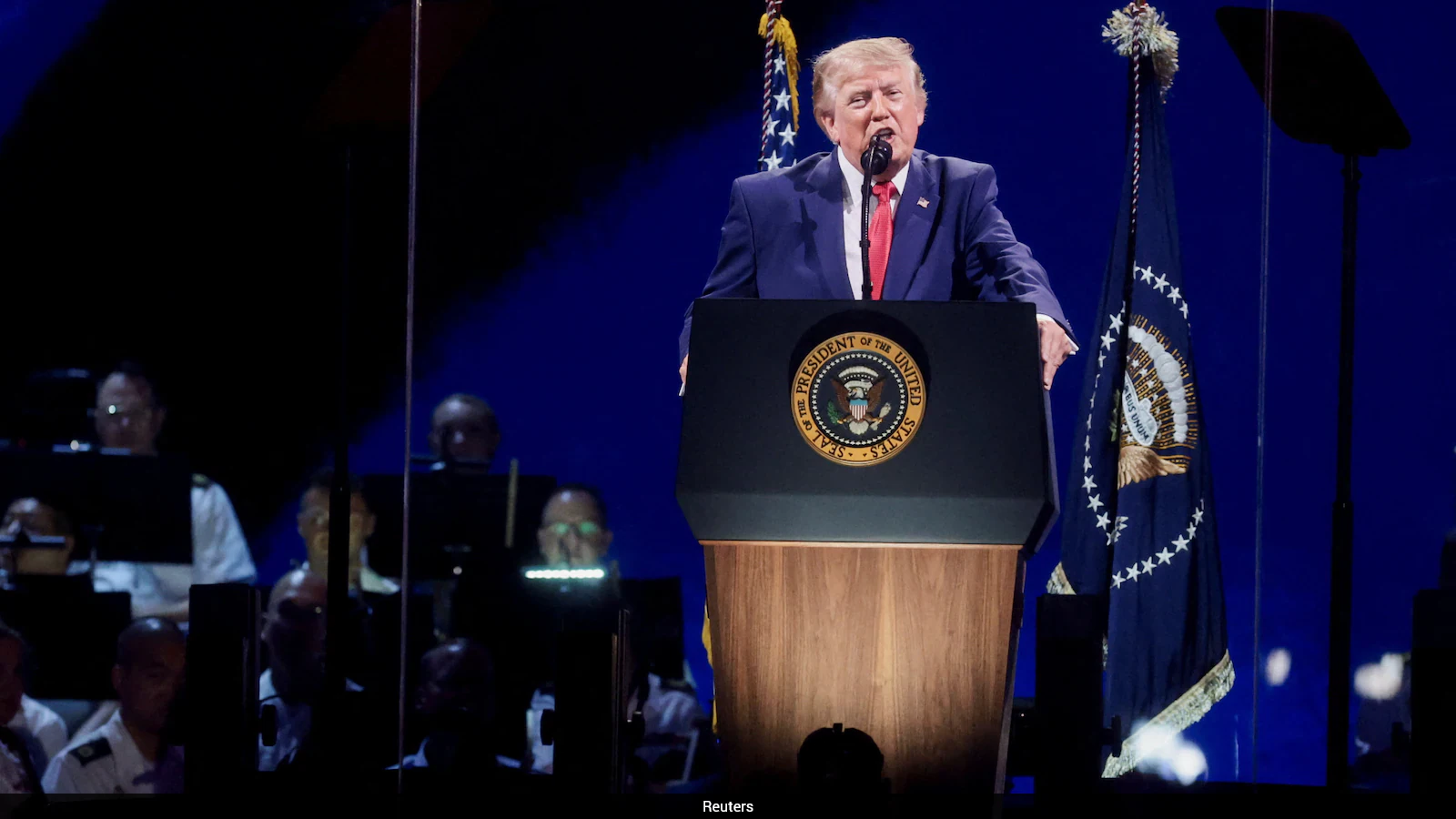
US President Donald Trump is pursuing an ambitious remaking of Washington, planning a range of controversial projects from a new White House ballroom to a 250-foot (76 m) arch and a renovated Kennedy Center.
While Theodore Roosevelt championed an overhaul of the National Mall in the early 1900s and Harry Truman gutted the White House in the early 1950s, Trump’s efforts have sparked criticism from Americans concerned about pocketbook issues and the preservation of historic landmarks. Here are some of Trump’s projects.
REFLECTING POOL
Trump announced in April that he was remodeling Washington’s historic Lincoln Memorial Reflecting Pool, near the site where Martin Luther King Jr. delivered his 1963 “I Have a Dream” speech.
A more-than-$16 million renovation project followed on the 2,000-foot pool, carried out by contractors who were not selected through a competitive bidding process.
Trump declared the renovation project complete on June 6, but the pool was soon found to have peeling paint and algae growth that turned its crystal-blue waters green.
Trump and other administration officials blamed the damage on vandals, without citing evidence, and threatened arrest of anyone seen interfering with the pool.
WHITE HOUSE BALLROOM
Trump has said a planned 90,000-square-foot (8,360-square-meter) ballroom will be “the greatest of its kind ever built,” matching the White House in height and scale.
The president initially said he and wealthy donors would pay for the estimated $400 million project. He later sought $1 billion from Congress for what the Trump administration described as security features to harden the facility.
Congress did not provide the funds, but construction has continued and is due to be completed before the end of Trump’s four-year term in office.
The project, which he says will seat 1,000 guests, has faced public backlash. Preservationists and opponents say Trump exceeded his authority when he demolished the historic East Wing, which housed the first lady’s offices and the White House movie theater, to make room for the structure.
A lawsuit to stop the project is before federal court judges, who heard arguments in June.
KENNEDY CENTER
Congress authorized the John F. Kennedy Center for the Performing Arts to honor the Democratic president who was assassinated in 1963.
That name went unchallenged for decades, until a Trump-appointed board voted last year to rename it the Trump Kennedy Center.
The cultural center experienced a flurry of show cancellations and slumping ticket sales after Trump’s assumption of control.
In February, Trump announced that the property would close for two years beginning July 4 for a major overhaul. A judge in May ordered the removal of Trump’s name from the venue and blocked the renovation plans.
Trump later said he would transfer control of the Kennedy Center to Congress, although it was not clear how he could do so. A tarp was installed over the building’s facade, obscuring the removal of Trump’s name.
THE OVAL OFFICE
Trump embarked on his first major redecoration project at the White House when he moved back into the Oval Office in January 2025.
He transformed the historic room with gold accents and statuettes, portraits of famous Americans pulled from storage, including some who are not easily identifiable, and a copy of the Declaration of Independence that hangs on the wall.
Busts of Abraham Lincoln and Benjamin Franklin are now situated on tables near his desk. Trump is pleased with it and likes to give tours to visitors.
THE ROSE GARDEN AND WHITE HOUSE GROUNDS
Outside the Oval Office, Trump replaced the Rose Garden’s grass lawn with a white stone patio and umbrella-covered tables, giving it a patio style similar to Trump’s Mar-a-Lago Club in Palm Beach, Florida. He said the stone was needed because women wearing high heels would sink into the soil.
Trump also added statues of US independence heroes Alexander Hamilton and Benjamin Franklin in the Rose Garden, along with a sculpture called “Freedom’s Charge” that depicts two Revolutionary War soldiers.
Trump recently ripped out the Tennessee flagstone walkway that had lined the West Wing colonnade adjacent to the Rose Garden for 60 years and replaced it with a black granite surface.
Along the colonnade wall, he placed portraits of America’s 47 presidents, with a plaque beneath each inscribed with Trump’s view of that person. Trump replaced the portrait of Joe Biden, who defeated him in the 2020 election, with an image of an autopen, which is used to sign documents.
Elsewhere on the White House grounds, Trump has placed large flagpoles on both the North and South Lawns.
INDEPENDENCE ARCH
Across the Potomac River from the Lincoln Memorial lies a nondescript highway roundabout upon which Trump wants to build what he calls the Independence Arch, which would be reminiscent of the Arc de Triomphe in Paris but much bigger.
The height of the arch, with eagle statues and a Lady Liberty-type figure on top, would be around 250 feet. That is taller than the Lincoln Memorial and close to the height of the U.S. Capitol, which at 288 feet can be seen across much of Washington.
By contrast, the Arc de Triomphe in Paris is 164 feet high.
Whether the arch may ultimately be built at that height remains unclear, as it could interfere with the flight path of southbound planes on the final approach to Ronald Reagan Washington National Airport, a few miles away.
GARDEN OF AMERICAN HEROES
Trump has talked about establishing a National Garden of American Heroes since his first term in office in 2017-2021.
Congress in 2025 provided $40 million for the project, which Trump plans to develop at West Potomac Park along the Potomac River to mark the 250th anniversary of U.S. independence.
Trump said the park will include statues of the country’s founding fathers, military warriors, religious leaders, civil rights champions, athletes, artists and entertainers.
The project’s opening has been delayed from the initial target date of July 4. Preservation groups have sued to have the project halted on legal grounds.
EAST POTOMAC GOLF LINKS
The president has said he wants to begin work on September 1 to overhaul Washington’s East Potomac Golf Links, a century-old public golf course in the capital city.
Trump, a frequent golfer who owns several courses, is pushing a renovation that he hopes will allow the course to host major tournaments.
That project is also tied up in legal challenges by groups that say it violates the law.
(Except for the headline, this story has not been edited by NDTV staff and is published from a syndicated feed.)