Security and defence have consistently received the largest share of the federal budget.
Some senators have called on the Presidency and the National Assembly to conduct a comprehensive audit of Nigeria’s defence spending to determine whether funds allocated to security agencies have been properly used.
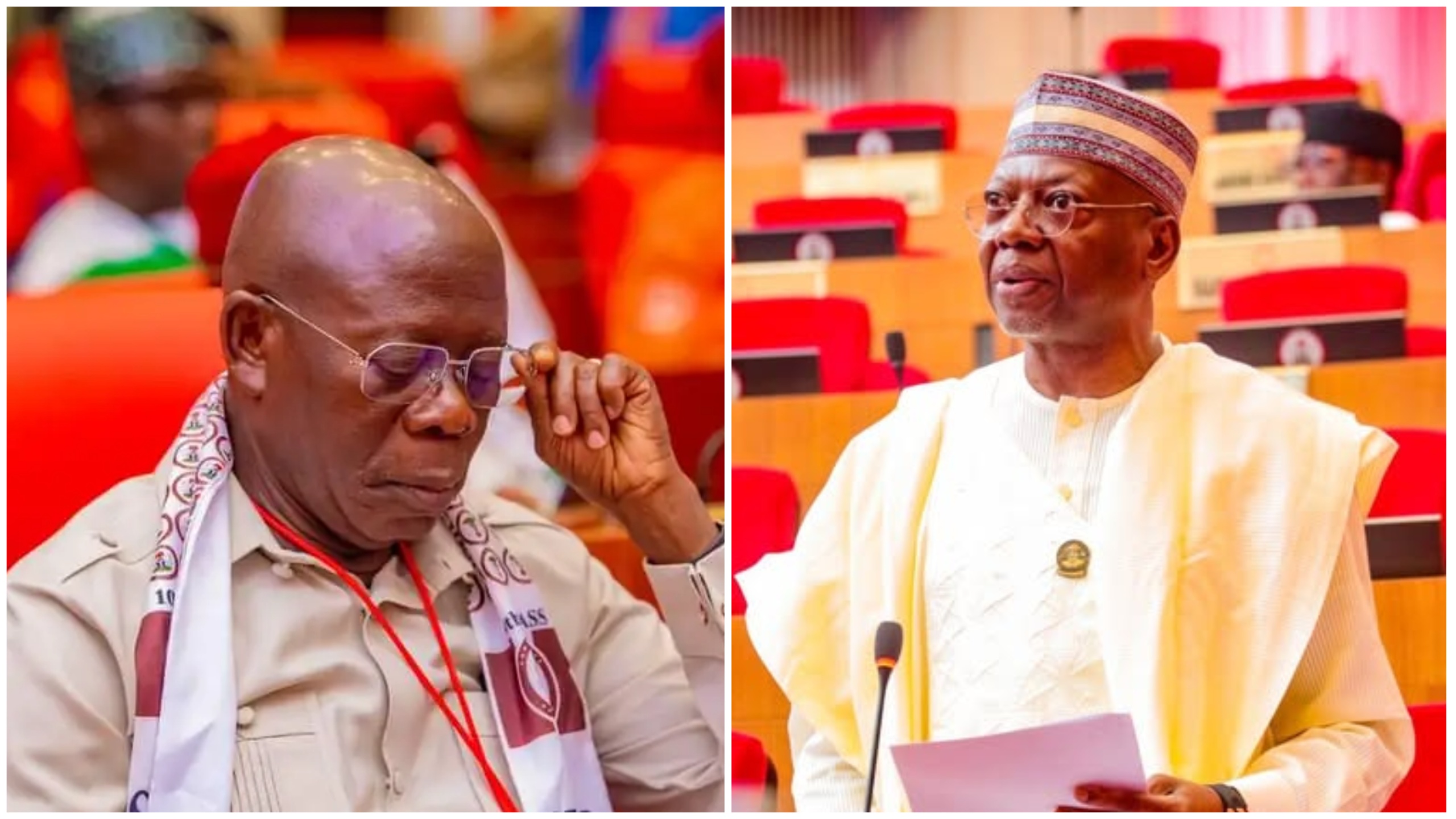
The call was made on Wednesday by the senator representing Edo North, Adams Oshiomhole, and his counterpart from Niger East, Sani Musa, during debate on a motion on the abduction of schoolchildren and teachers in Oriire Local Government Area of Oyo State.
Mr Oshiomhole, a former governor of Edo State, lamented that the Senate had repeatedly debated insecurity and adopted several resolutions aimed at addressing the crisis, but had failed to follow up on those resolutions to assess their implementation and impact.
He questioned the rationale for continuing to pass new resolutions when previous ones had produced little measurable results.
“What I want to say this afternoon with profound respect is that it doesn’t appear to me that we have carried out an audit. By this I mean to refer to each of those resolutions that we have passed in the past, to ask ourselves as a consequence what specific actions have been taken based on those resolutions.
“If past resolutions did not change anything, why should we believe that today’s own will be different? And if today’s own will not be different, why should we waste our precious time on it?” he asked.
Mr Oshiomhole who chairs the Senate Committee on Interior specifically referenced a Senate resolution passed last year following the abduction of schoolchildren in Kebbi State.
He said that the Senate in its resolution directed the military to disclose the identity of the officer who allegedly ordered the withdrawal of security personnel from the school shortly before the attack.
Mr Oshiomhole noted that the military had yet to respond to the Senate’s request, while lawmakers had failed to follow up on the matter.
“We were shocked about the kidnapping that took place in Kebbi, and it was reported that the governor of Kebbi State cried aloud that military personnel who were in that particular school were ordered to be withdrawn. And about 40 minutes later, the kidnappers came and carted away about 200, I can’t remember exactly the number of children.
“This Senate under your leadership, we passed a resolution that the military high command should disclose the name of that officer, the action that had been taken against him to satisfy us that that action was not willful, or that people who are entrusted to protect us, that some of them have not become part of our problem. Mr President, I have always tried to be present every day that this Senate sits. As I speak, I am not aware that we have gotten a response to that simple inquiry,” he added.
The senator insisted that the legislature must undertake a thorough audit of security allocations and strengthen oversight of defence spending.
“If the armed forces are not accountable, if we do not carry out due audit and oversight of resources that we have all been blackmailed to appropriate to protect Nigeria, and we come here lamenting that it is now taking over the country, I think we need to do more than that. We need to carry out a security audit, money appropriated, who got what, and how it was used.
“And, I still insist that this Senate is entitled to have a reply to the question we unanimously asked – who withdrew those people for the children to be carted away. I believe that any time we pass a motion, we are entitled to note the feedback arising from the response that the motion is directed to.”
Unlike bills, motions passed by the legislature have no force of law.
Security and defence have consistently received the largest share of federal budget allocations under the Tinubu administration.
In the 2024 budget, security was prioritised as one of the government’s key spending areas. The trend continued in 2025 and 2026, with the president proposing ₦5.41 trillion for defence and security in the 2026 budget. That was the highest sectoral allocation and the third consecutive year that security has topped federal spending priorities.
The sustained increase in defence spending has been justified by the government as necessary to tackle terrorism in the North-east, banditry in the North-west, kidnapping-for-ransom across several states, farmer-herder conflicts in the North-central region, oil theft in the Niger Delta, and violent criminal activities in parts of the South-east and South-west.
Despite the huge investments, insecurity remains one of Nigeria’s most pressing challenges. A recent report by SBM Intelligence recorded 4,722 abductions and at least 997 kidnapping incidents nationwide between July 2024 and June 2025. During the same period, victims reportedly paid about ₦2.57 billion in ransom to kidnappers.
School abductions have also persisted despite repeated government assurances. More than 1,500 students have been kidnapped in mass school attacks across Nigeria over the past decade, while bandit groups continue to operate in parts of the North-west and North-central regions.
Nigeria is ranked among the world’s least secure countries despite record defence allocations in recent years. The Global Peace Index 2025, ranked Nigeria 148th out of 163 countries among the least peaceful countries in the world.
Similarly, the Global Terrorism Index 2025 placed the country sixth among nations most affected by terrorism. The rankings reflect the persistence of insecurity, including terrorism in the North-east, banditry in the North-west, mass kidnappings, farmer-herder clashes and communal violence, despite trillions of naira allocated to defence and security since President Tinubu assumed office.
Although, security experts have repeatedly argued that increasing budgetary allocations alone may not be sufficient to address the country’s security crisis without stronger oversight, transparency, intelligence gathering, procurement reforms and accountability mechanisms.
Speaking in the same vein, Mr Musa, who chairs the Senate Committee on Finance, urged President Bola Tinubu to hold security chiefs accountable for funds allocated to the procurement of military equipment and operations.
Drawing a comparison with the United States, he said defence officials should be subjected to scrutiny regarding how public funds are spent.
“If the US Secretary of Defence can be called to be scrutinised publicly on the expenditures, spending and operational mechanisms of the armed forces, especially in the area of expenditure and budgeting.
“I think it is high time now that Mr President, in his wisdom, called the service chiefs to account for the resources that this National Assembly has been budgeting for. Because if this is not done, the issue of overcoming this issue of security is going to be child’s play,” he said.
Mr Musa also questioned the source of wealth behind Nigeria’s booming real estate sector, suggesting that greater scrutiny of public expenditure was necessary.
“Today, go and check the economy. Go and check how the economy plays. Today, if you look at the indices that contribute to the growth of our GDP, and areas where these expenditures are going, you will see that real estate is playing a role in this country. Who are the owners of these real estates? How do the resources come?
“We are here in the National Assembly, every day, saying we want to appeal to Mr President to look at domestic debts. I think it is the government’s responsibility upon us, as legislators, to do our oversight without fear or favour. We need to do it. We have been allocating resources. At one time, three of our budgets, defence was carrying the highest. And yet, every day, it is either that we don’t have the arms, or the money is not there to give allowances to our servicemen. Where is the money going to?