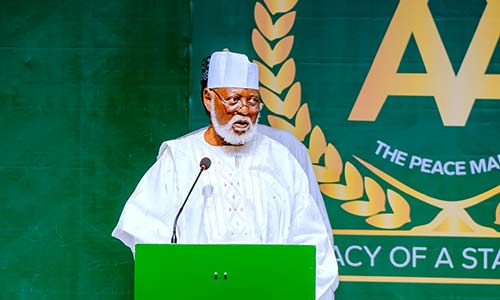
Former Head of State, General Abdulsalami Abubakar (rtd.), has said the circumstances surrounding the death of his predecessor, General Sani Abacha, on June 8, 1998, initially gave him the impression that “something was fishy.”
Abdulsalami made the disclosure in his autobiography, Call of Duty, which was publicly presented in Abuja as part of activities marking his 84th birthday.
In the book, the former Head of State narrated how he was called very early on the morning of June 8, 1998, and informed that Abacha wanted to see him at the Presidential Villa.
According to him, he initially thought Abacha wanted to send him to Togo for an ECOWAS summit, a trip he said he was not eager to make because he was already tired of representing the Head of State at several official engagements.
Abdulsalami explained that at the time, Abacha’s deputy, Lt.-General Oladipo Diya, was in detention over an alleged coup plot, making him effectively the number two man in government.
“On Monday, 8 June, I received a call very early in the morning that he wanted to see me. I quietly prayed that he would not send me to Togo where there was going to be an ECOWAS summit. I was tired of going everywhere,” Abdulsalami wrote.
He said he informed his wife that he was unhappy with the call because he suspected he might be asked to travel. He then directed his orderly to pack his travelling bag and personal effects.
However, while he was preparing, another call came in, again insisting that Abacha wanted to see him urgently.
Abdulsalami said he asked whether he was being summoned because of the Togo trip, but the caller told him it was for another issue.
Because of the urgency, he said he did not wear his military uniform but instead went to the Presidential Villa in a tracksuit and slippers.
On getting to Abacha’s residence, Abdulsalami said he was told that the Head of State was in the office. He found this unusual because it was very early in the morning.
He said that as he was climbing the stairs, one of the guards informed him that Abacha had directed that he should stay in the waiting room.
According to him, this was strange because whenever he visited Abacha in the past, he was usually allowed in immediately, regardless of who was with the Head of State.
“What struck me was that anytime I went to see him, regardless of who was with him, I would still go in. After waiting for about half an hour, I reasoned that it was odd,” he wrote.
Abdulsalami said Major-General Ishaya Bamaiyi later joined him in the waiting room, and both of them remained there for about an hour without any explanation.
He said he eventually decided to go and see Abacha by any means because he could not understand why he was being kept waiting for so long.
To his surprise, however, the door of the waiting room had been locked.
“I decided to go and see Abacha by any means because I could not understand why I would be kept that long. To my greatest surprise, the door of the waiting room had been locked,” Abdulsalami stated.
He said he asked Bamaiyi whether he knew that they had been locked inside.
“I asked Bamaiyi if he was aware that we had been locked inside. Something kept telling me that something was wrong, but I could not place a finger on it,” he added.
After some time, the door was opened by the then Inspector-General of Police, Alhaji Ibrahim Coomassie, who simply told them, “Let’s go.”
Abdulsalami said they walked towards Abacha’s residence, but he reminded Coomassie that he had earlier been told that Abacha was in the office.
It was at that point, he said, that Coomassie informed him that Abacha was dead.
“He said: ‘Let’s go.’ We walked towards the residence and I informed him that I was told Abacha was at the office. It was at this stage that he informed me that Abacha was dead,” Abdulsalami wrote.
The former Head of State said he was shocked by the news and asked what had happened, but Coomassie insisted that they should first proceed to the residence.
He said when they arrived, he asked to see Abacha’s body and was allowed into the room where it had been kept.
“When we got to the residence, I asked to see Abacha’s body. I was told it was inside. I entered the room and removed the covering. I was in shock at the sudden development. I prayed for him and left the room,” he narrated.
Abdulsalami said the experience left him disturbed because of the unusual manner in which he had been summoned, kept waiting, locked inside a room and later informed of Abacha’s death.
Later that day, Abdulsalami was named Abacha’s successor after a vote by the Provisional Ruling Council.
He would go on to supervise Nigeria’s transition from military rule to civilian government, handing over power to democratically elected President Olusegun Obasanjo on May 29, 1999.