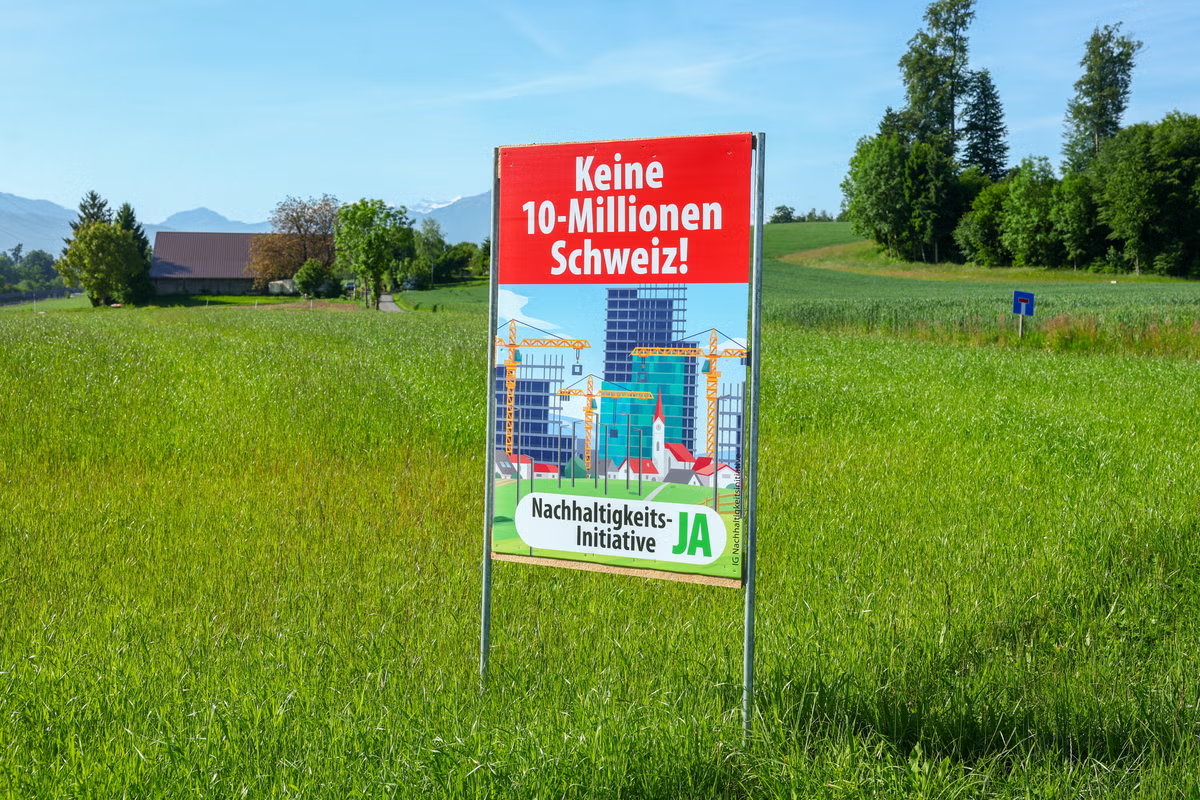
Switzerland is poised for a pivotal vote on 14 June, as citizens head to the polls to decide on a proposal to cap the nation’s population at 10 million. The referendum, which some have dubbed a “Swiss Brexit”, has sparked alarm among businesses, who fear economic repercussions should the measure pass.
Supporters of the cap, championed by the right-wing Swiss People’s Party (SVP), argue that the country’s expanding population is straining local infrastructure, roads, and public transport to their limits. They also contend that it is driving up rents and contributing to an increase in crime.
However, companies and employers are deeply concerned that a “yes” vote would restrict Switzerland’s access to skilled labour and damage its relationship with the European Union, its largest export market.
“As a Swiss citizen, it concerns me very much for the future of our country and its prosperity,” said Martin von Moos, CEO of luxury hotels Belvoir in Ruschlikon and Sedartis in Thalwil, near Zurich. He highlighted the critical role of foreign workers, noting, “If we lost all of our foreign staff, the hotel simply wouldn’t function,” with nearly half of his 115 employees originating from outside Switzerland.
Recent polls indicate a finely balanced outcome, with the latest figures showing 47 per cent in favour and 52 per cent against. Switzerland’s population reached 9.1 million by the end of 2025, a significant rise from 7.3 million in 2002 when the free movement of people between Switzerland and the EU was introduced. Foreign nationals now constitute almost 28 per cent of the population.
SVP lawmaker Yvan Pahud told The Independent: “Switzerland is a small country with a limited territory, and it has experienced the highest population growth in recent years.” This vote reflects a broader European trend, where right-wing parties are capitalising on anxieties surrounding immigration, housing, and public services, mirroring events such as Britain’s 2016 vote to leave the EU and the rising popularity of parties like France’s National Rally and Germany’s AfD.
Business leaders warn that the proposed population cap could be a “showstopper” for one of Europe’s most robust economies. Molecular Partners, a Zurich-based biotech firm where more than half of whose roughly 120 staff are non-Swiss, already struggles to recruit necessary talent. Daniel Steiner, senior vice president of targeted radio therapeutics at the company, said: “I think if we said we could only hire out of the Swiss talent pool, or if we could only collaborate with the Swiss companies, it would basically be a showstopper.” He added: “We may be forced to move things out of Switzerland.”
Rudolf Minsch, chief economist at business association economiesuisse, said the cap was a “populist attempt” to address complex issues with a simplistic, artificial limit. “It sells the illusion of a free lunch, and will not solve our housing or traffic problems,” he said.
Like many European nations, Switzerland faces an ageing population. Projections from the Swiss statistics office indicate that the proportion of the population aged 20-64 will fall from 60 per cent to 56 per cent by 2055, while those over 65 will climb from 21 per cent to 27 per cent. Opponents of the cap argue that many newcomers have been entrepreneurs who have contributed to the Swiss economy, citing companies like Nestle, Swatch, and ABB, which were set up either wholly or partially by foreigners. A 2023 study by Avenir Suisse found that 39 per cent of all company founders in Switzerland were foreigners.
Referendums are a cornerstone of Swiss politics, with citizens voting four times annually on national and regional matters. Under the current proposal, if Switzerland’s population surpasses 9.5 million – forecast for 2031 – the government would be mandated to implement measures to prevent it reaching 10 million, a milestone predicted for 2042. At 10 million, Bern would be required to terminate international accords that encourage population growth. This includes the critical agreement with the EU allowing free movement of people, a condition of the complex web of Swiss accords with Brussels that give the country access to the European single market.
Claude Maurer, chief economist at BAK Economics, a research institute, warned that abandoning these bilateral accords could reduce Swiss economic growth between 2028 and 2045 by 7.1 per cent, equating to a loss of 685 billion Swiss francs (£867 billion). He added that growth would slow, while inflation, driven by wage increases, could trigger higher interest rates.
Thomas Matter, another SVP lawmaker and banker, dismissed these concerns as scaremongering. He said that only one in ten immigrants possessed sought-after skills, and that the rate of GDP growth per head had declined since the increase in immigration. “We are not against immigration, but it has to be moderate and controlled so we bring in the right people,” he said. “Before we had qualitative immigration, now we have quantitative immigration. Switzerland is still the same size as it was in 1848, and more and more people are living in the same space.”
Major Swiss corporations, including Roche ROPC.S, Nestle NESN.S, ABB ABBN.S, UBS UBSG.S and Novartis NOVN.S have all criticised the cap. “We reject the initiative,” Roche said, adding that a ‘yes’ vote would threaten agreements with the EU and exacerbate a shortage of skilled workers. “Companies depend on access to qualified workers – especially from the EU.”
Hotelier von Moos, who also heads the Swiss hotels association, said that some hotels could be forced out of business, prices would rise, and it would become more difficult for non-European visitors to come to Switzerland. “We call this initiative a wolf in sheep’s clothing. It’s a simple message but it hides serious consequences.”