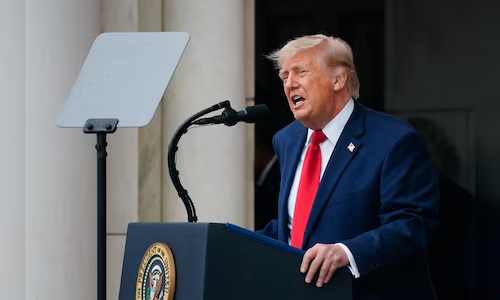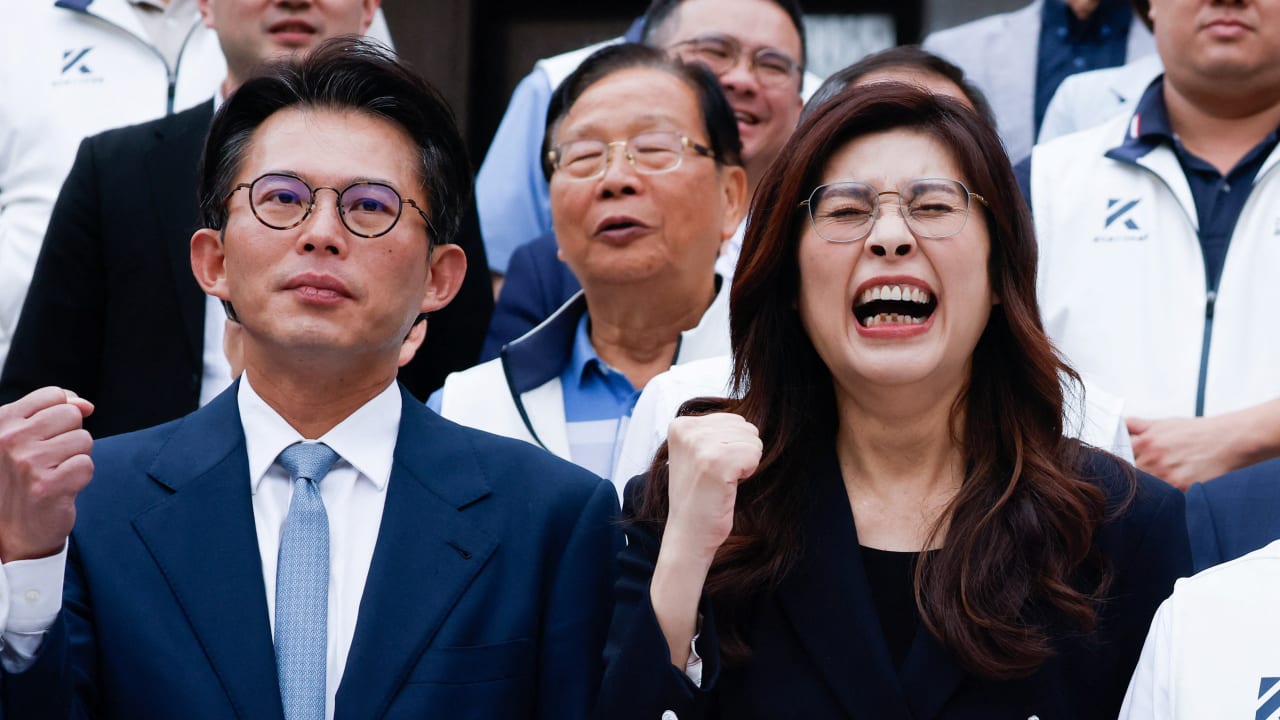
Taiwan opposition leader Cheng Li-wun said on Monday that she would be “very willing” to meet US President Donald Trump when she visits the US this month.
Cheng, chairwoman of the Kuomintang (KMT), Taiwan’s largest opposition party, leaves for a two-week US trip later on Monday, following on from her April visit to China, where she met President Xi Jinping.
Speaking to reporters in Taipei, Cheng said since the severing of diplomatic relations between Taipei and Washington in 1979, no Taiwanese leader had met a sitting US president, although she said her only official position was KMT chairwoman.
“I am of course very willing,” she said when asked if she would meet Trump.
Cheng said she was willing to meet anyone who is “conducive to peace” and has a pivotal leadership position, just as she had met Xi.
“The same applies to President Trump. Anything that is helpful to peace, I am willing to do; anyone who is helpful to peace, I am willing to meet, let alone the most critical decision-maker and leader, which is the president of the United States.”
Dialogue to ‘thoroughly eliminate any possibility of military conflict or war’
The White House did not immediately respond to a request for comment outside of office hours.
China, which claims Taiwan as its own, refuses to speak to its President Lai Ching-te, saying he is a “separatist” and has rebuffed his repeated offers of talks. Lai rejects Beijing’s sovereignty claims, saying only Taiwan’s people can decide their future.
Cheng said she was pleased to see China-US ties moving in a better direction after Trump and Xi met in Beijing last month.
She said she would be meeting lawmakers as well as US officials while on her trip, which includes a Washington stopover, but declined to say who, citing confidentiality.
While Cheng has repeatedly said the KMT, which, along with its small ally the Taiwan People’s Party, has a majority in parliament, backs defense spending, last month it cut by a third the government’s plans to spend an extra $40 billion on arms.
The US has backed Taiwan’s defense spending boost, especially the part that the opposition cut, which includes money for drones and other domestically-made equipment.
Cheng said Taiwan’s defense resilience comes not only from the strengthening of military hardware, but it also needs dialogue with China to “thoroughly eliminate any possibility of military conflict or war.”