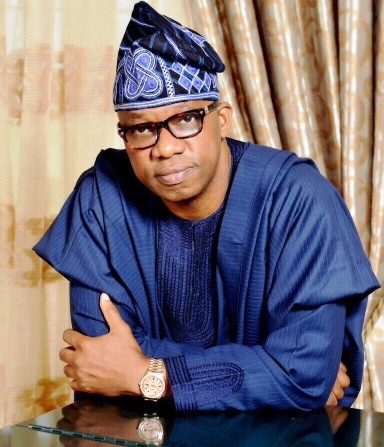
Special Adviser to Ogun State Governor on Information and Strategy, HON KAYODE AKINMADE writes on how strategic investments, fiscal reforms, industrial expansion and bold infrastructure projects propelled Ogun State to become Nigeria’s second best-performing state and one of the nation’s fastest-growing economies
By Kayode Akinmade
When the 2025 State Performance Index (pSPI), released by Phillips Consulting, ranked Ogun State second only to Lagos among Nigeria’s 36 states and the Federal Capital Territory, it validated what years of strategic investments in infrastructure, industrialisation, logistics, and fiscal reforms had already signposted.
Since assuming office on May 29, 2019, Governor Dapo Abiodun has pursued a development agenda anchored on connectivity, economic expansion, and sustainable revenue growth. The result is a state increasingly regarded as one of Nigeria’s most competitive destinations for investment and industrial activity.
Importantly, the pSPI is not a political award. The index combines 70 per cent objective performance data drawn from audited records covering fiscal management, infrastructure, healthcare, education, and economic output, with 30 per cent citizen perception surveys. Ogun’s emergence as the nation’s second-best performing state reflects measurable outcomes rather than political sentiment.
Any assessment of Ogun State’s transformation begins with the numbers.
When Governor Abiodun took office in 2019, the state’s Gross Domestic Product (GDP) stood at approximately ₦2.9 trillion. By 2024, it had risen to ₦7.3 trillion, while projections based on expanding industrial productivity place the figure closer to ₦17 trillion.
Internally Generated Revenue (IGR) has followed a similar trajectory. From about ₦50.6 billion in 2020, IGR rose to ₦100.7 billion in 2021, climbed to ₦146 billion in 2023, and reached nearly ₦192 billion in 2024. The state is targeting ₦250 billion in 2025 and ₦500 billion by 2026.
The growth has been driven by tax digitisation, the elimination of multiple taxation, improved compliance, and the expansion of industrial activities across the state.
Reflecting its growing economic capacity, Ogun’s 2025 Budget of Hope and Prosperity stood at ₦1.054 trillion, with over ₦600 billion dedicated to capital projects. Infrastructure, education, and healthcare received the largest allocations, reinforcing the administration’s emphasis on long-term development.
One of the most visible achievements of the Abiodun administration has been its extensive investment in road infrastructure.
More than 1,700 kilometres of roads have been constructed or rehabilitated across the state since 2019. These projects include the reconstruction of the Abeokuta-Sagamu Expressway and intervention works on the Lagos-Ota-Abeokuta Expressway, one of Nigeria’s busiest commercial corridors.
After more than two decades of jurisdictional disputes stalled progress on the Lagos-Ota-Abeokuta road, the state government secured federal approval and commenced reconstruction in 2024.
Road projects have also been executed across industrial and agricultural corridors in Ifo, Sango-Ota, Idiroko, Remo, Yewa, and Ijebu areas, improving mobility, reducing logistics costs, and strengthening economic integration.
For the administration, roads are more than physical infrastructure; they are economic assets that facilitate trade, attract investment, and improve competitiveness.
The administration’s governance philosophy is encapsulated in its ISEYA agenda—Infrastructure, Social Investment, Education, Youth Empowerment, and Agriculture.
Under this framework, infrastructure development has remained a priority, while investments in healthcare, education, housing, youth development, and agriculture have sought to ensure inclusive growth.
The revitalisation of primary healthcare centres, recruitment of teachers, rehabilitation of schools, support for small businesses, youth skills acquisition programmes, and agricultural interventions have all contributed to improvements in human capital development.
The strong citizen perception scores recorded in the pSPI suggest that residents are experiencing tangible benefits from these investments.
A major milestone in the administration’s infrastructure drive was the completion of the Gateway International Agro-Cargo Airport.