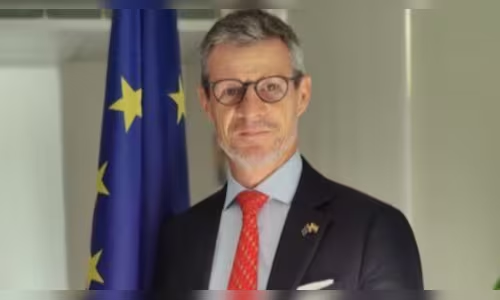
The European Union is increasingly looking at Northeast India as a promising destination for business and economic cooperation, with EU Ambassador to India Hervé Delphin describing the region as one of the country’s fastest-growing geographies and an emerging centre of economic activity.
Speaking at a media interaction on the sidelines of “European Union: Annual Erasmus- Pre-Departure Event,” Delphin said the Northeast should no longer be viewed as being on the periphery of India’s geography but increasingly at the centre of its economic development.
Referring to his recent visit to Assam, the envoy said the EU and the state government had launched a pilot initiative around a “Blue Valley” cluster focused on flavours and fragrances. He added that the region’s strong economic growth and unique assets were attracting interest from European businesses.
“I think the Northeast is one of the fastest-growing geographies of India in terms of GDP. While India has grown 27%, the Northeast has grown 45% in the past decade,” Delphin said.
He said the EU was exploring opportunities across multiple sectors in the region, including flavours and fragrances as well as information technology. “There is no reason why the Northeast should be out of it; on the contrary,” he said, referring to efforts to deepen economic engagement with the region.
The remarks come as India and the EU seek to expand cooperation across trade, investment, connectivity and sustainable development, while negotiations for a free trade agreement continue.
FTA could take effect in early 2027
While declining to provide a specific timeline, on the proposed India-EU Free Trade Agreement, he said it was reasonable to be optimistic about the agreement entering into force in the first quarter of 2027, subject to the completion of procedures on both sides, including approval by the European Parliament.
He added India and the EU are currently working to complete the legal vetting of the agreement and remain focused on signing the deal by the end of this year.
“Both sides are working very hard to complete the process of the so-called legal vetting of the text and in such a way that by the end of the year, there will be a possibility to sign the FTA,” he stated.
The CBAM issue
Addressing concerns surrounded over the EU’s Carbon Border Adjustment Mechanism (CBAM), Delphin said discussions related to the trade pact and the carbon levy were separate issues.
He reiterated that any simplification measures adopted under CBAM would also be applied in the context of India. The envoy said the EU was supporting India’s decarbonisation efforts through a €500 million programme and a dedicated platform focused on sectors where India has sought cooperation.
He said Europe viewed green hydrogen as an area of significant interest and noted India’s progress in the sector. He said, “We are also looking at India’s impressive strides with respect to green hydrogen, which is also a source of energy of great interest for Europe.”
Net movement of migration is a necessity for Europe
The envoy also said mobility between India and Europe is expected to increase further as bilateral ties deepen.
Citing the Schengen visa cascade mechanism agreed two years ago, Delphin said Indian travellers with an established record of travel could increasingly benefit from longer-term visas instead of applying for a new visa for every visit.
Responding to a question on the impact of the proposed India-EU Free Trade Agreement on mobility, the envoy said stronger business ties could lead to greater movement of business professionals, researchers and workers, alongside increased tourism and more direct flight connections between India and Europe.
He said, “You will see more tour operators in the tourism industry between the two geographies. You will see probably more point-to-point flights between Europe and India.”
Separately, Delphin said Europe would require additional labour in the future as demographic trends alone would not be sufficient to sustain its workforce, making net migration an economic necessity for the continent.
Also Read: 5 British PMs in 8 years: How UK political chaos shaped Keir Starmer’s rise and fall