Hannah Ray J Childs finds exhilaration in Iowa’s Maquoketa River, performing whitewater acrobatics that give her the “feeling of flying” and she met her husband through their shared passion for violent currents.
Yet, her deep connection to the state’s waterways comes with a stark reality: she’s also fallen ill from its pollution, now wearing nose and ear plugs to minimize risk. This paradox prompts a bewildered response to her hobby: “Ew, that’s disgusting. Why would you do that?”
Iowa, a leading agricultural state, grapples with one of the Midwest’s most severe water quality challenges. Its rivers and streams are increasingly contaminated. Its farms, as a top producer of corn, soybeans, and hogs, generate nitrates and phosphorus, draining into these waters and contributing to the Gulf of Mexico’s dead zone. Last summer, its largest city faced water restrictions due to harmful nitrates in tap water.
This decades-old pollution affects public health and water enjoyment. Algal blooms create dangerous conditions at beaches, and soil runoff makes waters unappealing. Bacterial contamination, sometimes from human sewage, deters swimmers. In 2024, over half of the state’s monitored river, stream, and lake sections failed to meet standards for swimming, drinking, or aquatic life.
The state has largely relied on voluntary actions and incentives, not mandates, to curb runoff, consistently falling short of its goals. Environmental groups recently sued a previous administration, alleging it improperly reversed a Biden-era requirement for Iowa to address nitrate pollution in several rivers.
Despite challenges, investment and improvement have occurred. Governor Kim Reynolds recently championed a $320 million package for water infrastructure and other projects, adding to the nearly $100 million annually that the state allocates to the problem. Phosphorus levels have diminished, and better practices like cover crops, reduced tillage, and on-farm runoff reduction installations have substantially increased.
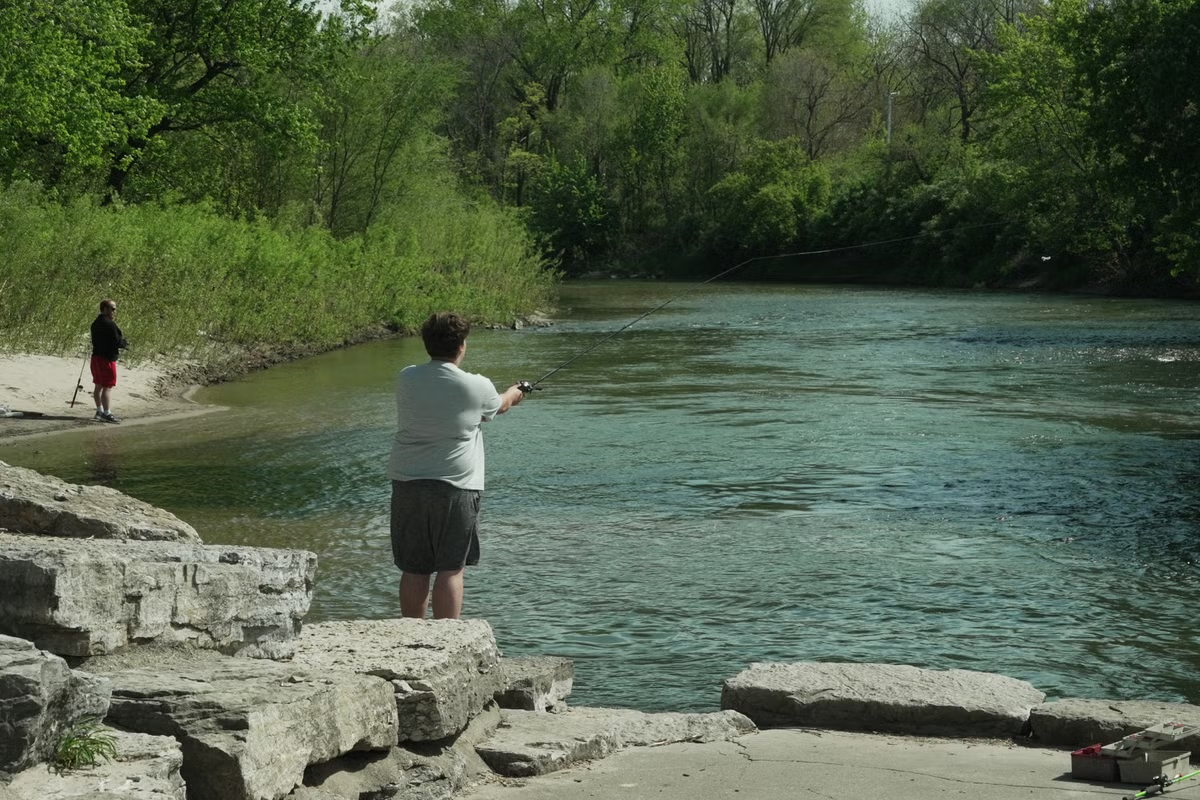
Iowa’s identity is deeply intertwined with its waterways, including the Missouri and Mississippi rivers. These offer beautiful lakeside beaches and excellent trout fishing. Childs learned to love the Maquoketa River growing up on a nearby corn and hog farm, remembering paddling to find fishing holes and exploring streams with friends.
Now, she volunteers to test the river for chemicals and championed a whitewater park in Manchester, her hometown, to foster community connection with the water. “If we don’t get people invested in their local river, their local community, how are we ever going to ask them to take care of it?” she said.
Mary Swander, a 75-year-old theater director and former state poet laureate, fondly remembers learning to canoe and swim outdoors while growing up near the water. Summer was for splashing around. Winter, ice skating.
“I had a little group of friends and we played hooky once, and we all got our swimsuits and drove over to Lake MacBride and spent the whole day in the lake, in the water, swimming, and we had a whole picnic,” she said.
Swander now avoids the water after bad experiences. One time the water at a state park felt wrong — sticky. Another time a ranger warned her canoeing group not to get their hands — or anything else — in the water.
“I was like, ‘Well, what the hell are we doing out here, then?’” she said.
Swander was able to replace swimming with other activities and keep some friendships, but others faded. The loss of places outside the home and office where people can connect may make sustaining social interactions harder, especially for older adults, said Philippa Clarke, a University of Michigan professor who has researched social spaces.
Bacteria plays the biggest role in making streams inaccessible. It comes from cows, deer and other animals, although in some places human sewage is the biggest problem. Experts say heavy rains are a major risk when they wash away manure — something that climate change will intensify — and improving sewage treatment and leaky septic systems is vital.
Nitrates and phosphorus from manure and fertilizer on farms are also at the heart of the problem. Millions of acres of farmland use plastic pipes under fields — a system called tile drainage — to quickly direct water into streams. The nutrients feed algae, leading to lake advisories and threatening drinking water.
The challenge of keeping water bodies clean is exemplified by Lake Darling, a roughly 300-acre (120-hectare) human-made lake that offers camping, trails and a beach for swimmers in Iowa’s southeast. But last year the lake had the worst overall health of any state beach with 10 weeks of E. Coli advisories and six with algal warnings, According to the Iowa Environmental Council, which tracks such advisories.
Years ago the lake was closed, drained and renovated — its earlier brown water became inviting and clearer. Nearby landowners altered their properties to catch runoff, and critical land was purchased for conservation, according to Bob Shepherd who is part of a proud park volunteer group.
Recently, however, it has struggled, said Claire Hruby, an environmental science professor at Drake University who studied pollution at the lake. Hruby said there are several new hog operations in the lake’s watershed, and nutrient runoff from manure triggers algae issues.
When the water is particularly bad, “It’s like swimming in green paint,” she said.
Concerns about water quality keep people away even on days that are not that bad, according to Lawrence Eyre, a tennis camp director and teacher at a nearby school. As recently as several years ago, kids would finish playing tennis on courts baking in the summer sun and, minutes later, be rewarded with a swim in another nearby lake.
But parents noticed that some kids were getting itchy skin, and algae appeared at the water’s edge. Word spread, and many wanted their children not to take the risk. Now they tend not to bother, Eyre said.
“It does put a dent in the enjoyment of the summer,” he said.
Environmentalists see a state that can’t say no to agriculture.
In 2015, Des Moines’ water utility sued three counties over the money it had to spend filtering out nitrates. A judge eventually dismissed the complaint, saying any push to permit and reduce runoff from nearby agriculture was an issue for the Iowa legislature.
While Minnesota has mandated vegetation near streams to reduce runoff, Iowa has taken a different approach. It relies on its agriculture and natural resources departments, along with Iowa State University, to develop voluntary strategies that include less fertilizer use, improved crop management and adding wetlands to reduce runoff.