A U.S. Marine who shot and wounded a police officer outside an immigration detention center has been sentenced to 100 years in federal prison after the landmark prosecution of more than a dozen protesters accused of “Antifa”-linked terrorism.
Seven other demonstrators received prison terms ranging from 30 to 70 years during sentencing hearings in Texas on Tuesday, and another group of convicted protesters could face similar sentences in their hearings next week.
The charges were among the first against anyone accused of being a member of Antifa, a longtime boogeyman for Donald Trump’s administration as it searches for legal tools in a wider crackdown against left-wing dissent and protests against the president’s immigration enforcement arms.
U.S. District Judge Reed O’Connor said 30-, 50-, 70- and 100-year sentences against eight protesters in what critics have called a politically loaded test case against the militant antifascist movement will “send a message to anyone who shares a similar ideology.”
Benjamin Song, a Marine who was convicted of attempted murder for shooting and injuring an Alvarado police officer outside the Prairieland Detention Center last year, said in a statement after his sentencing that he tried to stop the officer from shooting a “running, unarmed protestor” to “prevent what happened” to Alex Pretti Renee Good, two Minneapolis demonstrators who were fatally shot by federal agents earlier this year.
“Now, 21 people have been arrested, have been persecuted, have been punished. For knowing me or being my friend? This is wrong,” Song wrote. “This is mass punishment. Collective punishment. This is guilt by association. This is injustice. … It may be my friends today but it will be your friends tomorrow.”
His attorney said they will appeal the sentencing.
“There is no ‘appropriate’ sentence for a wholly fictitious crime,” Lydia Kosza, the wife of Prairieland defendant Autumn Hill, said in a statement. “These draconian sentences bear no connection to any notion of due process.”
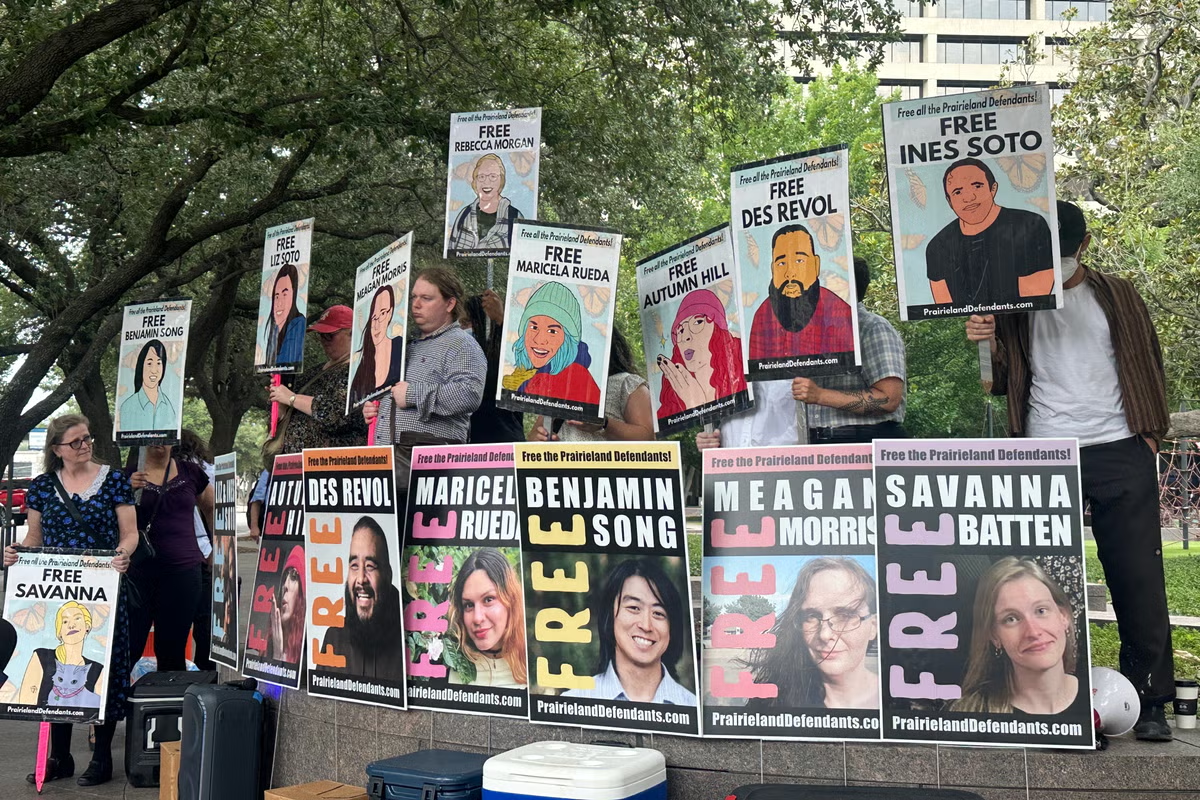
The case involves 22 people charged with state and federal charges after a demonstration in solidarity with detainees at the Prairieland ICE Detention Center in Alvarado, Texas, on July 4, 2025. Prosecutors accused the group of launching a premeditated terror attack against the facility.
Maricela Ruedo was sentenced to 70 years. Zachary Evetts, Savanna Batten, Autumn Hill, Meagan Morris and Elizabeth Soto were each sentenced to 50 years, and Daniel Sanchez Estrada was sentenced to 30 years.
Antifa, short for antifascist, encompasses individuals and loosely affiliated groups in a broader militant subculture — often physically confronting far-right groups in the streets — rather than a specific organization.
But the the Justice Department has opened a wider investigation into the movement, which Trump and prosecutors are calling a criminal “enterprise” that can be prosecuted like the Mafia.
Administration officials have repeatedly tied acts of political violence to Antifa, while also claiming without evidence that the movement is being financially supported by groups that support Democratic candidates — what critics fear is an attempt to criminalize political opposition itself.
Last fall, the president signed an executive order designating Antifa as a domestic terrorist organization, even though there is no domestic equivalent to the list of foreign terror organizations managed by the State Department.
First Amendment advocates told The Independent that the president’s order acts as a “permission slip” for government actors to target and censor expression and could be used to justify broad and unconstitutional investigations, creating a chilling effect against political opposition.
Tuesday’s sentencing also follows federal charges against 15 anti-ICE demonstrators in Minnesota “for conspiracy to impede or injure federal officers” and for efforts to allegedly “violently oppose immigration law enforcement” during a surge of federal immigration officers in the state.
Dario Sanchez, another defendant facing state charges in Texas, said the Prairieland case has “become a template for silencing political activity.”
“How you engage in politics doesn’t determine whether you’ll be targeted or not, now it’s whether or not you voice your dissent,” Sanchez said in a statement.