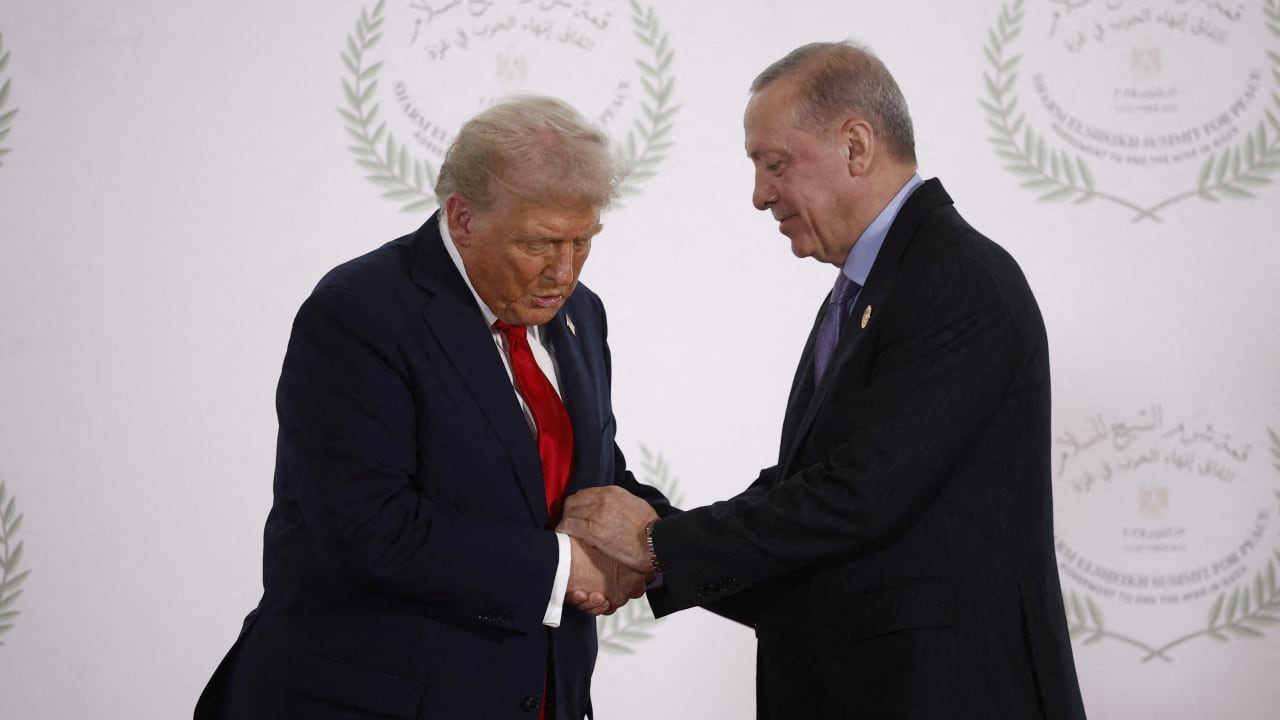
US President Donald Trump raised eyebrows when he revealed on Wednesday that Turkey had come close to joining the conflict involving Iran, but ultimately stayed out of it after a personal request from him. At the same time, Trump showered Turkish President Recep Tayyip Erdogan with praise and hinted at future steps that could significantly strengthen Turkey’s military capabilities, developments that are causing concern in Israel.
When speaking at the meeting with NATO Secretary General Mark Rutte at the White House, Trump described his conversations with Erdogan during the regional crisis.
“I like him. He’s a friend of mine. And he stayed out of the war,” Trump said. “You know, he was a leading candidate to get involved in the war with Iran.”
Trump acknowledged Erdogan’s strained relationship with Israel, but said the Turkish leader nevertheless respected his request.
“He’s not a big fan of Israel, as you know,” Trump said. “And I asked him to stay out of it, and he stayed out.”
Ahead of a planned visit to Turkey next month, Trump continued to lavish praise on Erdogan.
“Erdogan is a strong man,” he said. “Everything I’ve ever asked him to do, he’s done.”
Trump and Erdogan’s relationship
According to Dr. Gallia Lindenstrauss, a senior researcher at Israel’s Institute for National Security Studies (INSS), Trump views Erdogan as a leader who can deliver results.
“Trump sees Erdogan as someone who can deliver what he needs and as a leader who wins,” Lindenstrauss said. “We know that Trump is attracted to successful leaders.”
Dr. Assa Ophir, an expert on Turkey and the Middle East, said that the relationship goes both ways.
“Erdogan values Donald Trump because he feels he can do business with him,” Ofer explained. “He has managed to obtain things from Trump that he simply could not secure from previous US presidents.”
Trump is helping to modernize the Turkish airforce
The Trump administration has begun advancing measures that could significantly strengthen Turkey’s air force. The Turkish Air Force currently relies largely on old US-made F-16 fighter jets and domestically produced drones such as the Bayraktar, which gained widespread attention during the war in Ukraine.
Lindenstrauss noted that modernizing the air force is one of Erdogan’s top priorities.
“The issue of the air force is a major concern for Erdogan,” she said. “Turkey’s air force is currently at a relative disadvantage. The goal is to achieve greater independence, and one of Erdogan’s key priorities in recent years has been developing Turkey’s domestic defense industry.”
As part of that effort, the US administration approved a deal worth hundreds of millions of dollars to supply engines for Turkey’s indigenous fifth-generation fighter jet program, known as KAAN.
“Turkey is working on building its own fighter aircraft, the KAAN,” Lindenstrauss explained. “But it needs engines, and those still have to come from the Americans. Without them, the project is effectively stalled.”
Israel and NATO concerns about Trump’s relationship with Erdogan
The issue generating the greatest concern in Israel is the possibility that Turkey could eventually regain access to the F-35 stealth fighter program. For years, Israeli officials have lobbied Washington to prevent such a sale.
Prime Minister Benjamin Netanyahu previously addressed the matter last year, saying: “We will continue our efforts to equip our outstanding pilots with the best tools available. And I would add: we will also work to ensure that those who should not receive these capabilities do not receive them.”
Trump’s recent comments, however, have fueled speculation that his administration may be reconsidering the issue.
“He’s a member of NATO,” Trump said of Erdogan. “Some people don’t consider him one, but he is. He’s a strong member of NATO.”
He then added: “Yeah, I’m probably going to do something that will make him very happy.”
Until now, the United States has refused to sell F-35 fighter jets to Turkey because of Ankara’s decision to purchase and operate Russia’s S-400 air defense system. Western officials have long argued that operating the S-400 alongside the F-35 could allow Russia to gain valuable intelligence on the aircraft’s stealth capabilities.
“As long as Turkey possesses the S-400 system, NATO views it as a Trojan horse,” Lindenstrauss warned.
Earlier this week, however, US Vice President JD Vance indicated that a review was underway to see how the United States could sell Turkey F-35 fighter jets, given Ankara’s 2019 acquisition of Russian S-400 missile defense systems.
“Pete and the entire team are reviewing this right now, because there are certain things that we have to certify have happened… in order to comply with American law. The president has asked us to do that,” Vance told reporters.
Erdogan’s anti-Israel rhetoric has become increasingly hostile since 2023
The prospect of Turkey gaining access to more advanced military technology is cause for concern in Israel, given Erdogan’s increasingly hostile rhetoric toward the country since the outbreak of the war in Gaza.
“Israel must be stopped,” Erdogan declared in a recent speech. “This is the duty of humanity, and of all those who stand on the side of humanity. We must not allow history to repeat itself.”
Against that backdrop, many Israeli officials and analysts believe that any significant upgrade to Turkey’s air force could alter the regional balance of power. While some members of Congress continue to push back against future defense deals with Turkey, it remains unclear whether they will be able to stall or stop the trend.
For now, Trump’s remark, “I’m probably going to do something that will make him very happy,” has left policymakers in both Jerusalem and Washington wondering whether a new chapter in US-Turkey defense relations is about to begin, and what that could mean for Israel’s security interests.