Donald Trump’s administration is considering a plan to summarily reject certain immigrants’ applications for asylum in the U.S. without even interviewing them, yet another escalation of the president’s campaign to deport at least 1 million people a year.
Proposed guidance from U.S. Citizenship and Immigration Services would allow officials to outright deny asylum to vulnerable immigrants if their application was filed a year after their arrival. The proposal was first reported by CBS News.
Those rejected cases would then be sent to immigration courts, where immigrants would have to fight for their status against lawyers and a judge controlled by the Department of Justice.
The proposal follows the administration’s dramatic overhaul of the legal immigration process, including last week’s plan to give Immigration and Customs Enforcement “greater authority” to prosecute lawyers representing asylum seekers.
Officials have increasingly targeted legal immigration pathways and people seeking asylum in the U.S., a process that the Trump administration claims is ripe for fraud from Democrats, judges and immigrants and their families seeking humanitarian relief.
“The Trump administration, from day one, has viewed the basic promise of DUE PROCESS embodied in our Constitution as an obstacle to be crushed, and not a principle to be upheld,” Aaron Reichlin-Melnick, a senior fellow at the American Immigration Council, said Monday in response to the latest USCIS proposal.
“If they could tear up the Constitution to carry out mass deportations, they would do it instantly,” he said.
A spokesperson for USCIS told The Independent that the administration “is considering multiple options to address this backlog including ensuring aliens who file deficient asylum claims before USCIS are referred to immigration court proceedings as quickly as possible.”
The new guidance “would allow USCIS to avoid wasting time on asylum applications that it would otherwise refer to immigration proceedings and will allow illegal aliens to have their claims heard by a judge,” the spokesperson said.
The asylum process requires applicants to be physically present in the U.S. or at a port of entry to apply. Immigrants must claim past persecution in their home country or a well-founded fear of future persecution to qualify.
Immigrants whose cases are denied are then vulnerable to removal.
Administration officials are eager to punch through a growing immigration court backlog — which has reached more than 3 million active cases — to accelerate the president’s mass deportation efforts. Roughly 2.3 million of those cases involve asylum requests.
USCIS is facing 1.5 million pending asylum applications, according to government figures.
Shortly after taking office, the president suspended all asylum claims at the U.S.-Mexico border, citing an “invasion” of immigrants as a pretext for denying asylum protections for people who fled persecution, violence and economic and political turmoil in their home countries.
Last month, a federal appeals court blocked the president’s executive order, arguing that federal immigration law does not allow the president to develop policy “of his own making.”
After an Afghan man shot two National Guard service members in Washington, D.C., in November, Trump’s USCIS explicitly blocked asylum officers from making “any decision” on asylum cases.
That freeze remains in place for cases filed by citizens of 39 countries listed on the president’s “travel ban” order.
The president also issued an executive order in March 2025 alleging that immigration attorneys and “powerful Big Law pro bono practices” have coached their clients to lie to government officials about their circumstances when applying for asylum.
That executive order accuses asylum seekers and their lawyers of trying to “circumvent immigration policies enacted to protect our national security and deceive the immigration authorities and courts into granting them undeserved relief.”
In response, ICE lawyers have been directed to develop “anti-fraud policies” to go after immigration attorneys under a federal law targeting document fraud.
“For many years, millions of illegal aliens have committed fraud in our immigration system,” according to last week’s statement from Homeland Security general counsel James Percival. “No place is this more rampant than in immigration court.”
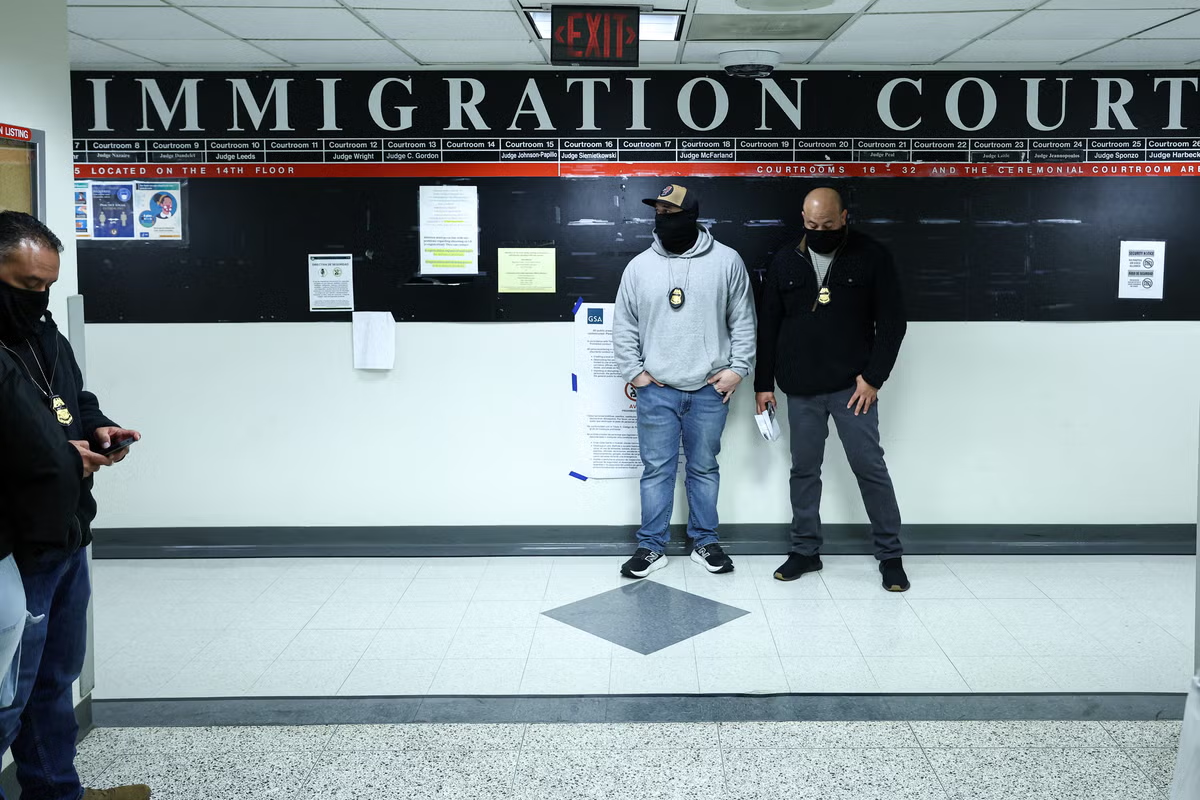
The multi-pronged attack on the asylum process includes a dramatic upheaval of the immigration court system. Dozens of judges who have been fired or forced out of their jobs, ICE agents have detained hundreds of people in courthouse hallways, and judges have been instructed to throw out bond applications and summarily dismiss immigrants’ cases, making them immediately vulnerable to arrest and removal from the country.
USCIS has also transformed into a powerful law enforcement arm for the president’s mass deportation efforts. The administrative agency is now working with the Department of Justice to strip citizenship from naturalized Americans and working on a policy change to force green card applicants to leave the country while they adjust their status.