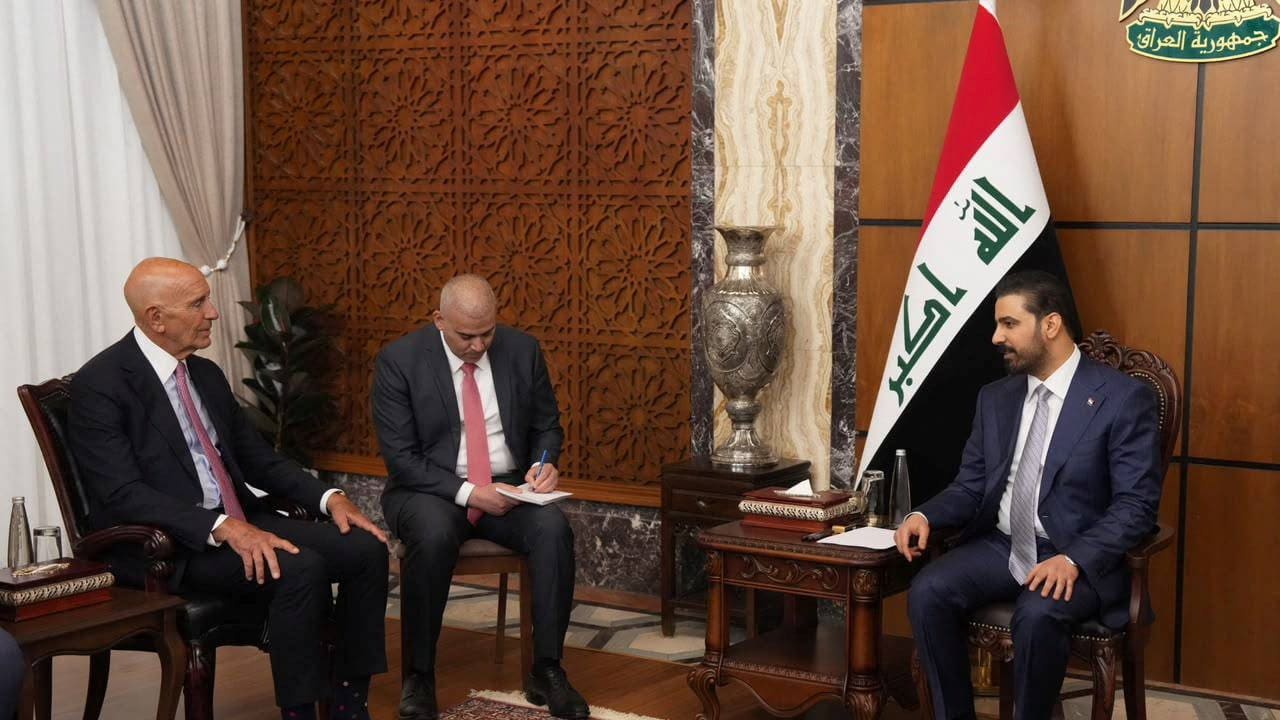
US Envoy to Iraq and Syria Tom Barrack arrived in Iraq this week for a series of important meetings. On June 15, Tom Barrack, who is also the US Ambassador to Turkey, wrote that he was “happy and honored to be back in Baghdad, meeting with our great US Embassy team led by Chargé d’Affaires Joshua Harris. Today I will meet with Prime Minister Al-Zaidi to convey President Trump’s support for his government, and discuss our partnership on a new direction for a strong and mutually beneficial US-Iraq relationship.”
On June 15, he met with Iraq’s new Prime Minister Al-Zaidi. Zaidi is preparing for a trip to Washington next month. He is also being encouraged to rein in Iranian-backed militias. He met with Barrack in this context. Also, Barrack has unified the US envoy files on Syria and Iraq, making Barrack one of America’s most important diplomats in the region.
Iraq is going through a transition, and so is Syria. The US wants both countries to succeed and to be US partners. A decade ago, the countries were occupied by ISIS, and Syria was run by the pro-Iranian Assad regime. Iraq was also dominated by pro-Iranian Shi’ite parties, who had thrived under former prime minister Nouri al-Maliki. The Trump administration opposed Maliki seeking a new term this year. Zaidi is seen as having high potential within the White House.
Barrack reiterated the shared commitment of the United States Government, under President Trump’s leadership, and the Government of Iraq, under Prime Minister Al-Zaidi, to a strong and mutually beneficial US-Iraq partnership, able to fulfill Iraqi aspirations for a sovereign, secure, and prosperous future and to deliver tangible benefits for Americans and Iraqis alike. Special Presidential Envoy Barrack conveyed that President Trump looks forward to welcoming Prime Minister Al-Zaidi to the White House in mid-July to discuss the future of this important relationship,” the US Department of State said on June 15.
The report by the US State Department also added that “the leaders discussed the shared aspirational vision for the Iraqi government to build a brighter future free from terrorism, to implement Iraqi plans for ensuring the complete disarmament and disbandment of all armed groups and formations operating outside the authority and control of the Iraqi state, to ensure the confinement of their weapons within the authority of the Iraqi state, and to assert full sovereignty in order to keep Iraq away from conflict and ensure that Iraqi territory cannot be used by any side to threaten regional peace.” Barrack and Zaidi discussed the urgency of these efforts.
Iraq committed to close ties with the US
Iraq says that it is committed to trade and investment and close ties with the US in this respect. Barrack and Zaidi “commended the Iraqi decision to finalize the operating license for Starlink to offer worldclass internet services for Iraqi consumers; to launch negotiations with Chevron to develop the West Qurna-2 and Nasiriyah oil fields for the benefit of both sides; to enable US companies HKN, Western Zagros, and Hunt to resume operations with full security guarantees; and to advance a memorandum of understanding with TI Capital to rehabilitate the Kirkuk-Baniyas Pipeline as a vital oil export route.” Iraq and the US are also discussing Iraq’s electricity needs and the “Excelerate Energy’s project to develop an integrated LNG import terminal at Khor Zubair.”
Barrack has credited US President Donald Trump for the new endeavors in Iraq. He sees it as an “epic chapter” in Trump’s regional policy. Barrack also traveled to meet with Kurdish leaders of the Kurdistan autonomous region. The Kurdistan Regional Government is a key partner of the US, and the US has a large new consulate in Erbil, the capital of the KRG. In the Kurdistan region, Barrack met with KRG President Nechirvan Barzani and KRG Prime Minister Masrour Barzani, as well as Masoud Barzani. The Barzanis lead the KDP Kurdish party, the largest in the Kurdistan region.
The KDP dominates Erbil. Barrack also met with the leadership of the Kurdish PUK party, the second-largest party in the autonomous region. PUK dominates the Kurdish city and region of Sulimaniyeh near the Iranian border. Barrack met with PUK leaders Bafel Talibani and Qubad Talibani. The Talibani and Barzani families and large clans and tribes they are connected with have dominated Kurdish politics for generations in northern Iraq. They played a key role in the rebellions against the Saddam regime. They have had close ties to the US and other Western powers for many years. They also worked with the US and other members of the anti-ISIS coalition.
End of US anti-ISIS coalition
The US anti-ISIS coalition is expected to end its role in Iraq in September. It has already wrapped up its role in Syria. Iraq is expected to try to disarm some Iranian-backed militias in Iraq. The militias have been present in Iraq in greater numbers since 2003, after the US invasion. Some militias, such as Badr, have ties to the Iranian IRGC going back to the 1980s.
In the war on ISIS, the militias benefited from a fatwa by Iraqi Ayatollah Ali Sistani, a key Shi’ite cleric. In recent years, the militias have targeted US forces, attacked the Kurdistan Region, and attacked Syria and Israel, as well as targeting the Gulf states, and kidnapped a US journalist and a Princeton researcher. As such, the militias are a major threat to Iraq. The US hopes Zaidi will try to rein them in. Barrack’s visit is about showing how Iraq and the US can cooperate. Iraq should reduce the Iranian influence and get on track with the US.
Meanwhile, reports in Erbil say that “Pearl Petroleum has proposed a $10.2 billion capital investment plan spanning from 2026 to 2035 with aims of more than doubling its natural gas production in the Kurdistan Region,” Rudaw media reported on June 15. “According to the company’s latest report, the Kurdistan Gas Project’s 10-year expansion plan estimates an increase in production from 750 million to 1.65 billion cubic feet per day by scaling output at the strategic Khor Mor and Chamchamal fields in Sulaimani province.” This is very important. “The investment by Pearl Petroleum – a consortium led by Dana Gas and Crescent Petroleum – is expected to significantly boost domestic electricity supply, support thousands of local jobs, and unlock tens of billions of dollars in fiscal and environmental savings.” This is the kind of project that the US and others will support.