Authorities warned the death toll could rise as thousands of people remained unaccounted for following the 7.2- and 7.5-magnitude earthquakes, among the strongest to hit Venezuela in more than a century. The tremors were felt across neighbouring countries, with buildings evacuated as far away as Brazil’s Amazon region.
The coastal state of La Guaira, north of the capital Caracas, suffered some of the worst destruction. The region, home to Venezuela’s main international airport, was particularly hard hit, with damage to the airport further complicating relief efforts.
An earthquake of this magnitude in a country where infrastructure has not been modernized for decades and under an inept, corrupt dictatorship. the ’67 historic earthquake in Caracas was 6.8… Please pray for Venezuelans https://t.co/KMCewipoxC pic.twitter.com/gUxJJHfjwd
— Germania Rodriguez Poleo (@iamGermania) June 24, 2026
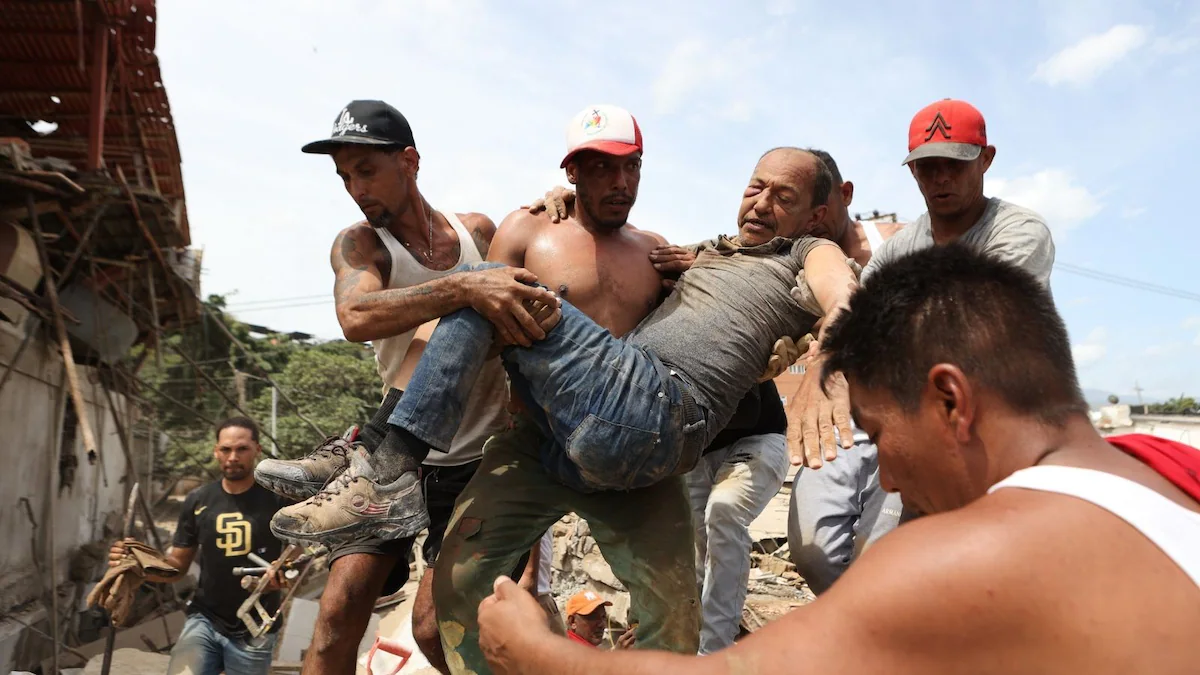
State television broadcast images of rescue operations as emergency crews pulled survivors from collapsed buildings. In several areas, however, residents said neighbours were carrying out much of the search effort themselves.
Dayana Delgado, whose eight-year-old son remained missing, questioned the absence of heavy machinery promised by the authorities.
“I want to know where my child is, if he’s trapped or in a shelter,” she said.
In another rescue effort in La Guaira, retired schoolteacher Juan Alberto Mendaño said he came across a woman trapped beneath the debris after hearing her call for help.
“May God rescue her as quickly as possible,” he said. “When we heard the scream, there was nothing we could do.”
Acting President Delcy Rodríguez, who declared La Guaira a disaster zone, said rescue teams from across Venezuela were being redirected to the affected areas, while international assistance was beginning to arrive.
“We hope to rescue as many living people as possible,” Rodríguez said, adding that the first rescue teams from the Dominican Republic were expected to arrive, with more international personnel due in the coming hours.
Se encuentran ya en camino hacia nuestro país los primeros rescatistas provenientes de República Dominicana, para apoyar las labores de atención al pueblo venezolano ante esta terrible tragedia. pic.twitter.com/1cXfa5LVfD
— Delcy Rodríguez (@delcyrodriguezv) June 25, 2026
Rodríguez also appealed to businesses to make heavy construction equipment available to support rescue operations.
The government declared a state of emergency late on Wednesday and announced a $200 million reconstruction fund to repair damaged homes and hospitals.
The United States Treasury on Thursday temporarily eased some sanctions on Venezuela until October 23, allowing transactions related to earthquake relief that would otherwise be restricted.
Several countries, including the United States, Brazil, Mexico, Spain, Portugal, Qatar and Canada, pledged assistance, with emergency personnel, search-and-rescue teams, medical supplies, aircraft, drones and water purification equipment being mobilised.
The United States Geological Survey (USGS) said the first earthquake, measuring magnitude 7.2, struck west of Morón on Venezuela’s Caribbean coast at a depth of about 22 kilometres. Around a minute later, a second magnitude 7.5 earthquake struck approximately 16 kilometres southwest of Morón at a depth of 10 kilometres.
According to Marcos Ferreira, a geophysicist with the Geological Survey of Brazil, the combination of two powerful, shallow earthquakes occurring in quick succession significantly amplified the destruction.
Large parts of Caracas experienced power and mobile network outages after the earthquakes, while metro services and natural gas supplies were suspended. Schools will remain closed for several days, with some educational institutions being converted into temporary shelters and aid distribution centres.
Families across the country continued searching for missing relatives, posting photographs and handwritten lists of names in affected neighbourhoods, while Venezuelans living overseas struggled to contact loved ones.
The earthquakes present another major challenge for Rodríguez’s administration as Venezuela continues to grapple with a prolonged economic crisis and political uncertainty following the capture of former president Nicolás Maduro earlier this year.