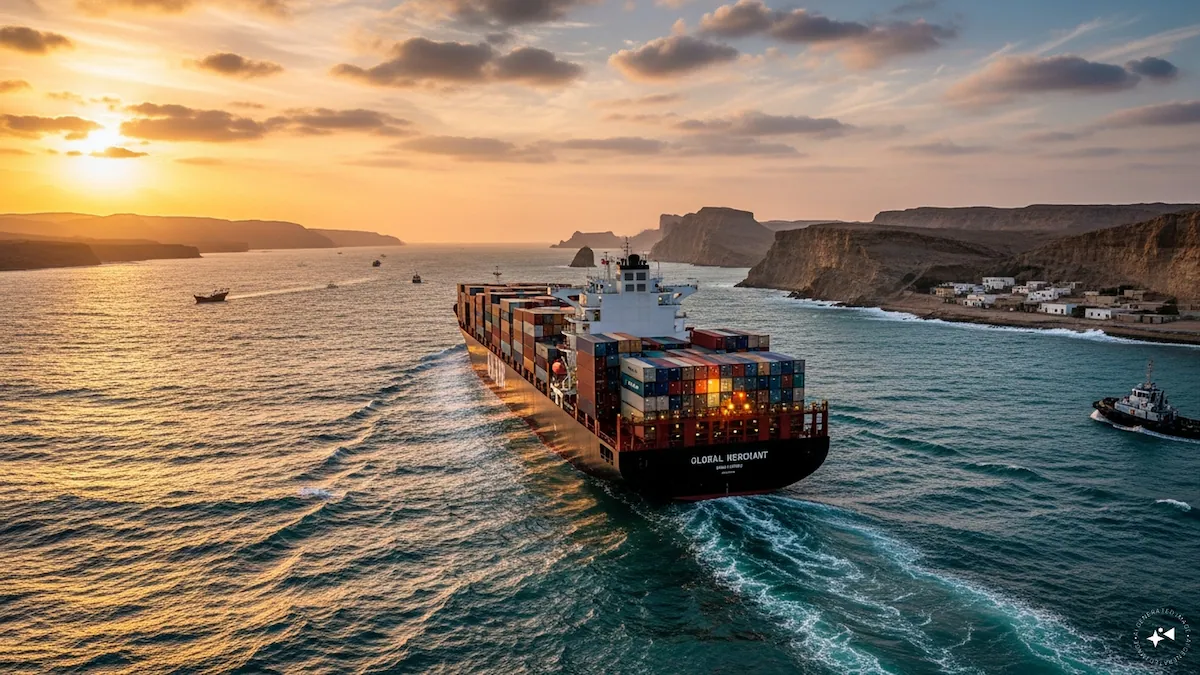
It was hit on its side and suffered damage to the bridge as it was sailing to the southeast of Oman, as per the UK Maritime Trade Operations (UKMT).
News agency Reuters reported, citing two US officials, that Iran had fired on the cargo ship as it attempted to pass they key waterway. However, news agency Bloomberg had reported, citing a US official source, that it was too early to determine who truck the ship.
The US was looking into which party was responsible for the strike, including whether it was an action ordered by high levels of the IRGC or a rogue decision by lower-level personnel. The official said there were no deaths or environmental damage, and that the ship was able to continue sailing, Bloomberg reported.
Iran’s Persian Gulf Strait Authority said Thursday that any transit happening in routes outside its framework would not be eligible for insurance coverage or be protected by “safe-passage guarantees.”
Vessels had been racing out of Hormuz since an interim peace deal between the US and Iran came into effect last week, quickly adding millions of barrels of supply. Gulf energy producers have begun ramping up production as flows through Hormuz appeared to be holding up.
Following the attack on Thursday, the International Maritime Organization, the UN’s global shipping regulator said it was pausing its evacuation operations in the strait.
“I have been informed of an attack today in the Gulf of Oman on a vessel which passed through the Strait of Hormuz,” IMO Secretary-General Arsenio Dominguez said in a statement. “This vessel did not transit under IMO’s evacuation framework. I have always reiterated that the safety of the seafarers remains paramount. Therefore, to ensure a coordinated approach and navigational safety, the evacuation plan will be paused until further clarity is obtained.”
The IMO on Tuesday said it had received safety guarantees that could allow hundreds of ships to exit the Persian Gulf through the strait. Still, even before the IMO plan was annouced, there were already signs that traffic through the crucial waterway was picking up.
Two key exit routes through Hormuz have emerged over the past several weeks because the normal one through the middle is thought to have been mined. One is near Iran, while the other hugs Oman’s coastline and is protected by the US.
A few hours earlier, at least three commercial vessels, including two oil supertankers, appeared to turn around while attempting to cross Hormuz outbound on the Oman side. Shipping intelligence company Windward Maritime said the u-turns came after Iran’s Revolutionary Guard Corps instructed vessels to turn around using radio calls and social media platforms.
Not all ships U-turned around the same time as those that turned back, according to tracking data compiled by Bloomberg. Some continued their exits. Iranian media also reported that Tehran was reasserting its control over transits.
Thursday’s tumult comes two days after the International Maritime Organization, the UN’s global shipping regulator, said it had received assurances that passage through Hormuz was safe. The IMO canceled a media briefing on Thursday minutes before it was due to start, due to unspecified urgent matters.
Traffic through Hormuz quickly picked up after an interim peace deal between the US and Iran took effect last week. However, there have been glitches, including when Iran said at the weekend that the waterway was shut. Tehran’s Persian Gulf Strait Authority said last week that no ships are allowed to transit Hormuz without its permission.
In addition to three outbound U-turns, a fourth ship appeared to turn around after sailing toward Hormuz from the Gulf of Oman, the vessel tracking data show.
With inputs from Bloomberg