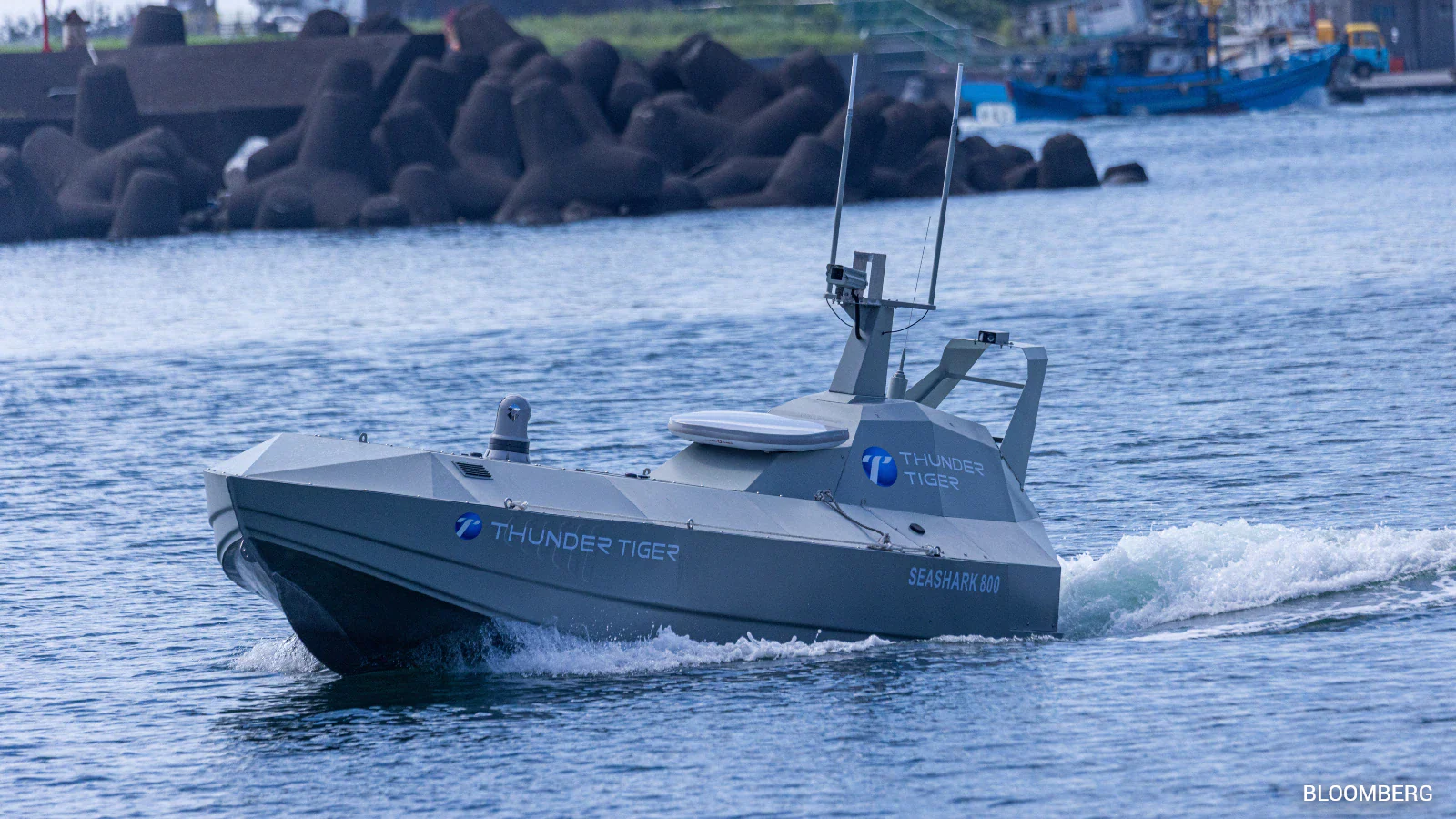
In grainy video footage, US special forces guide sea drones toward the hull of a large, unsuspecting ship. Seconds later, they detonate and the vessel sinks beneath the waves, leaving behind a rapidly dissipating cloud of smoke.
The attack against a decommissioned target ship unfolded as part of a recent exercise in the Philippines, unannounced but shown on video to Bloomberg News. It marked the first Indo-Pacific trial of Magura-class uncrewed surface vehicles, developed in Ukraine and used with deadly effect against the Russian Black Sea fleet.
Just as the wars in Ukraine and the Middle East have laid bare the value of cheap airborne drones, sea drones are seen as playing a crucial role in the Indo-Pacific region – an area 30 times larger than continental US and dominated by vast expanses of water.
Militaries from the US to China are now racing to develop and deploy such systems above and below the surface.
“They’re the kind of thing we need more of – distributed, survivable, relatively affordable systems that can help deny China the ability to use the seas around Taiwan and the First Island Chain,” said Thomas Shugart, a former US submarine captain and an adjunct senior fellow at the Center for a New American Security, referring to the archipelago that extends from Japan, through Taiwan and down into Southeast Asia.
To be sure, building and operating large fleets of sea drones poses challenges. Undersea vehicles in particular are more costly and complex than their surface counterparts, and because they operate submerged, are more difficult to communicate with.
But they can operate in high-risk areas and perform a wide range of tasks such as intelligence collection, mine-laying and even launching missiles, adding depth to a naval force and preserving crewed ships and submarines for an extended conflict.
“They allow navies to keep their most valuable crews and platforms out of the enemy’s kill zone,” said Rintaro Inoue, a defense expert at the Tokyo-based Institute of Geoeconomics.
The latest real-world example of those capabilities came in early June, when a 24-foot Corsair autonomous surface vehicle was used for the first time to rescue the crew of a US Army AH-64 Apache helicopter that crashed off the coast of Oman. A month earlier, Ukraine used Maguras to pummel Russian ships in Crimea.
Their relatively low cost – a few hundred thousand dollars each, much less than a modern US torpedo – offers a way for militaries with small budgets and limited manpower to punch above their weight.
In Taiwan, for instance, the US “Hellscape” concept for defending the self-ruled island relies on choking the strait between the chip hub and China with cheap anti-ship weapons. USVs like Maguras – essentially explosives-laden speedboats – will play a crucial role.
Taiwan is developing its own such weapon, the Kaui-Chi attack USV, as a key part of its defense strategy. The government plans to procure 1,320 such USVs that local reports said would cost NT$28 billion ($888 million).
In April, the head of the US Navy’s unmanned surface vessel squadron, Captain Garrett Miller, said he expected thousands of small USVs in the Indo-Pacific by 2030. Dozens of US companies already make such systems, including Anduril Industries Inc., Saildrone Inc., and Saronic Technologies Inc.
Japan has allocated around $600 million for coastal defense drones in the current fiscal year, and it has contracts with IHI Corp. and Mitsubishi Heavy Industries Ltd.
The US is also increasing its deployments of uncrewed systems to the Philippines, the country most under pressure from Chinese military activity in the South China Sea. On Tuesday, the US said it provided four underwater vehicles to the Filipino military.
“Within our region, the area where the strategic environment is most complex, where the strategic contest is greatest, is the maritime domain,” Australian Defense Minister Richard Marles said at the Shangri-La Dialogue defense and security meetings in May, after agreeing to jointly work on uncrewed underwater vehicles, or UUVs, with the US and UK.
But no country in the region is investing more in sea drones than China. At the nation’s Victory Day military parade last September, the People’s Liberation Army unveiled several large UUVs, including the HSU100, which can be used for intelligence gathering, and the AJX002, which has mining capabilities.
China already operates the 58-meter, 500-tonne Orca JARI-USV-A, equipped with phased array radars and an uncrewed helicopter for antisubmarine warfare and patrols. In April, China held its first test of a swarm of L30 USVs off the coast of Guangdong province.
So far, China’s use of maritime drones has been clearest as part of its strategy to try and control the South China Sea, said Benjamin Blandin, a research fellow at the Institute for National Defense and Security Research in Taipei.
“We had the land reclamation there, we had militarization, we had buoys and now we have drones,” he said.
A recent series of war games led by the Hudson Institute think-tank, based around a scenario in which China attacks Japan as part of a Taiwan invasion, highlighted the pivotal role of sea drones in a high-stakes conflict.
During the exercise, Japan used undersea drones to track and attack enemy ships and submarines. Surface drones carried out strikes and distracted the Chinese from striking larger naval vessels.
Their use alongside more traditional weapons such as missiles meant the Japanese military still had more than half of its navy and aircraft several weeks into the conflict despite China’s much larger force. That allowed time for US support to arrive, said Bryan Clark, who led the war games in conjunction with the Japanese Defense Ministry.
“Japanese military officers have the mindset that they need to get out there in front and they need to be the primary defenders of Japan – they should not delegate that to unmanned systems,” Clark said. “They wanted to put their destroyers and cruisers into the Sea of Japan.”
“After that didn’t work, they started to realize they’re just going to have to think about a different approach,” he added.
Japan’s Defense Ministry declined to comment on the war games but said that building an asymmetric defense posture combining “inexpensive, mass-produced” unmanned aerial and underwater drones “has become a more urgent priority than ever before.”
Japanese Defense Minister Shinjiro Koizumi told Bloomberg TV last week that drones were a critical military technology for Tokyo, particularly as it grapples with recruitment problems due to a shrinking population. Some of the sharpest manpower shortfalls are in the submarine fleet.
“I believe the Japanese Self-Defense Forces must become the world’s best military at utilizing unmanned assets, so we will firmly invest there,” he said.
No major power has expressed a willingness to deploy an uncrewed vessel that can locate and attack targets entirely on its own. Requiring underwater drones to communicate with a distant control station could give away their position.
Still, interest in the USVs is high, said Oleg Rogynskyy, the Ukrainian chief executive of Uforce, the London-based startup that produces the Magura USVs. He said his company is in discussions with countries around the Indo-Pacific about the vessels and is looking at building at least two manufacturing facilities in the region.
During the Ukraine conflict, Maguras have sunk about 10 Russian warships, which Rogynskyy said shows their value in the Indo-Pacific.
“Combat-proof is absolutely key to anything moving forward here,” he said.
(Except for the headline, this story has not been edited by NDTV staff and is published from a syndicated feed.)