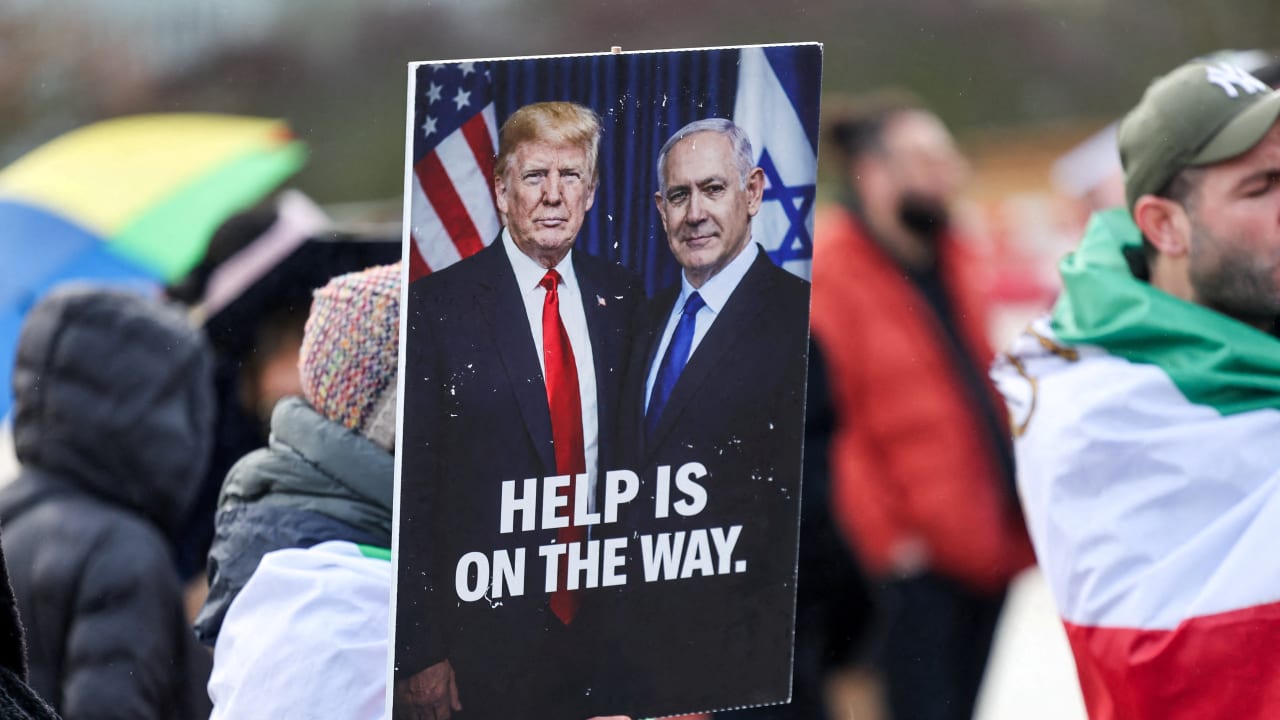
US President Donald Trump announced that as US-Iran peace deal has been confirmed in a post on Truth Social on Sunday.
“The deal with the Islamic Republic of Iran is now complete,” Trump stated, adding his “congratulations to all.”
“I hereby fully authorize the toll free opening of the Strait of Hormuz, and, simultaneously herewith, authorize the immediate removal of the United States Naval blockade,” Trump continued.
Trump told the New York Times in an interview after the agreement was announced that if Iran failed to reach a final agreement on nuclear issues, the US would restart attacks against Tehran.
There are five twists which will determine whether Trump’s nuclear deal will be seen in five months and five years as good or bad for Israel.
1. 60% enriched uranium AND 20% enriched uranium:
The framework deal signed on Sunday-Monday starts a 60 days negotiations period to resolve nuclear and sanctions issues. If the 60% enriched uranium is removed from Iran or diluted under US supervision, the last piece of Iran’s nuclear program which could have presented a danger in the next year or two will be gone (most of the near term danger was removed by the June 2025 war.)
If the 60% uranium is not dealt with, Iran will retain a nuclear threat which could be weaponized within one to two years. The heavy presumption is this will be properly dealt with because it is the only major item Trump is receiving in the deal and was a key reason he said he went to war in early 2026.
Keep an eye though also on the 20% enriched uranium. This is not as dangerous as the 60% and so has been in the news less. But getting from 3.67% to 5% to 20% is a significant achievement. Removing ot diluting this uranium is also critical to prevent Iran from ever having a running start toward a nuclear weapon.
Patience will be critical. It will probably take weeks or months even after the 60-day final deal will likely be signed in mid-August to get the 60% uranium as it is under huge volumes of rubble from when the facilities holding it were bombed by Israel and the uS in June 2025.
2. Uranium enrichment freeze:
It has been widely leaked that Iran will agree to a 15-20 year uranium enrichment freeze. However, Trump said overnight that he had agreed to some low level of enrichment for Iran.
Being that Trump is rarely strong or accurate at nailing down nuances, this is an important one. If he was saying that even after 15-20 years, Iran will still be limited to low level enrichment, then that is a big win.
If he is saying that Iran will get to enrich at a low level at some earlier date, then it depends what the level is and how many centrifuges would be spinning. One of the largest problems with the 2015 Obama Iran deal was that around 5,000 centrifuges kept spinning and another 15,000 or so were in storage and could be reactivated quickly.
The Jerusalem Post understands that all or nearly all of these were destroyed in June 2025. It is critical that Iran not be allowed to rebuild this fleet under the guise of being within some low level of enrichment. As long as it lacks this fleet, it cannot weaponize uranium.
3. Lebanon withdrawal:
Trump and Iran have raised an Israeli withdrawal from southern Lebanon. Israel does not need to remain in southern Lebanon and that was never part of the grand plan.
It does want to be able to use a full or partial withdrawal from southern Lebanon in order to achieve an end to Hezbollah’s presence in southern Lebanon, and possibly some level of broader disarmament, such as a commitment not to smuggle in new long range precision weapons.
There is also a possibility of maintaining the five small outposts which Israel maintained after the 2023-2024 war, as a small security strip to prevent future Hezbollah attempted invasions.
It would be wise for Israel not to withdraw from those outposts until there is a much more complete end to the Hezbollah threat, something which is not on the horizon. Withdrawals from Lebanon could also help achieve normalization with the Lebanese government to further isolate Hezbollah.
4. Return to MABAM:
If there is a new nuclear deal, it would be wise for Israel to hold its fire against Hezbollah certainly up until the 60% enriched uranium issue is dealt with.
However, once that issue is dealt with, if Hezbollah does try to rearm, especially with long range precision missiles, Israel should be clear that, even if covertly and without press releases, it will return to the MABAM (war between wars) where it carried out quiet and targeted airstrikes against weapons smuggling convoys in Lebanon and Syria.
Stopping minor attacks on minor Hezbollah rearming efforts is one thing. Stopping attacking strategic weapons smuggling should not happen, at least not once the uranium is removed or diluted.
5. Unwritten Israel threat on Iran ballistic missiles:
Israel cannot allow Iran to cross a line of volume in ballistic missiles which could overwhelm its missile shield.
While it is unclear whether that number is 4,000 or 6,000, and Israel has tolerated 3,000 such missiles, so it is not that low, Jerusalem must deliver a clear message to Tehran about this red line.
The Jewish state already has lived with Iran having a couple thousand missiles since the 1990s. But it cannot tolerate the possibility of an arsenal which becomes too large to defend against.