For Sara Cabral, faith was once a distant concept, much like for many young people across Southern Europe. Her upbringing in Spain’s Canary Islands was “Catholic but never practicing,” a common sentiment that held little personal relevance.
That changed three years ago when a song from a faith youth group resonated deeply, making her feel as if God were speaking directly to her. Now, Cabral, 26, is an active member, attending weekly adoration sessions and eagerly anticipating Pope Leo XIV’s Mass in Gran Canaria with her friends.
“You get a restlessness about an emptiness that you don’t know how to fill,” Cabral says of her embrace of Catholicism. “God is the one looking for you first, but you need to go meet him.”
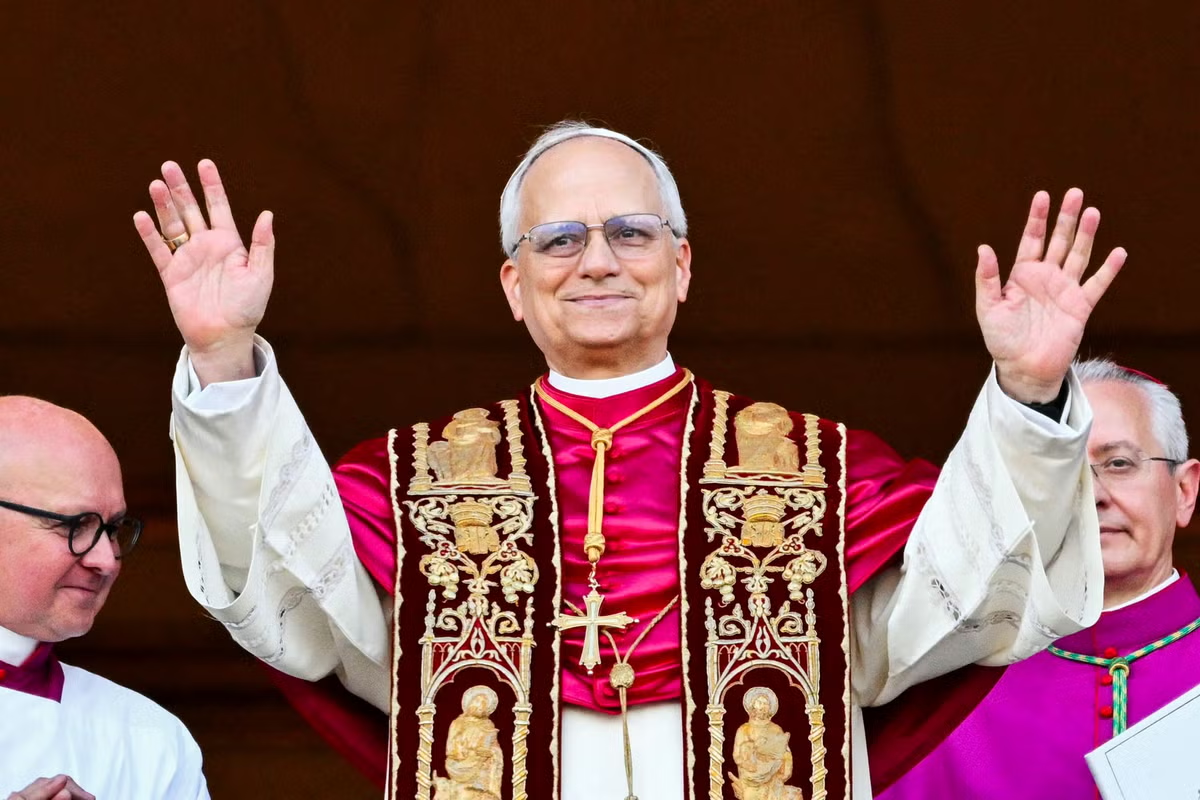
Pope Leo XIV will encounter thousands of young people like Cabral during his upcoming trips to Spain this month and France in September. These visits highlight a surprising trend in traditionally Catholic but increasingly secular nations, where historic churches stand abundant yet Mass attendance remains sparse.
Church leaders and some experts interpret the success of youth movements and a surge in adult baptisms as indicators of a burgeoning interest in the church among some young people. This renewed engagement also presents a challenge to the institution to embrace a more inclusive message. The Rev. Josetxo Vera, spokesperson for Spain’s Catholic Bishops Conference, notes, “They are drawing near with a look of surprise. It’s an excellent opportunity that bursts forth from heaven, not from the church.”
Vera has observed teenagers “scare” their atheist parents by requesting baptism after being drawn to Christian messages in popular culture, such as Catalan pop star Rosalía’s spirituality-infused album, Lux. This generation approaches faith in an environment vastly different from their parents and grandparents.
Spain, for instance, was ruled by dictator Gen. Francisco Franco until 1975, a period when the state was closely aligned with a deeply traditional Catholic Church. The country’s transition to democracy led to “a kind of divorce between popular piety and the church’s religious culture,” according to Mónica Cornejo Valle, a religion professor at Complutense University in Madrid.
Despite the continued popularity of religious processions and the ubiquitous presence of Catholic vestiges, the church faces significant challenges. Spain boasts nearly 23,000 active Catholic parishes, yet new priestly ordinations have not rebounded. A 2024 Pew Research Center survey revealed that while 80% of Spanish adults were raised Catholic, only 47% currently identify as such, with a mere 2% joining the faith from non-Catholic backgrounds. Furthermore, only about 16% of Spanish Catholics attend Mass at least weekly, despite it being an obligation for practitioners.
José María Marrero, one of Cabral’s friends in Gran Canaria, recalled attending Mass as a child, saying, “all you met were the old folks.” His wife, a teacher baptized in her early 20s, recounted how some of her students on a recent trip, upon seeing a picture of Jesus, asked, “Miss, that’s the Catholic one, right?”
In this landscape, scholars like Cornejo Valle caution that a perceived revival in religiosity might be a “publicity effect” fueled by savvy media use. However, youth movement and church leaders see opportunity in this “blank slate,” especially if they “transmit Jesus’ message with happiness, a message that’s easy to understand,” as Cabral puts it.
This approach is evident in Hakuna, the group Cabral belongs to, which boasts some 35,000 members. Founded in the early 2010s in a Madrid parish, it began with college students organizing weekly Eucharistic adoration, followed by a lecture and a social gathering at a local bar. The movement became an official lay organization of the Spanish church in 2017, expanding to include volunteer trips and concerts, with seven Christian music albums released. Maca Torres, Hakuna’s spokeswoman, attributes their success to “the Holy Spirit, we’re the first to be surprised,” noting that most members are former practitioners, though some are converts.
While infant baptism is traditional in Catholicism, Spain’s Catholic bishops conference reported over 13,300 baptisms of individuals older than seven in its latest annual report. In France, a country known for its strict secularism, some 13,000 adults were baptized at the Easter Vigil this year, with 42% aged 18 to 25.
This represents a tripling of such baptisms compared to a decade ago, according to the country’s Conference of Catholic Bishops. Last summer, Pope Leo XIV encouraged a gathering of baptism candidates and newly baptized individuals from France to share their faith experiences and let it guide their daily lives. “What a joy to see young people who are engaging with faith and want to give a sense to their life, by letting themselves by guided by Christ and his Gospel,” he told them.
Experts suggest the appeal for young people is twofold: a disillusionment with other institutions and the increasing loneliness of life lived on social media, coupled with a church that, under Pope Francis, has shifted its focus from doctrine to social justice. On June 6, the first day of his trip to Spain, Pope Leo XIV will hold a prayer vigil with youth in a vast Madrid public square. His itinerary also includes visits to a migrant center in the Canary Islands and a prison near Barcelona, outreach initiatives that tend to resonate with progressive youth.
Cornejo Valle observes, “We don’t think that the number of Catholic young people has grown by a lot, but we do see that in general the profile of the Catholic youth is more committed than before.”
María Salazar, 23, who leads a Barcelona outpost of the global Catholic youth movement Effetá, believes many of her peers are seeking different forms of spirituality, both within and outside the church.
“More than looking for faith, we look for a feeling of peace,” Salazar says. “We live in a microwave society — everything has to be immediate — but the Lord doesn’t work this way.”
Salazar notes a “boom of youth” in her parish, which happens to be the Sagrada Familia, Antoni Gaudí’s iconic unfinished masterpiece. Around 120 young people participate in adoration and weekend spiritual retreats, with organizers and the basilica’s rector once staying up past midnight to prepare the church. They also volunteer to assist the elderly attending Mass in the crypt and international tourists flocking to services in the grand temple above, where Pope Leo XIV will celebrate Mass on June 10 and inaugurate the new tower of Jesus Christ.
“We’re going to have him here at home,” Salazar exclaims. “I see the tower from afar and I see the home that God gave us.”