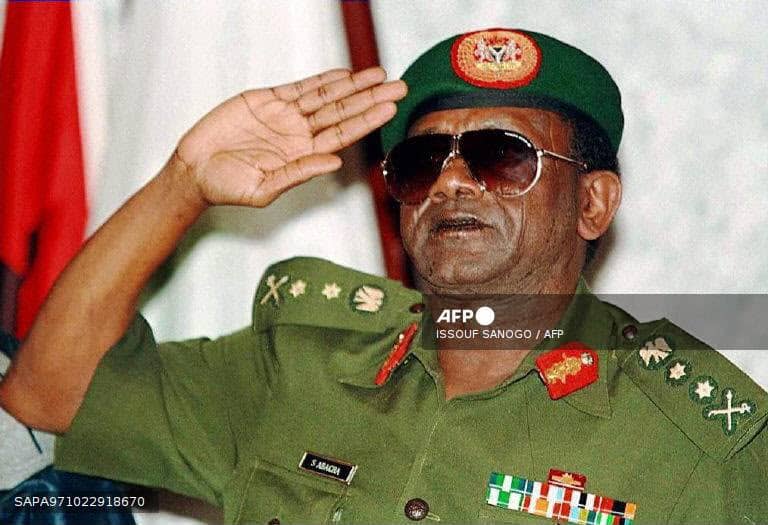
A former Assistant Director of the Department of State Services, Dennis Amachree, has claimed that Nigeria’s late Head of State, Gen. Sani Abacha, died from a cardiac arrest during an intimate encounter at the Presidential Villa in Abuja, dismissing years of conspiracy theories surrounding the military ruler’s death.
Amachree made the disclosure in his newly released memoir, DSS @40: My Journey Behind the Shield, where he recounted what he described as the events leading to Abacha’s death on June 8, 1998.
The retired intelligence officer, who served as Assistant Director of Operations and Intelligence at the Lagos command of the then State Security Service at the time, said his account was based on official investigations carried out shortly after the incident.
According to him, Abacha died around 4:05 a.m. after suffering what he described as a “coitus-induced cardiac arrest” while with a female pharmacist inside the Presidential Villa.
Amachree said the woman, who had accompanied her elder sister—described as Abacha’s girlfriend—to Aso Rock earlier that night, fled the villa after discovering the military ruler had become unresponsive.
He explained that the elder sister later returned to her hotel, leaving the pharmacist alone with Abacha.
The former DSS officer wrote that after noticing Abacha had stopped responding during the encounter, the woman checked for his pulse but found none.
In panic, she reportedly informed a soldier on duty that the Head of State had asked that she be driven back to her hotel.
“The soldier, unaware of what had happened, arranged transportation for her,” Amachree stated.
He added that the woman later left Abuja for Lagos aboard an early morning commercial flight before security operatives realised she was the last person seen with the late military leader.
According to Amachree, security agencies immediately launched efforts to locate her after Maj. Hamza Al-Mustapha, Abacha’s Chief Security Officer, was informed of the Head of State’s deteriorating condition around 5 a.m.
He said DSS operatives traced the woman to Lagos, where he personally interrogated her.
Recalling the interrogation, Amachree said the woman repeatedly insisted she had no involvement in Abacha’s death.
“The first thing she said was, ‘I did not kill him; he died on top of me,’” he quoted her as saying.
The retired intelligence officer argued that the woman’s statement and subsequent investigation disproved several narratives that had circulated over the years, including claims that Abacha was poisoned by foreign women or died after eating a poisoned apple.
He maintained that the findings of the security investigation established that the former military ruler died from cardiac arrest during the intimate encounter.
Abacha ruled Nigeria from November 1993 until his death in June 1998.
His sudden demise triggered widespread speculation, with numerous conflicting accounts emerging over the years regarding the circumstances surrounding his death.
His regime was widely criticised by local and international human rights groups over alleged widespread human rights violations, suppression of dissent and the imprisonment of pro-democracy activists, including the presumed winner of the June 12, 1993 presidential election, Chief Moshood Kashimawo Olawale Abiola.
Abiola died in government custody about a month after Abacha’s death while the country was undergoing political transition.