The Church of England’s General Synod debated a motion on Sunday encouraging engagement with a series of Palestinian Christian texts, including one that describes the State of Israel as “a colonial enterprise built on racism.”
The General Synod is the national assembly and legislative body of the Church of England. It is the only body alongside the UK Parliament empowered to pass national laws for England, and is responsible for setting church budgets and shaping doctrine.
On Sunday, it debated Motion GS 2451A, ‘Standing in solidarity for a just peace in Israel and Palestine’, brought by the Carlisle Diocesan.
This motion calls on the General Synod to respond “prayerfully, theologically, and practically to the ongoing trauma in Israel and Palestine, and to stand in solidarity with Palestinian Christians and all who seek a just and lasting peace.”
It calls for the Church to accept the Kairos Palestine Declaration (2009), the Cry for Hope (2020), the Call for Repentance (2023) and Kairos Palestine II (2025) as “heartfelt expressions of the lived experience of Palestinian Christians” and encourages the Church of England at all levels to engage with these documents.
The motion calls for engagement with the texts but “does not require agreement with every aspect.”
Church of England debates Palestinian Christian texts
It is the Kairos II document that has attracted the most controversy. The 14-page document, also titled ‘A Moment of Truth: Faith in a Time of Genocide,’ was drafted on 14 November 2025 by the Palestinian Christian Ecumenical Initiative.
Many figures, including several participants of the synod, decried the “inflammatory language” of Kairos II, which unequivocally defines Israel’s actions in Gaza as genocide, deems Israel a racist, colonial endeavor, and expresses deep opposition towards the Abraham Accords.
Section 1.3 is particularly controversial. Among other things, it refers to Israel’s military actions in Gaza as a “genocidal war [which] is the continuation of the Zionist project to seize all of Palestine, emptied of its Palestinian people.” It also denounces what it calls “decades of apartheid, settler colonialism, political repression […] Zionist racism and arrogant Jewish supremacy.”
Kairos II notably also downplays and justifies the October 7, 2023, saying “the Hamas attack of that day was itself born out of decades of injustice, oppression and displacement since the Nakba of 1948, and more than sixteen years of an immoral, suffocating blockade on Gaza.”
It proceeds to speak of “the right of a people under occupation to resist their occupier and oppressor.” This appears to contrast with the motion itself, which expresses solidarity with Palestinians engaged in “non-violent resistance to the ongoing occupation.”
Kairos II calls for global movements of resistance, advocacy, and popular pressure, including boycotts, divestment, and sanctions.
It also rejects Christian Zionism, which it deems to be “produced by the theology of racism, colonialism and ethnic supremacy.”
“Any genuine beginning must involve dismantling settler colonialism and the apartheid system built on Jewish supremacy as codified in Israel’s racist Nation-State Law,” it says.
Jewish leaders criticize Kairos II
Ahead of the Synod, the UK’s Chief Rabbi Ephraim Mirvis warned the Church against Kairos II.
“While it is important to recognize the suffering of Palestinian Christians, this document does so in a way which can only harm the cause of peace,” he said.
“It is truly shocking that a document which purports to speak in the name of truth contains so much falsehood, using extreme rhetoric to challenge the very concept of a Jewish state, and to oppose existing peace agreements in the region.”
Mirvis said that Kairos II risks undermining decades of careful Jewish-Christian relationship-building.
A spokesman for the Board of Deputies of British Jews said: “Any Church that wants a credible role in tackling prejudice here or advocating for peace in the Middle East should reject Kairos II.”
Synod vote delayed until November
The Synod ran out of time before the motion could be put to a vote. It will return to the agenda at the next Synod in November.
The debate itself, however, showcased multiple conflicting perspectives.
Clergy Stewart Fyfe of Carlisle (who brought the motion) encouraged the Synod to listen to the voices of Palestinian Christians.
“This is what the Palestinian church is saying to us,” he said.
“Kairos does not just describe their suffering. It describes their imminent extinction from the land of the savior, a land where they have kept a consistent witness since the day of Pentecost,” he said, adding that “if the language is challenging, it is because it comes from a place of deep trauma.”
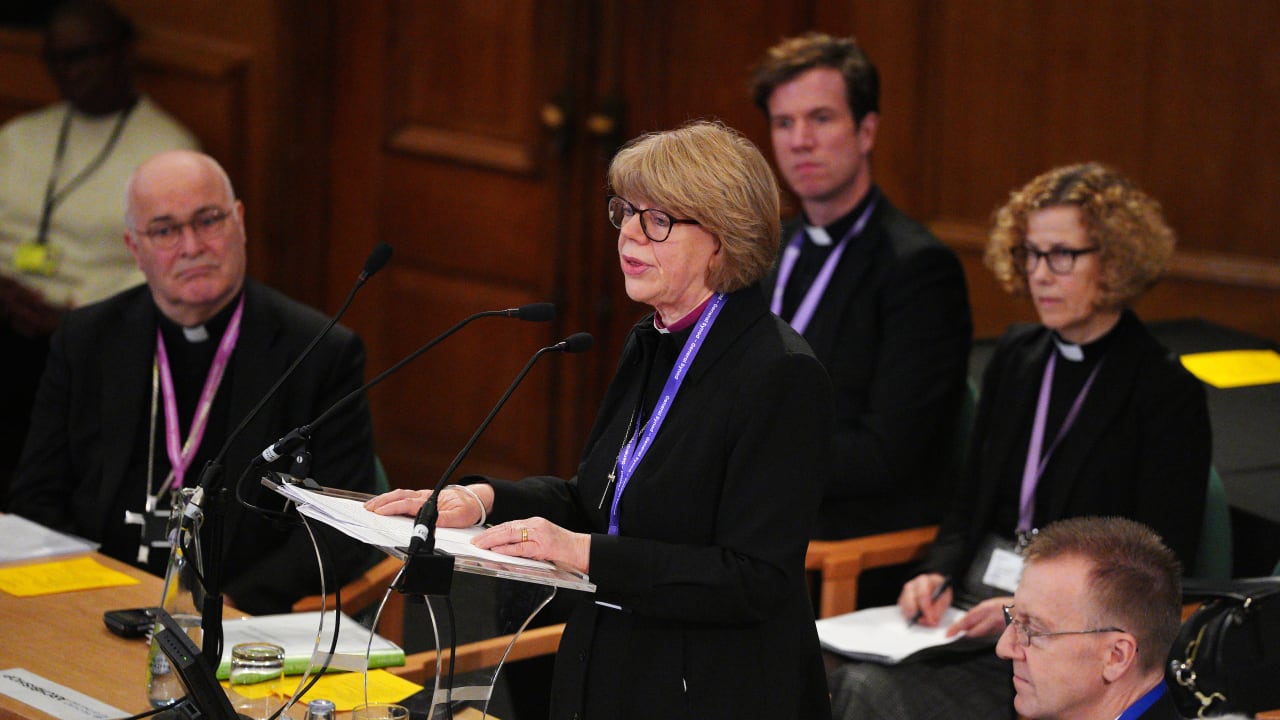
The Archbishop of Canterbury, who just returned from a trip to the Holy Land, said: “Palestine, which the British government recognized last year, is disappearing.”
“To hear the heartfelt expression of the lived experience of Palestinian Christians does not mean we agree with everything in these documents,” she said.
She called for the acknowledgment of both peoples in light of the “gravely serious” situation, and also warned that “in light of rising antisemitism, we must be vigilant about the long and terrible history of Christian antisemitism.”
Synod members voice opposing views
Other clergymen however expressed vehement opposition towards the motion, and the Kairos II document.
Laity Jacob Vince said that calling the state of Israel from its founding a ‘racist enterprise’ directly goes against the International Holocaust Remembrance Alliance definition of antisemitism, which the Church of England adopted in full in 2018. The document also calls to “boycott dialogue with Zionist voices,” which Vince said, “read plainly, is the vast majority of Jews worldwide.”
He also noted that the Open Doors’ World Watch List ranking of the 50 countries where Christians face the most extreme persecution does not include Israel or the Palestinian territories.
Clergy Ian Paul asked, “How can we claim as a church to stand against antisemitism when we have tabled before us a document which says ‘we consider Israel a colonial enterprise based on racism?”
“How can we avoid the charge of anti-Israel bias when we single out for censure the one democracy in the Middle East, the only place it is safe to be gay. We have never once debated the oppression of gay people in Palestinian territories, or women in the Arab world.”
Clergy David Bruce Bryant-Scott warned the Synod that the motion would be “heard as antisemitic by the world” and said the “language is incorrect and inflammatory.”