Governor Seyi Makinde links the May 15 abduction of pupils and teachers to his 2027 presidential bid, as security experts question intelligence failures and warn against turning children into pawns in power struggles.
By Onibiyo Segun
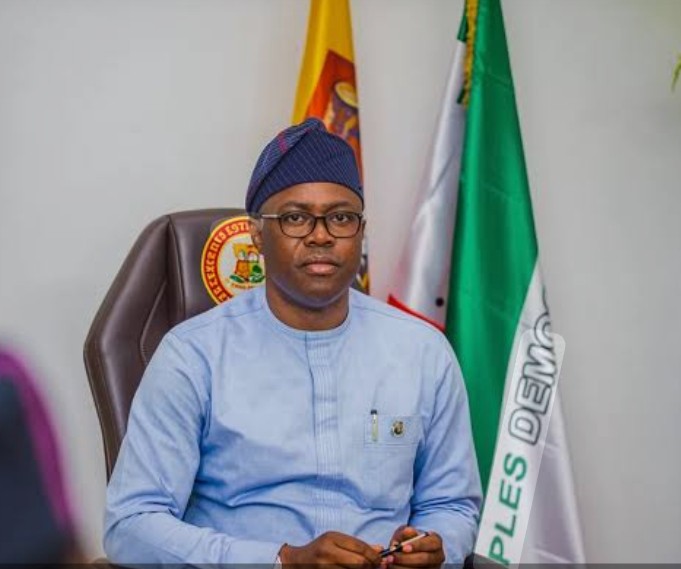
Ibadan, Oyo state — Governor Seyi Makinde of Oyo State has called for an independent international inquest into the kidnapping of pupils and teachers from schools in Oriire Local Government Area and the gruesome murder of two teachers, sparking a national crisis of trust in the integrity of the ruling party.
The Governor on Friday linked the timing of the Oyo kidnapping of May 15 to the announcement of his presidential ambition just hours earlier on May 14.
After a grueling captivity in the bush for 56 days the 46 children were rescued on July 10, according to media reports. Circumstances of the rescue are disputed.
Makinde said he declared his presidential ambition at about 4 p.m., and by 9 a.m. the following morning, armed men attacked three schools in Oriire Local Government Area and abducted pupils and teachers.
“For seven years, we didn’t witness anything like this in Oyo State. I declared to run for the presidency at four o’clock, and by 9 a.m. the following morning, the children were abducted,” Makinde said, according to Broadscope Network.
Makinde made the statement on Friday, July 10, during a meeting with Bauchi State Governor Bala Mohammed and leaders of the Allied Peoples Movement (APM) in Bauchi.
The governor declared his 2027 presidential ambition on May 14 during a PDP and APM gathering in Ibadan, where he promised to “reset Nigeria.”
Makinde’s comments have intensified debate over the timing of the attack, but there is no verified evidence linking the kidnapping to political actors or his presidential ambition.
Security And Political Questions Surround Oyo Kidnap Crisis
Major Fajola Ojomo, a retired military officer based in Ogun State, said he suspects the Oyo kidnapping may have had a political dimension because of its timing, although such a claim cannot be proven without evidence.
“I suspect the kidnap may be political. It is difficult to ignore the fact that a state that had not witnessed an attack of this magnitude was targeted shortly after the governor declared his intention to contest the 2027 presidential election,” Ojomo said in an interview with TruthNigeria.
“It is possible that some people wanted to send a message or slow down his political ambition. Politicians use different strategies to outmaneuver one another. But the question remains: why should innocent children, teachers and women become victims of political conflicts? That an innocent teacher was killed makes the situation even more disturbing,” Ojomo said.
Ojomo said the 56 days the victims spent in captivity exposed serious questions about intelligence gathering, operational response and the ability of security agencies to track criminal networks.
“The security agencies must explain what information they had about the attackers, what actions were taken after the abduction and why the criminals remained unidentified for such a long period,” Ojomo said.
Obi-Kwankwaso Alliance Faces 2027 Test
The Oyo crisis has also entered Nigeria’s 2027 political debate, including discussions about a possible alliance between Peter Obi and Rabiu Musa Kwankwaso.
Such a partnership could combine Obi’s support among young voters and urban professionals with Kwankwaso’s political structure and influence in parts of northern Nigeria.
Political analyst and social commentator Dr. Ukah Patrick, based in Lagos, said the alliance must move beyond personalities and build a nationwide political structure.
“An alliance cannot be built only around two popular politicians. It must answer questions of leadership, party structure, regional balance and how it will govern Nigeria’s different interests,” Ukah said.
Ukah said Obi’s challenge is converting public support into a political organisation, while Kwankwaso must expand his influence beyond traditional strongholds.
“The 2027 election will not be won by public excitement alone; it will be won through organisation, alliances and the ability to reach voters across all regions,” Ukah said.
Obi Takes Security Debate To Washington
The Oyo crisis became another issue in Peter Obi’s criticism of the Federal Government’s handling of insecurity.
Obi said Governor Makinde told him that he had not received contact from President Bola Tinubu after the abduction, while renewing calls for accountability over the government’s response, Premium Times reported.
Obi’s Washington, D.C., engagements placed Nigeria’s security challenges before diaspora communities and international observers as he promoted his governance message ahead of the 2027 election.
Obi said a government led by him would combine security operations with dialogue to address national tensions, Vanguard reported.
56-Day Captivity Raises Rescue Questions
President Bola Tinubu condemned the reported killing of an abducted teacher in Oyo State, describing the incident as “barbaric” and assuring that security agencies were working to rescue the victims.
The Presidency had said the Federal Government was collaborating with the Oyo State Government and security agencies to secure the release of the kidnapped pupils and teachers and bring the perpetrators to justice.
Major Fajola Ojomo said the government’s response must be judged against the 56 days victims spent in captivity.
“Condemning the attack is not enough. The real questions are: what intelligence was available, what actions were taken after the abduction and why were these criminals allowed to keep innocent children and teachers for 56 days?” Ojomo said.
Ojomo said rescuing victims after prolonged captivity should not end the investigation into failures that allowed the kidnappers to operate.
“The focus should not only be on celebrating the rescue. We must investigate the gaps that gave criminals enough time and space to hold citizens hostage,” Ojomo said.
Nigeria’s Security Crisis Draws Western Attention
Nigeria’s expanding insecurity has attracted international attention because attacks by terrorist and criminal networks affect regional stability, counterterrorism cooperation and economic confidence in West Africa.
The United States has continued security engagement with Nigeria through intelligence cooperation and counterterrorism coordination.
Nigeria’s National Security Adviser Nuhu Ribadu also held discussions with U.S. officials on strengthening cooperation on security, counterterrorism and regional stability, the State House reported.
Nigeria’s Defence Ministry has called for stronger international cooperation against evolving terrorism threats, warning that violent networks increasingly operate through cross-border connections and illicit financing.
Oyo Crisis Becomes 2027 Security Test
The Oyo kidnapping has become more than a criminal incident.
It now sits at the intersection of security failures, government accountability and political competition ahead of Nigeria’s 2027 election.
For affected families, the political debate remains secondary.
Their demand is immediate: identify the attackers, strengthen protection for communities and ensure another school or family does not experience the same fear.
Onibiyo Segun reports on terrorism and conflict for TruthNigeria.