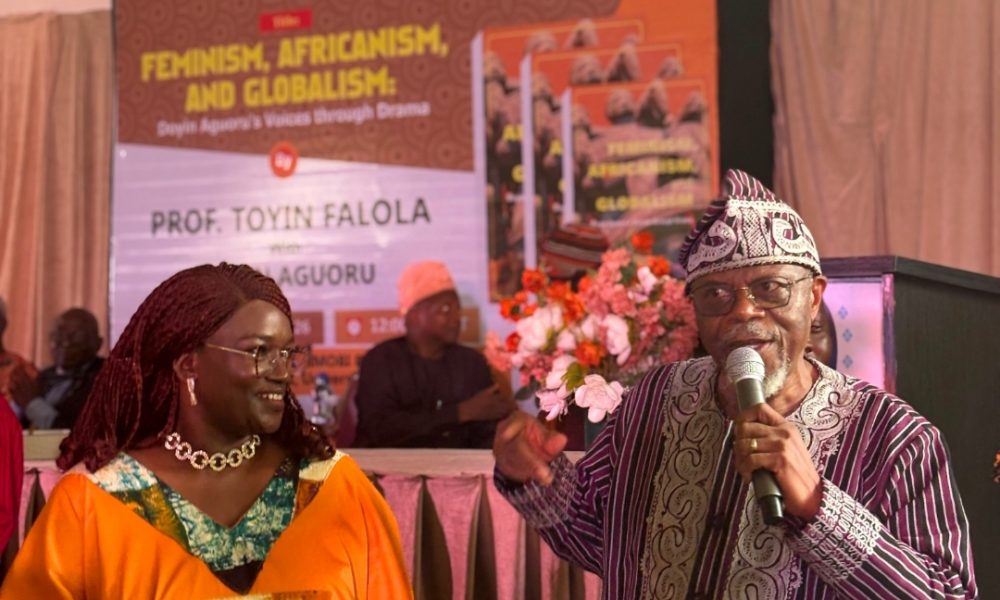
Globally acclaimed scholar, Professor Toyin Falola, has challenged Nigerian universities to move beyond the culture of excessive reverence for hierarchy and embrace an academic tradition that rewards originality, merit, innovation and intellectual excellence irrespective of age or rank.
Falola made the call on Wednesday during the presentation of his latest book, Feminism, Africanism, and Globalism: Doyin Aguoru’s Voices through Drama, held at the Senator Abiola Ajimobi Resource Centre, University of Ibadan.
The book, which offers a sustained critical examination of the scholarship and dramatic writings of Professor Doyin Aguoru, was formally unveiled before an audience comprising eminent traditional rulers, university administrators, scholars, literary critics, students and members of the public.
Speaking with journalists shortly after the presentation, Professor Falola explained that the publication was conceived not merely as a celebration of one scholar but as an intervention in the intellectual culture of Nigerian universities.
According to Professor Falola, “I believe that scholarship must not become a hierarchy of silence in which established academics receive endless recognition while younger intellectuals are expected to wait indefinitely for validation. The greatness of a senior scholar should not be measured only by the number of books written, honours received, or students supervised, but also by the capacity to identify emerging excellence, nurture it, and bring it to wider attention. Academic maturity should produce generosity rather than insecurity.
“Falola lamented that age and academic rank have increasingly become the principal basis for intellectual recognition within Nigerian universities, often at the expense of originality and transformative scholarship.”
In much of Nigerian academia, age and rank are frequently treated as the primary sources of intellectual authority. Younger scholars may produce original, rigorous, and transformative work, yet their contributions are sometimes ignored until they have accumulated titles, offices, or international recognition. I consider this unfortunate. Knowledge does not always announce itself through seniority,” he said.
Explaining why he chose to devote an entire scholarly monograph to Professor Aguoru, Falola described the decision as both an intellectual and ethical responsibility.
According to him, Aguoru’s scholarship demonstrates remarkable coherence and originality by bringing together feminism, Africanism, performance, identity, social justice and global perspectives into a unified body of work deserving serious scholarly attention. “My decision to write a book on the scholarship of a younger colleague was therefore both intellectual and ethical. It was intellectual because I encountered a body of work that deserved sustained analysis rather than a passing compliment. The scholarship revealed coherence, originality, courage, and an ability to connect feminism, Africanism, performance, identity, social justice, and global concerns. Such contributions should not be reduced to ceremonial praise. They deserve critical engagement, documentation, interpretation, and circulation.”
The renowned historian further argued that academic recognition should not be postponed until retirement or death, insisting that scholars deserve meaningful recognition while they remain intellectually productive.
“It was also an ethical decision because scholars should be celebrated while they are alive, active, and still capable of extending their contributions. Too often, we wait until retirement, death, or institutional elevation before acknowledging the value of a colleague’s work. By then, celebration becomes retrospective and sometimes ritualistic,” he noted.
Falola also criticised what he termed the “culture of intellectual scarcity,” whereby some academics believe acknowledging another scholar diminishes their own accomplishments.
“Knowledge expands through acknowledgement, collaboration, criticism, and intergenerational exchange. A secure scholar does not fear the rise of another mind. On the contrary, one of the highest achievements of an established academic is to help create the conditions in which others can become visible, influential, and even greater.”
He equally called for a broader understanding of academic mentorship, insisting that mentoring extends far beyond supervising dissertations or writing recommendation letters.
“Mentorship should go beyond writing recommendation letters, supervising dissertations, or helping younger colleagues obtain appointments. It should include serious engagement with their ideas. To study a younger scholar’s work, identify its strengths and limitations, situate it within broader intellectual traditions, and present it to the world is a profound form of mentorship.”
Describing the book as a challenge to existing academic conventions, Falola maintained that it seeks to reshape how scholarly reputations are formed across Africa.”The book is therefore not merely about an individual. It is also an intervention in the politics of Nigerian and African academia. It asks us to reconsider how reputations are formed, whose work is canonised, and why recognition is often delayed. It challenges the excessive reverence for seniority and calls for a more open intellectual culture based on merit, originality, discipline, and social relevance.”He concluded by urging senior academics to become builders of future generations rather than custodians of recognition.”I did not step out of the crowd merely to be different. I did so because established conventions sometimes need to be disrupted. If African academia is to grow, senior scholars must not stand at the gate of recognition; they must open it. We must transform intellectual authority into intellectual responsibility.
The true legacy of a scholar is not only the knowledge one produces, but also the voices one helps the world to hear.”In her response, Professor Doyin Aguoru described the publication as one of the defining moments of her academic career, saying Professor Falola had demonstrated an uncommon model of scholarly generosity and mentorship.”I receive this honour with profound humility and gratitude. Professor Toyin Falola has shown that scholarship is not a competition for prominence but a shared commitment to advancing knowledge across generations. By engaging critically with my work and presenting it to the wider scholarly community, he has demonstrated that true mentorship is measured by the willingness to invest intellectually in others.”
She added that the recognition would inspire her to continue producing scholarship that contributes to African literary studies while mentoring younger academics, especially women, to pursue excellence, intellectual courage and impactful research.