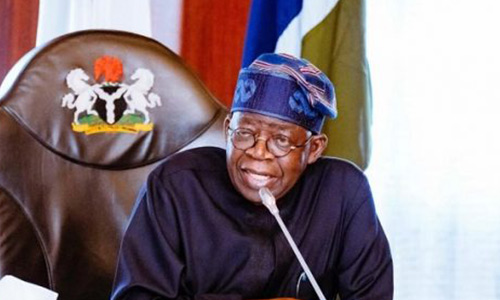
The Federal Government has renamed the Lagos-Calabar Coastal Highway as the President Bola Ahmed Tinubu Coastal Highway in recognition of what it described as President Bola Tinubu’s long-standing vision for the project.
Minister of Works, David Umahi, announced the decision during a media briefing in Abuja, saying it was reached after consultations with the ministry’s permanent secretary, minister of state, directors and other officials.
“That highway is named President Bola Ahmed Tinubu Coastal Highway,” Umahi said.
“By the powers conferred on me as Minister of Works, in consultation with my Permanent Secretary, the Minister of State, directors and staff of the ministry, we decided to name it after him because of his dream for it.”
Umahi said Tinubu conceived the coastal highway project approximately 27 years ago while serving as governor of Lagos State.
“He had that dream about 27 years back as governor of Lagos State. It is one thing to dream and another thing to have the grace of God to actualise that dream,” the minister stated.
The minister said work was progressing on several sections of the 750-kilometre coastal highway, which is expected to connect Lagos to Calabar through coastal states.
According to him, Section One stretches 47.47 kilometres from Victoria Island to Eleko Village in Lagos and consists of two carriageways separated by a 25-metre median reserved for a future railway line.
Umahi described the section as a model of modern highway construction, noting that its design includes nine mega bridges and flyovers intended to withstand the heavy industrial traffic around the Dangote Refinery and Lekki Deep Seaport corridor.
He said Section Two, running from Eleko Village to the Lagos-Ogun boundary, had reached about 60 per cent completion and could be substantially completed by the end of November, although work on some complex bridges might continue beyond that date.
The minister added that the 75-kilometre section beginning from Calabar was about 30 per cent complete, while the 82-kilometre Ogun-Ondo section had reached approximately 20 per cent completion.
He said work was also progressing on the 180-kilometre section in Akwa Ibom State despite the reported non-release of mobilisation funds.
Umahi also disclosed that Tinubu approved an additional 400 kilometres for the Fourth Legacy Highway, increasing its projected length from about 700 kilometres to approximately 1,100 kilometres.
The highway was originally designed as a dual carriageway linking Akwanga in Nasarawa State to Maiduguri in Borno State through Plateau, Bauchi, Gombe and Biu.
The newly approved extension will take the corridor into Taraba State and strengthen connections between the North-Central and North-East geopolitical zones.
“The greatest story is that yesterday President Bola Tinubu approved the addition of 400 kilometres to our Fourth Legacy Road. That is unprecedented,” Umahi said.
He explained that the extended route would pass through several communities in Plateau State before proceeding into Taraba.
The minister further announced presidential approval for the reconstruction of the Lagos-Ibadan Expressway using reinforced concrete pavement.
Umahi said sections of the road had begun deteriorating less than five years after rehabilitation by two major construction companies.
According to him, repeated repairs to the asphalt pavement had failed to provide a lasting solution, necessitating the proposed concrete reconstruction.
“It is 135 kilometres by two carriageways. That project is not up to five years old, yet it has already started failing,” he said.
“They repaired it, and it still failed. The answer is to reconstruct it using reinforced concrete pavement that will last between 50 and 100 years, maintenance-free.”
Umahi said the proposed reconstruction justified the ministry’s campaign for reinforced concrete on strategic federal highways because of its expected durability and lower maintenance requirements.
Tinubu also approved the dualisation of an additional 400 kilometres of road described by the minister as part of the East-West corridor, running from Lokoja towards Benin.
Umahi said the intervention would improve safety, facilitate trade and reduce travelling time along the corridor.
The President equally approved the review and completion of the abandoned Ibi Bridge in Taraba State.
The bridge contract was awarded in 2018 and had reportedly reached about 40 per cent completion before work stopped.
Umahi said the government would now review the project and complete the remaining construction.
The President also approved the design, procurement and award of the proposed 5.76-kilometre Lau Bridge across the Benue River in Taraba State.
The minister said the approvals formed part of the administration’s efforts to improve regional connectivity, stimulate trade and economic activities, reduce travel time and modernise Nigeria’s transport infrastructure.