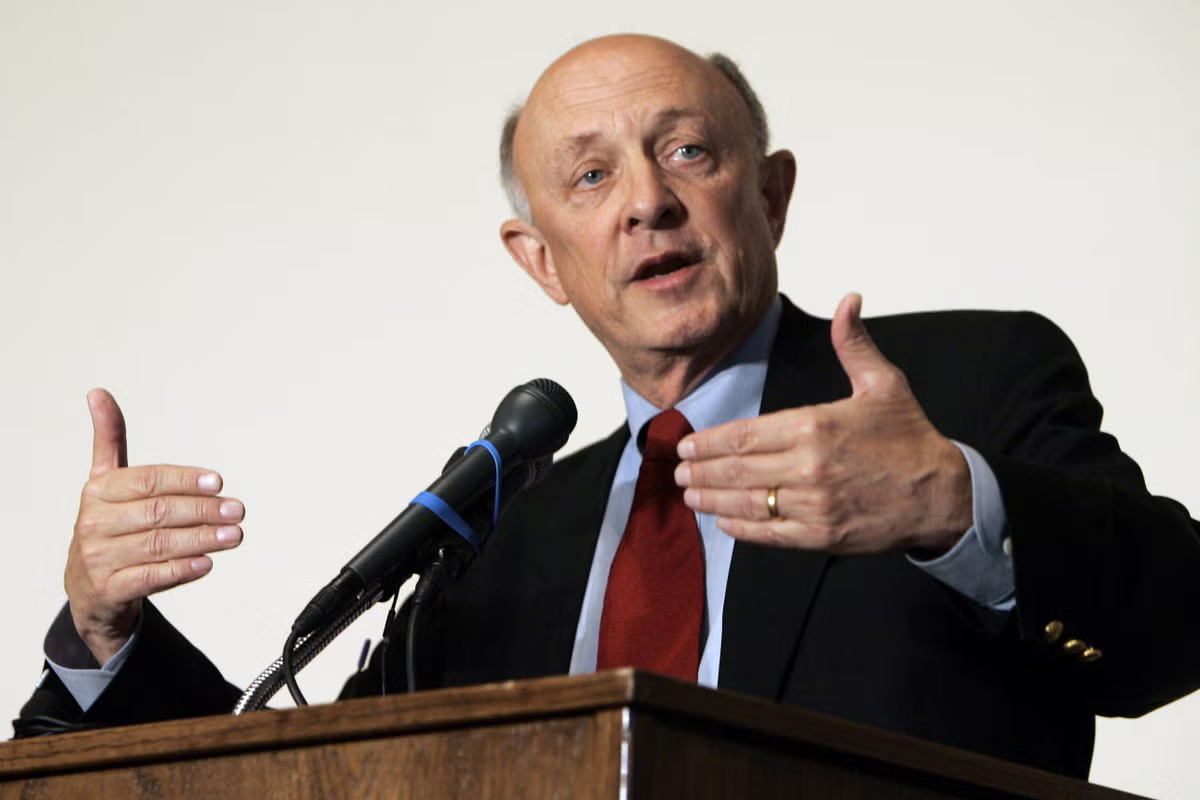
James Woolsey, the former CIA director who steered America’s top intelligence agency through the uneasy years after the Cold War and defended it during one of its biggest espionage scandals, has died at 84.
Woolsey died Tuesday at his home in Washington after suffering a stroke, his wife, Conchita Sarnoff Woolsey, said.
She also told The Washington Post that his health had deteriorated in recent years because of what she described as Havana syndrome, the mysterious illness reported by some U.S. diplomats, intelligence officers and other government personnel.
The condition, first reported in Cuba in 2016, has been linked to symptoms including headaches, dizziness, balance problems, memory issues and sleep disorders.
Woolsey served as CIA director from 1993 to 1995 during President Bill Clinton’s first term, a turbulent period that included the stunning exposure of Aldrich Ames, the veteran CIA officer who admitted spying for Moscow for nearly a decade.
Ames confessed to accepting $2.5 million from Soviet and Russian intelligence in exchange for some of America’s most closely guarded secrets before his arrest in 1994. His betrayal led to the exposure of numerous Western intelligence assets.
The scandal sparked fierce criticism of the CIA and questions over whether senior officials had ignored warning signs. Woolsey defended the agency, arguing that no intelligence service could completely protect itself from an insider determined to betray it.
He also warned against allowing the scandal to trigger an atmosphere of paranoia that could damage morale and fuel false accusations.
His time leading the CIA also coincided with the collapse of the Soviet Union, as lawmakers pushed for deep cuts to intelligence spending in what many believed was a safer post-Cold War world.
Long before taking over the CIA, Woolsey built a career at the highest levels of U.S. national security. He served as undersecretary of the Navy during the Carter administration and advised both Republican and Democratic presidents on arms control and defense policy.
In 1989, President George H.W. Bush selected him to lead negotiations between NATO and the Soviet-led Warsaw Pact over reducing troops and conventional weapons in Europe.
The talks culminated in the landmark Conventional Armed Forces in Europe Treaty, signed in 1990 by Bush and Soviet leader Mikhail Gorbachev.
Born in Tulsa, Oklahoma, on Sept. 21, 1941, Woolsey graduated from Stanford University, became a Rhodes Scholar and earned a law degree from Yale University.
He began his government career on the National Security Council in 1970 before serving as general counsel to the Senate Armed Services Committee and later practicing law in Washington between periods of public service.