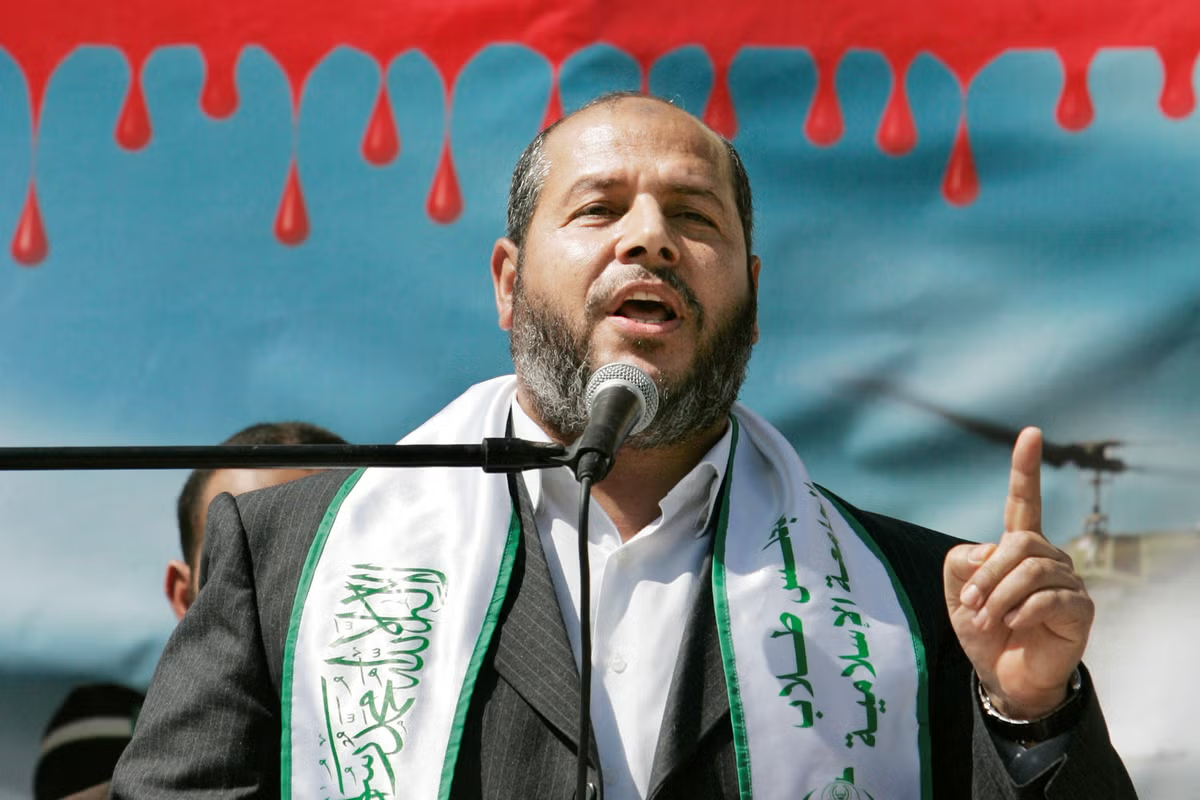
Hamas has named Khalil Al-Hayya as its new leader.
The Palestinian militant group announced the news in a statement on Monday.
Mr Hayya replaces Yahya Sinwar, who was killed in combat with Israeli forces in 2024.
Mr Hayya is Hamas’s top negotiator and is based in Doha. He has become an increasingly central figure in the leadership of the group since the deaths of Mr Sinwar and Ismail Haniyeh, who was killed in Iran in July 2024.
He was among top officials targeted in an Israeli attack in Doha in 2025, Israeli officials said.
Mr Hayya was at the heart of ceasefire talks throughout the war, which erupted when Hamas launched a surprise attack on Israel on 7 October 2023. That prompted a sweeping Israeli offensive that has flattened much of the enclave since then.
He took part in indirect talks with Israel that culminated in a US-brokered ceasefire in October 2025 that halted major fighting in Gaza, although Israel has continued its attacks on Hamas and other militants who it says pose an imminent threat.
Hailing from the Gaza Strip, Mr Hayya is a veteran member of the Islamist group.
He is regarded as having good ties with Iran, which is a vital source of weapons and money for Hamas. He has long been closely involved in the group’s efforts to broker several truces with Israel, playing a key role in ending a 2014 conflict.
Mr Hayya has been part of Hamas since it was set up in 1987. In the early 1980s, he joined the Muslim Brotherhood, the Sunni Islamist movement from which Hamas emerged, along with Mr Haniyeh and Mr Sinwar, Hamas sources say.
In Gaza, he was detained several times by Israel.
In 2007, an Israeli airstrike hit his family home in Gaza City’s Shejaia quarter, killing several of his relatives. In 2008, his son Hamza was killed by an Israeli airstrike.
In the 2014 war between Hamas and Israel, the house of Mr Hayya’s eldest son Osama was bombed, killing him, his wife and three of their children.
A third son, Himam, was killed in the Israeli strike on Doha in 2025.
Mr Hayya left Gaza several years ago, serving as a Hamas point person for ties with the Arab and Islamic worlds and basing himself in Qatar. He accompanied Mr Haniyeh to Tehran for the visit in July during which Mr Haniyeh was assassinated.
He has been cited as saying the October 7 attacks had been meant as a limited operation by Hamas to capture “a number of soldiers” to swap for jailed Palestinians.
“But the Zionist army unit completely collapsed,” he said in comments published by the Hamas-linked Palestinian Information Center, referring to Israel’s military.
He has said that the attack succeeded in bringing the Palestinian issue back into international focus.
Hamas-led militants killed some 1,200 people and abducted 251 others in the attacks, according to Israeli tolls. More than 67,000 Palestinians have been killed in Israel’s offensive in Gaza since then, according to the Gaza health ministry.
Alongside leading Hamas delegations in mediated talks to try to secure a ceasefire, Mr Hayya has performed a range of other high-profile political work for the group.
In 2022, he led a Hamas team to Damascus to mend ties with former Syrian President Bashar al-Assad, broken a decade earlier when the movement endorsed the largely Sunni uprising against Assad, a member of the minority Alawite sect.
The breach had strained a regional alliance built by Iran to counter Israel and the United States.