The Deputy Director and Head of the Department of Voter Education, Publicity, Gender, and Civil Society at the Independent National Electoral Commission (INEC) in Lagos State, Taiwo Gbadegesin, has urged the political class to encourage voter turnout during elections by keeping the promises they make to the electorate.
Gbadegesin made this call during the Wole Soyinka Centre for Investigative Journalism’s 18th Wole Soyinka Annual Media Lecture.
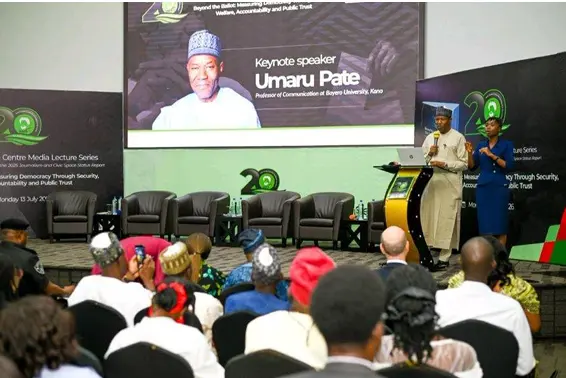
The event, on Monday in Lagos, was organised in honour of Professor Wole Soyinka with the theme: “Beyond the Ballot: Measuring Democracy Through Security, Welfare, Accountability, and Public Trust.”
Responding to questions about low voter turnout during elections and whether INEC was doing enough in terms of education and enlightenment, Gbadegesin insisted that INEC was doing its best to address the issue.
He seized the opportunity to explain that in the last few days, INEC officials have been visiting radio stations to educate voters.
He added that rather than placing all the blame for low voter turnout on INEC, the political class is also guilty.
He argued that if politicians continue to renege on the promises made to the electorate during campaigns, Nigerians may become apathetic and reluctant to turn out for elections.
He further noted that while INEC and the media have been carrying out their duties of educating voters, the bulk of the challenge lies with the political class, which must also contribute to enlightening the public.
The event featured the launch of the public review of the 2025 Journalism and Civic Space Status Report, titled: “Silenced Voices, Shrinking Space: Civic Freedoms Under Pressure.”
It brought together stakeholders from journalism, academia, government, law enforcement, election management, civil society, and development organisations to examine how democracy should be measured beyond periodic elections.
The day’s lecture challenged participants to rethink democratic governance through the lens of citizens’ lived experiences, institutional accountability, and public trust.
Declaring the lecture open, Professor Repo Sekoni, the immediate past Board Chair of WSCIJ, observed that there could hardly be a more fitting time to reflect on what happens before and beyond the ballot, noting that the conversation was both timely and necessary as Nigeria continues its democratic journey.
Delivering the keynote address, Professor Umaru Pate, Professor of Communication at Bayero University, Kano, challenged participants to rethink how democracy is measured.
Distinguishing between procedural and substantive democracy, Pate argued that while elections remain fundamental to democratic governance, citizens ultimately judge democracy by the quality of governance it delivers.
According to him: “Democracy must be assessed by its ability to improve citizens’ lives through security, economic opportunity, access to healthcare, education, accountability, and public trust.”
He also warned against the growing challenge of misinformation, observing: “Today, the problem is not the absence of information in our democracy, but the abundance of information, much of it inaccurate, and the scarcity of attention.”
The keynote address was followed by the Democracy Delivery Conversation, moderated by Deji Badmus, Founder and Editor-in-Chief of TV360 Nigeria.
The panel featured Professor Pate; Gbadegesin; Nabilah Usman, General Manager, Radio Now 95.3FM; Muftau Gbadegesin, public affairs commentator and sustainable development practitioner, who joined virtually; and DCP Anthony Placid, Deputy Commissioner of Police, Department of Finance and Administration, Force Headquarters.
The discussion examined the interconnected roles of government institutions, electoral management bodies, security agencies, the media, and citizens in strengthening democratic governance beyond election cycles.
Panellists emphasised the need for greater accountability, responsible information management, credible elections, and sustained public engagement.
Pate emphasised that strengthening democracy begins at the community level, noting that rebuilding community spirit provides the foundation for stronger engagement at the state and national levels.
Placid acknowledged the trust deficit among Nigerians but noted that law enforcement agencies were exonerated following the last general elections.
He stated that addressing this challenge requires the public to partner with security agencies.