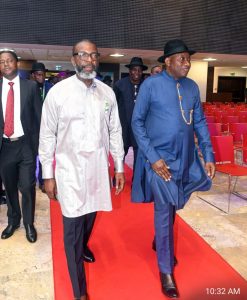
Jonathan spoke on Monday at the Nigerian Content Tower (NCT) in Yenagoa, Bayelsa State, during the SweetCrude Dialogue 2026 themed, “Through the Python’s Eye: 70 Years of Oil and Gas Production.”
The former President said he derives immense satisfaction from signing the Nigerian Oil and Gas Industry Content Development (NOGICD) Act into law in April 2010, noting that the legislation has transformed the nation’s oil and gas industry by promoting indigenous participation and driving economic development.
He recalled that the idea for the legislation crystallised after a visit to China while serving as Deputy Governor of Bayelsa State, where he led a trade delegation between December 2005 and May 2007.
According to him, he was struck by the fact that virtually every component used in China’s oil industry was sourced locally, a development that contrasted sharply with Nigeria’s heavy reliance on foreign expertise, equipment, technology and production inputs.
Jonathan noted that China emerged as a global oil and gas powerhouse following the discovery of crude oil at the Daqing Oilfield in 1959, just three years after oil was first discovered in commercial quantities in Oloibiri, now in Ogbia Local Government Area of Bayelsa State.


You May Like:NCDMB Outlines Achievements, Charges Media, Youth Groups on Social Responsibility
Reflecting on the experience, he said he returned to Nigeria deeply concerned about the country’s dependence on foreign companies despite its rich petroleum resources, a situation that informed his determination to support the enactment of the local content law.
He commended the NCDMB for sustaining the objectives of the Act over the years and praised the organisers of the dialogue, De Mangrove Conversations, led by Mr. Biobele Da-Wariboko, for creating a platform for stakeholders to reflect on the industry’s past, present and future.
Jonathan stressed that conversations on the oil and gas sector remain essential, particularly in addressing the concerns of host communities and tackling what he described as the “state dilemma,” while acknowledging the contributions of the Petroleum Industry Act (PIA) to the sector.
Speaking at the event, the Executive Secretary of NCDMB, Engr. Felix Omatsola Ogbe, represented by the Director of Monitoring and Evaluation, Barr. Esueme Dan Kikile, described the dialogue’s theme as an opportunity to evaluate the industry’s journey, assess current achievements and define future aspirations.
Ogbe credited Jonathan’s leadership for the establishment of the NOGICD Act and the Board, noting that Nigeria’s local content performance has risen from less than five per cent in 2010 to 61 per cent in 2026.
He attributed the progress to the Board’s deliberate implementation of policies aimed at building local capacity, retaining industry spending within Nigeria and strengthening indigenous participation across the oil and gas value chain.
According to him, the Board’s Human Capacity Development Initiative (HCDI) Guidelines have ensured that major industry projects dedicate resources to the training of Nigerian engineers, geologists, technicians and seafarers.
He added that programmes such as the Board’s flagship 60-40 Graduate Training Model, global technical certification schemes and specialised vocational training for host communities have created a steady pipeline of industry-ready professionals.
Highlighting major projects executed by the Board, Ogbe listed the 17-storey Nigerian Content Tower, the Oloibiri Museum and Research Centre, the Nigerian Oil and Gas Park Scheme in Emeyal I, Bayelsa State, and Odukpani, Cross River State, as well as gas processing infrastructure at Gbarain designed to support industrialisation in Bayelsa and the wider Niger Delta.
Other strategic initiatives, he said, include the Polaku Gas Project footprint, the Brass Shipyard, the Nigeria LNG Fertiliser Project alignment and the Back-to-the-Creek Initiative, which is focused on delivering development, empowerment and economic opportunities directly to oil-producing communities.
He said the projects are transforming Bayelsa State from the birthplace of Nigeria’s oil industry into a hub for commercial, technological and industrial value creation.
In his goodwill message, Bayelsa State Governor, Senator Douye Diri, represented by Deputy Governor Dr. Peter Akpe, said there could not have been a more appropriate venue for a dialogue marking 70 years of Nigeria’s oil and gas industry than Bayelsa, where crude oil was first discovered.
He commended De Mangrove Conversations for preserving the history and contributions of the Niger Delta to Nigeria’s development.
Similarly, Delta State Governor Sheriff Oborevwori, represented by his Chief of Staff, Prince Johnson Erijo, urged stakeholders to continually meet the expectations of host communities while assessing progress in the industry.
Also speaking, the Managing Director of the Niger Delta Development Commission (NDDC), represented by his Chief of Staff, Mr. Julius Oworibo, said the dialogue provided an opportunity to reflect on the region’s journey, evaluate the benefits that have accrued to oil-producing communities and chart a better future.