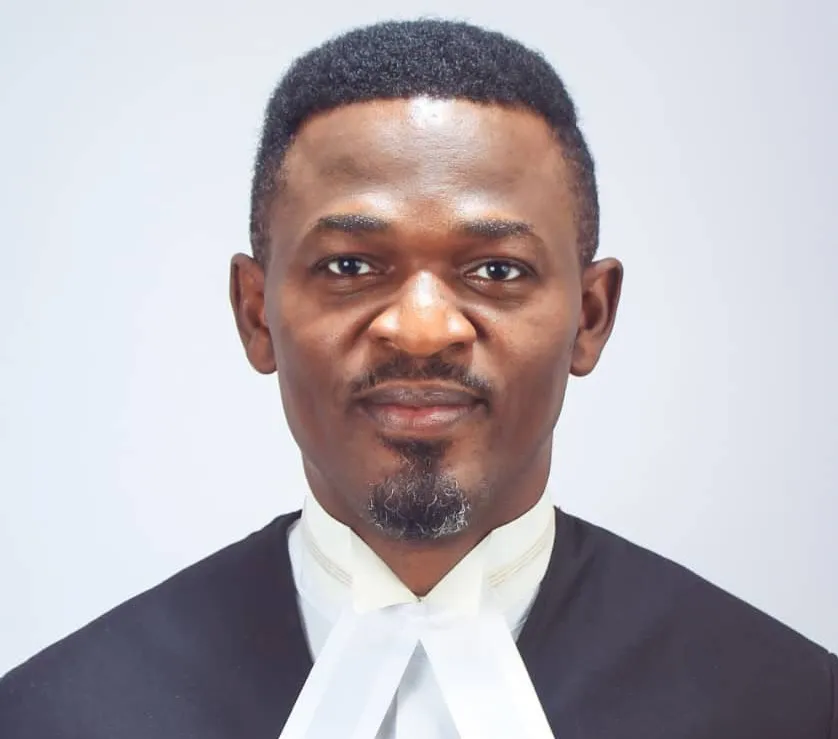
Lawyers in Ogun State have resumed court proceedings following the expiration of the three-day boycott organised by the Nigerian Bar Association (NBA) branches in Abeokuta, Sagamu and Ota, with the NBA stating that the association remains open to dialogue with the Ogun State Judiciary over the contentious court policies that triggered the industrial action.
The Nigerian Bar Association (NBA) branches in Abeokuta, Sagamu and Ota on July 6 had earlier embarked on a three-day boycott of court proceedings to protest policies introduced by the Ogun State Judiciary, including a N100,000 fee for virtual court sittings, increased affidavit charges and restrictions on the number of affidavits lawyers can file daily.
However, speaking on Thursday during an exclusive interview on Frontline, a current affairs programme on Eagle 102.5 FM, Ilese-Ijebu, Aderemi confirmed that the warning boycott, which ran from July 6 to July 8, had ended as scheduled, stressing that lawyers had returned to court while discussions on the disputed policies continue.
“The boycott has ended. We gave a minimum of seven days’ notice, and we gave the date. It’s seven and eight. Today is nine already. So it was a three-day thing,” he said.
The NBA chairman disclosed that although the association had resumed normal court activities, efforts were already underway by respected members of the legal profession to broker peace between the Bar and the judiciary.
Aderemi explained that the boycott was not a spontaneous decision but the culmination of months of internal consultations and repeated engagements with the Ogun State Judiciary.
He said members of the NBA branches in Abeokuta, Sagamu and Ota had consistently expressed concerns over the impact of the newly introduced court policies on legal practice and access to justice.
“It all started with certain policies introduced by the Ogun state Judiciary which our members met the three branches involved. At our monthly meetings, our members kept agitating and registering their displeasure over how negatively those policies affected us and even society at large.”
According to him, the association explored several avenues to resolve the issues, including passing resolutions at branch meetings, writing formal letters and holding discussions with judicial authorities, but said those efforts yielded no positive outcome.
“So at our respective branches, resolutions were reached that, certain things were done. Those things include writing letter But there was no positive response” he added.
Despite the various engagements initiated by the association, Aderemi said the concerns raised by lawyers continued to generate dissatisfaction among members, prompting the leadership to widen consultations beyond the branch level.
He explained that with no meaningful resolution in sight, the NBA sought the intervention of respected senior members of the legal profession in a bid to persuade the judiciary to reconsider the disputed policies before eventually resorting to the warning boycott.
According to him, several senior lawyers and stakeholders from within and outside Ogun State had reached out since the commencement of the boycott, expressing interest in resolving the dispute through dialogue rather than prolonged confrontation.
“Many elders have called, even from outside of Ogun state, from Abuja, from different places, saying that, what do we do going forward? All right. So, and then many of them even promised to enlist or put in their work as well into the Matter. So, we are hoping that that will be done.”
He added that the interventions had been encouraging but noted that no definite timeline had yet been agreed for the resolution of the issues.
“Oh, we have received, so many calls, so many interventions. And then the summary of the intervention is that which we looked into. And what we noticed, because I had to give feedback to our members, is that, we don’t have timeline yet”
Explaining the specific issues that informed the protest, Aderemi said the association identified three major policies introduced by the Ogun State Judiciary which members believe have significantly increased the cost of litigation and created additional burdens for both lawyers and litigants.
He identified the N100,000 fee for virtual court proceedings as one of the most contentious policies, arguing that while the NBA supports the digitalisation of the justice system, the charges attached to virtual hearings are excessive and difficult for many court users to afford.
He said: “So, we started having virtual courses as well, but the problem with that is that to have a virtual course session, you have to pay 100,000 Naira per session. So, members were of the opinion that this is, quite excessive, and then it should be reduced. Meanwhile, this money, when our clients pay, it doesn’t cover your own data or your device as a lawyer, and it doesn’t even cover your client. I still have to use my data as a lawyer, and my client still has to use his or her data as the witness.”
Aderemi also faulted the significant increase in the cost of obtaining affidavits following the introduction of the electronic affidavit system.
He said the upward review had placed an additional financial burden on litigants, many of whom frequently seek explanations from their lawyers over the sharp increase in fees.
“The second thing is the OATH fee. It used to be 200 Naira and it was similar to have your affidavits, and then the e-affidavit system came and then it shot up from 200 Naira to 1,500 Naira minimum, and people are asking again, lawyer, what’s happening?”
The NBA chairman further criticised what he described as administrative restrictions on legal practice, particularly the policy limiting lawyers to filing a maximum of four affidavits daily.
“The third thing I’ll mention now, is that when filing these affidavits, I saw a circular sent around, that even as lawyers, our members cannot file more than four affidavits per day. So, the question is, what if as a lawyer, I have about nearly 10, 20 witnesses, that means I have to wait several days to file it”
He argued that the measure not only slows down legal proceedings but also exposes litigants to unnecessary delays and additional financial penalties where statutory timelines for filing court processes are missed.
“Now, this thing I’ve said has a lot of things attached to it. For example, in some cases, you have seven days to respond as a lawyer. And it’s not just one case you have in your firm, we have many cases in our firm. So, what happens if the time passes, you have to pay default fee again, per day. So, we felt all these things are way too much, I am qualified to practice as a lawyer, then we have the opinion that it is not right, by policy or anything, to limit how far I can practice, when I have a license So, these issues have been raised many times”, he added.
While insisting that the protest had achieved one of its principal objectives, Aderemi explained that the NBA never intended to force the hands of the judiciary but rather sought to bring public attention to issues it believes have serious implications for access to justice and legal practice in the state.
“Our goal is not to force the hands of the judiciary or whoever cares to know. It is to make the broader community know what exactly is happening.” he said.
He maintained that the widespread media attention generated by the boycott represented a significant milestone in the association’s advocacy.
According to him, previous letters, meetings with the judiciary, consultations during Bar and Bench sessions and interventions by senior lawyers had attracted little public attention, unlike the boycott which sparked conversations across major media platforms.
“One of the progress made is front line discussing this issue. One of the progress made is Channel TV, Arise TV, TVC, OGTV, many of them asking questions. Yes, I’ve never for once, for example, granted interview on front line. Now I have. That is a milestone. That is progress.”
Aderemi further clarified that the NBA was not opposed to the ongoing digitalisation of the judiciary, stressing that the association supports technological advancement in the justice system but considers the financial burden imposed on litigants to be excessive.
He said: “Quoting the chief registrar, when he was interviewed, I think about two days ago. He said, ‘digitalization comes at a cost’, meaning that if you want to have things digitalized, it comes at a cost. So, as far as records are concerned, that’s the justification that I heard, that if you are digitalizing a concept, it becomes at a cost. Yes, we know it does come at a cost, but that cost should not be excessive”
He argued that while digital services naturally come with operational costs, such costs should not be passed on to court users in a manner that restricts access to justice, especially for ordinary Nigerians.
“We should not forget that of the three arms of government, the only arm of government referred to as the hope or the last hope of the common man is the judiciary. That is for a reason. That statement is not just a cliche. it is for a reason. So, when people that cannot afford certain things are shut out because they cannot afford it, it is a problem”. he said.
The NBA chairman proposed that the N100,000 virtual hearing fee should be reduced to N25,000 per case, while the minimum affidavit fee should be reviewed downward from N1,500 to N500.
“So, what we are saying is that, given that whatever, put it at 25,000 Naira, all right, per case. So, that’s what we are proposing for that, and for the affidavit…. from that 1,500 minimum that we have, take it to 500 Naira”
He also urged the judiciary to remove the restriction limiting lawyers to filing only four affidavits daily, describing the policy as an unnecessary impediment to legal practice.
“And then, for the last issue, which is for lawyers limiting the oath you file badly to just four, I mean, I’m a lawyer. These are the clear requests from our ends,” he added.
Aderemi also maintained that Ogun State currently has the highest virtual hearing fee in the country, claiming that inquiries made among NBA chairmen nationwide showed that Lagos charges N30,000 for similar proceedings, while some states allow virtual hearings without imposing additional fees beyond internet access.
“The next to Ogun State that I’m aware of is Lagos State, and Lagos is peculiar for many reasons. That’s where most of the industries are, it’s the commercialized state and the likes, and Lagos is 30,000 Naira from our findings. So, for other states for example, cross-river states, it is in their rules that if you want virtual hearing, just make sure you have data on your phone. I’m paraphrasing now. So, what that means it is free if you are coming to court.” he said.
On suggestions that the increased charges may have been introduced to boost internally generated revenue, the NBA chairman rejected such an approach, insisting that the judiciary should be funded through statutory government allocations rather than imposing heavy financial obligations on litigants.
“The judiciary should never, never be seen as, or even be perceived as, revenue generating among government. It should never happen.” he insisted
Concerning possible further industrial action if the disputed charges remain unchanged, Aderemi said the next line of action would be determined entirely by members of the association.
He stressed that as an elected leader, his responsibility is to implement decisions democratically reached by members rather than impose personal opinions.
“Our members have asked that we should reconvene. Some are suggesting other options already. All options are on the table. It is up to them, whatever they decide.”
Despite the disagreement with the judiciary, Aderemi reiterated that the NBA remains committed to peaceful engagement and negotiations, saying dialogue remains the preferred path to resolving the impasse.
“So, our members have asked that we should reconvene. Some are suggesting other options already. All options are on the table. So, it is up to my members to decide, not me. We are very much open, we are very much clear with our request.”