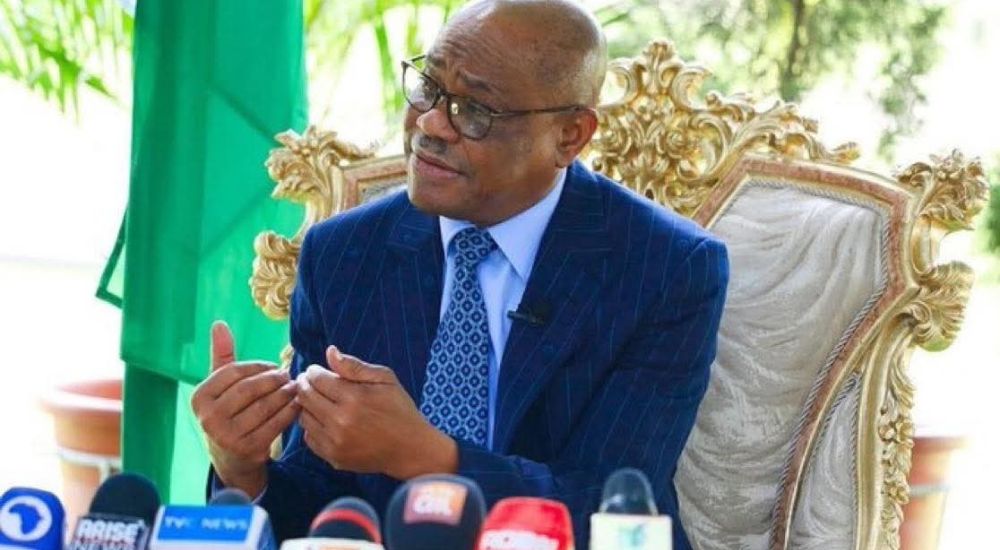
Speaking during his monthly media chat in Abuja on Thursday, Wike said Tinubu’s decision to exempt the FCTA from the Treasury Single Account (TSA) framework had strengthened the administration’s ability to finance and complete infrastructure projects without waiting for funds to accumulate.
According to him, this has allowed the FCT Administration (FCTA) to access commercial bank financing for capital projects.
He said the reform now allows the FCTA to use its Internally Generated Revenue (IGR) to secure loans from commercial banks and ensure contractors are paid on time and projects progress without delays.
“The President saw that this was a major impediment to the growth of the FCT. He directed that we should pull out from that arrangement and negotiate with commercial banks. Today, we can approach banks for project financing and repay them from our Internally Generated Revenue. That is why the jobs are moving,” Wike said.
The minister explained that before the policy change, the FCTA relied solely on available government funds before executing projects, which he described as a major obstacle to infrastructure delivery.
“Governance is like a business. It must be sustained. The President understood that and took the decision that has made it possible for us to continue delivering projects without interruption,” he added.
Wike disclosed that about 70 per cent of projects completed by his administration over the past three years were inherited from previous administrations after being abandoned for between 15 and 16 years.
He said the administration chose to complete long-abandoned projects instead of discarding existing contracts in favour of new ones, while also starting fresh infrastructure projects across the territory.
“About 70 per cent of the projects we have delivered were awarded 15 or 16 years ago and abandoned. We decided they had to be completed first while also embarking on new projects,” he said.
The minister said faster project delivery was driven by contractors’ confidence that they would receive prompt payment once they met agreed milestones.
“Contractors are working because they know government will pay. We are not just awarding contracts and sitting in the office. We supervise the projects, and we honour our payment obligations. That confidence is there,” he stated.
On the participation of indigenous contractors in FCT projects, Wike said contract awards are based on competence and technical capacity, not nationality or political considerations.
He said while many Nigerian firms have demonstrated the capacity to handle major projects, the government would not compromise quality in the name of promoting local content.
“I don’t award contracts because somebody is a local contractor. I award contracts based on competence. There are local contractors who are highly competent, and there are others who are not. Government cannot compromise quality because of sentiment,” he said.
Wike cited indigenous construction firms that have successfully executed major infrastructure projects in the FCT, saying their performance had earned them continued government confidence.
On waste management, the minister acknowledged the pressure created by Abuja’s growing population but said environmental sanitation had improved since the administration took office.
He said the FCTA is developing new industrial waste management facilities along the Airport Road corridor and in designated industrial areas. He also urged residents to adopt responsible waste disposal habits.
“Government has a responsibility, but residents also have responsibilities. People should stop throwing plastic bottles and refuse on the roads. Environmental cleanliness requires collective discipline,” he said.
Wike assured residents of underserved communities that more inner roads would be constructed as resources permit, specifically mentioning Ushafa, Nyanya and other densely populated districts.
He, however, said projects would continue to be awarded in line with available resources to ensure completion rather than leaving contracts abandoned midway.
“We cannot do everything at once. We prefer to award projects that we know we have the resources to complete. That is why you are seeing results,” he said.
On the operation of the new bus and taxi terminals, Wike said the facilities are being managed under a Public-Private Partnership (PPP) arrangement, with the government providing the infrastructure while private operators supply vehicles and handle daily operations.
He added that studies informed the locations of the terminals and said future expansion would be guided by population growth and changing transportation needs.
The minister reiterated the administration’s commitment to sustaining the current pace of infrastructure delivery, saying the funding reforms introduced under President Tinubu had placed the FCT on a stronger financial footing to meet its development goals.