The Nigerian Content Development and Monitoring Board (NCDMB), the Nigerian Upstream Petroleum Regulatory Commission (NUPRC), the Nigerian Midstream and Downstream Petroleum Regulatory Authority (NMDPRA), the Nigerian Petroleum Exchange (NIPEX), and the Oil Producers Trade Section (OPTS), representing international oil companies operating in Nigeria, have jointly developed a harmonised framework for grading in-country capacities and capabilities across the oil and gas industry.
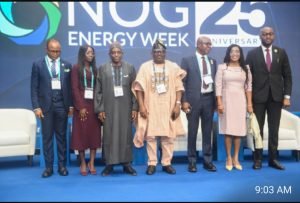
The Executive Secretary of the NCDMB, Engr. Felix Omatsola Ogbe, disclosed this on Monday during the 25th edition of the Nigeria Oil and Gas (NOG) Energy Week in Abuja. He said the initiative marks a new phase in Nigeria’s local content development, with emphasis shifting from indigenous participation and compliance to capacity expansion, industrialisation, manufacturing, sustainability, and global competitiveness.

According to Ogbe, the first phase of implementing the Nigerian Oil and Gas Industry Content Development (NOGICD) Act, 2010, delivered remarkable progress, increasing indigenous participation in the sector from less than five per cent to 61 per cent within 15 years. He noted that Nigerians now own and manage critical operational assets, provide specialised services, execute major projects, and contribute significantly across the entire oil and gas value chain.
Delivering the keynote address on behalf of the Executive Secretary, the Director of the Capacity Building Directorate, Engr. Abayomi Bamidele, said Nigeria’s energy sector has developed sufficient capacity to support a thriving manufacturing ecosystem. He, however, observed that many indigenous manufacturers continue to grapple with limited market access, technology gaps, and inadequate financing.
He stressed that overcoming these challenges would require strategic collaboration among regulators, operators, service companies, financial institutions, manufacturers, and other stakeholders. He added that the Presidential Directives on Local Content Compliance Requirements provide a strong platform for deeper collaboration within the regulatory and business environment of the oil and gas industry.
You May Like NCDMB Outlines Achievements, Charges Media, Youth Groups on Social Responsibility
Bamidele explained that under the Harmonisation Roadmap jointly developed by the industry regulators and the OPTS, the next major step would be the modification of their various certification portals in preparation for a joint industry capacity audit of in-country manufacturers and service providers.
He said the audit would provide a comprehensive assessment of existing capabilities within the industry, eliminate unnecessary intermediaries, shorten contracting timelines, and promote direct patronage of qualified service providers, thereby enhancing business sustainability and growth.
According to him, the exercise will also identify companies with the technical capacity to support major capital projects, including the seven Deepwater Projects. He noted that the harmonised framework has introduced five categories of service providers, including classifications that specifically recognise emerging businesses requiring structured support.
He explained that Class Four and Class Five service providers, designated as “Emerging Players” and “Essential Vendors” respectively, would serve as the foundation for a comprehensive vendor development programme aimed at helping indigenous companies evolve into manufacturers and Original Equipment Manufacturers (OEMs).
Bamidele expressed optimism that the joint industry capacity audit would commence in the third quarter of the year.
Looking ahead, the Executive Secretary identified three strategic priorities that will guide the next phase of local content development in Nigeria.
The first, he said, is competence, which entails sustained investment in human capital development, technology transfer, innovation, and technical excellence to enable Nigerian companies compete effectively at global standards.
The second priority is capacity expansion through deliberate investment in manufacturing, industrialisation, and the development of scalable productive assets capable of driving long-term economic growth.
The third priority is collaboration. According to him, operators, service companies, government agencies, financial institutions, Original Equipment Manufacturers, research institutions, and other stakeholders must work together to build sustainable industrial ecosystems that will strengthen Nigeria’s energy sector and enhance local manufacturing.
Highlighting some of the Board’s recent capacity-building initiatives, Ogbe listed the release of the Nigerian Content Equipment Certificate (NCEC) Application Guidance Notes, designed to provide applicants with greater clarity on approval requirements. He also cited the Field Readiness Training Programme, which focuses on the top 10 high-demand skill areas in the industry.
Other initiatives, he said, include the Nigerian Content Trainers Registration Certificate (NCTRC), the Back-to-the-Creek Initiative, and the Cradle-to-Career Academic Excellence Recognition and Advancement Programme, all aimed at strengthening human capital and supporting sustainable local content development.
He added that the NOG Energy Week 2026 provides another opportunity for the Board to deepen stakeholders’ understanding of the provisions of the NOGICD Act, while also clarifying the Board’s regulatory processes and reinforcing its commitment to building a globally competitive Nigerian oil and gas industry.
This version is structured in a conventional newspaper format, with a stronger lead, improved paragraph sequencing, smoother transitions, and preserved factual content.