The National Drug Law Enforcement Agency (NDLEA) and the Nigerian Copyright Commission (NCC) have entered into a strategic partnership to jointly target criminal networks operating across the drug trade, copyright piracy and other forms of organised crime.
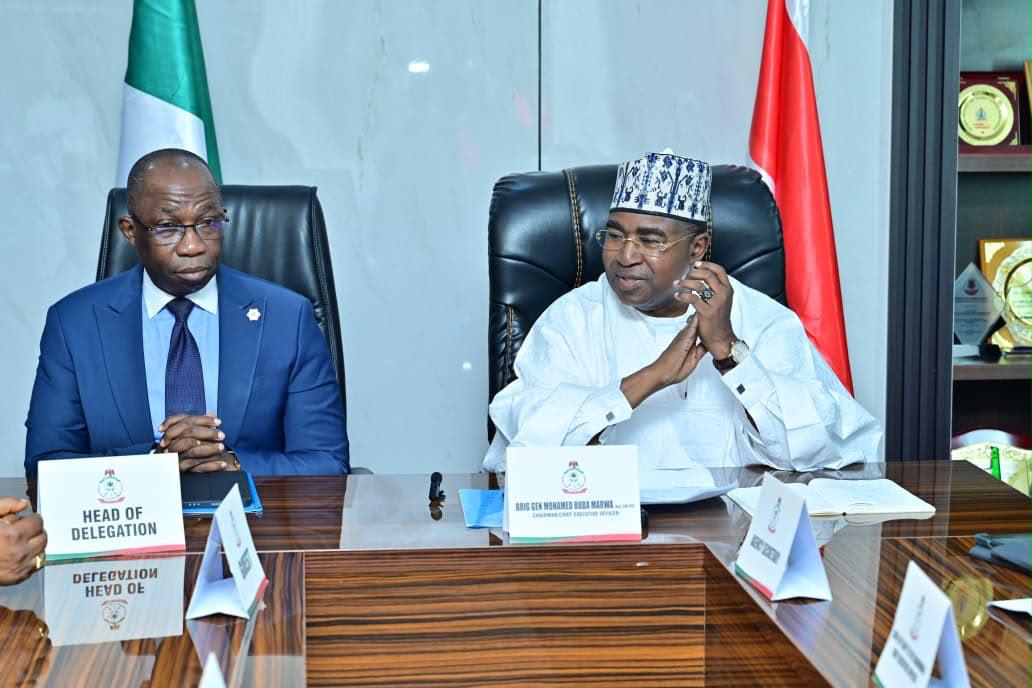
The two agencies signed a Memorandum of Understanding (MoU) at the NDLEA headquarters in Abuja on Friday, in what officials described as a significant step towards breaking down the traditional barriers between law enforcement institutions with different mandates.
The agreement is expected to facilitate intelligence sharing, coordinated operations, joint capacity building and technical cooperation between the two agencies.
Speaking at the signing ceremony, the Chairman and Chief Executive Officer of the NDLEA, Brig. Gen. Buba Marwa (rtd.), said the partnership was based on the growing realisation that criminal enterprises rarely operate within the boundaries of a single illegal business.
He said drug trafficking networks were increasingly linked to other forms of criminality, including the piracy of music, films, books, software and other intellectual works.
“Criminal networks rarely confine themselves to a single illicit enterprise,” Marwa said.
According to him, the same syndicates involved in narcotics trafficking may also be involved in economic crimes, with proceeds from one illegal activity potentially being used to finance another.
He described the development as a criminal value chain that must be disrupted through closer inter-agency cooperation.
“Today’s MoU gives structure to that shared fight,” the NDLEA chairman said.
Under the agreement, the agencies will exchange intelligence, coordinate joint operations, strengthen the capacity of their personnel and provide technical support to one another.
A Joint Working Committee is also to be established to drive the partnership, with regular meetings expected to ensure that the agreement produces measurable results.
Marwa said the alliance went beyond conventional law enforcement, stressing that it was also aimed at protecting public health, social wellbeing and Nigeria’s growing creative economy.
He said the country’s musicians, filmmakers, writers and software developers deserved protection from piracy, just as Nigerians deserved protection from the social and health consequences of illicit drugs.
The NDLEA boss commended the NCC for recognising the potential links between drug trafficking and piracy, describing the partnership as an example of effective governance.
“This is how effective government works; agencies finding the common threads in their missions and pulling together rather than in isolation,” he said.
The Director-General of the Nigerian Copyright Commission, Dr. John Asein, said the MoU represented a major milestone in the development of inter-agency cooperation within Nigeria’s public service.
He said copyright piracy was often wrongly regarded as a minor commercial offence, when in reality large-scale piracy could operate as a highly organised and profitable criminal enterprise.
According to him, piracy deprives creators and investors of legitimate income, destroys jobs, discourages investment, reduces government revenue and weakens the foundations of the creative economy.
Asein said international experience had shown that organised piracy was rarely isolated from other forms of serious crime.
He noted that criminal syndicates involved in piracy could share logistics networks, financial channels, transportation routes and distribution systems with networks involved in narcotics trafficking, money laundering, smuggling and cyber-enabled crimes.