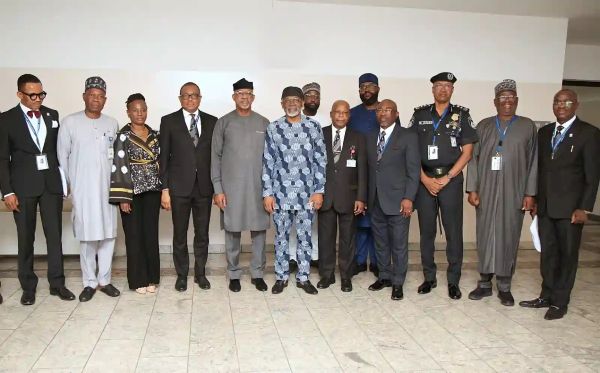
The National Film and Video Censors Board (NFVCB) inaugurated its maiden Masterclass Series to strengthen Nigerian filmmakers’ legal, business, and production skills for sustainable industry growth.
The board said the initiative would help participants build a more competitive, resilient, and globally relevant film industry.
It said this would be through practical knowledge and professional development.
The News Agency of Nigeria (NAN) reports the programme, tagged: “NFVCB Masterclass Series 1.0,” received support from the Federal Ministry of Arts, Culture, Tourism, and Creative Economy.
The masterclass was also organised in collaboration with CcHub Creative Economy Limited and Ojis Production Studios Limited.
NFVCB Executive Director, Dr. Shaibu Husseini, said the initiative addressed knowledge gaps identified during the 2025 PAO Nigerian Digital Regulatory Conference.
He said conference participants requested a practical platform where pressing industry issues could receive deeper examination beyond routine discussions.
Husseini said the programme demonstrated the Board’s commitment to supporting filmmakers beyond classification by promoting professional excellence and strengthening industry knowledge.
“It also prepares creatives for a rapidly evolving digital economy driven by innovation, technology, and changing consumer demands,” he said.
According to Husseini, the masterclass focused on protecting intellectual property, building sustainable creative businesses, and improving production standards across Nigeria’s film industry.
He urged filmmakers to embrace continuous learning to remain competitive amid streaming platforms, artificial intelligence, and rapidly evolving business models.
Lead facilitator and intellectual property lawyer, Sandra Oyewole, stressed that filmmaking’s commercial success depended on treating legal and financial matters as essential production components.
Oyewole said: “The underbelly of filmmaking is intellectual property.
“It is finance.
“It is a corporate and commercial issue.
“If this country wants to commercialise intellectual property and build a sustainable ecosystem, lawyers have to be in the room and part of the team.”
Oyewole urged filmmakers to adopt proper contracts, maintain accurate business records, and comply with regulatory requirements to strengthen investor confidence.
She warned that poor documentation, piracy, inadequate data, and artificial intelligence presented growing legal and commercial risks requiring urgent industry attention.
Intellectual property lawyer, Caleb Nmeribe, reminded participants that copyright protected creative works, not ideas, stressing the importance of written agreements before production.
Nmeribe said: “Ownership follows the law.
“The creator owns the work unless a contract provides otherwise.
“Agreements must be in place at the beginning, not during production, towards completion or after disputes arise.”
Another speaker, Habibat Abubakar, said weak financial records, poor intellectual property valuation, and inadequate governance discouraged investors from funding many film projects.
Veteran actress and producer, Joke Silva, described the masterclass as a timely intervention addressing longstanding challenges facing Nigeria’s creative industry.
She said the industry had discussed its problems for years and now required practical solutions to improve professionalism, attract investment and ensure sustainability.
Silva said: “Professionalism builds trust needed for investment and international partnerships.
“Innovation keeps Nigerian creative output globally competitive and sustainability ensures success benefits creators for generations.”