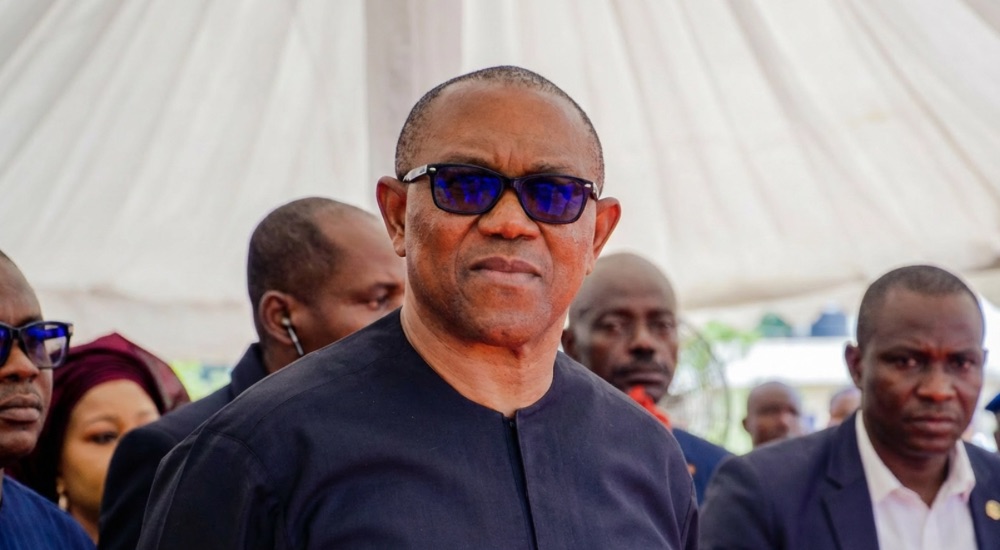
The National Democratic Congress presidential candidate for the 2027 election, Mr Peter Obi, has commended the Central Bank of Nigeria (CBN) for what he described as its sound monetary management under Governor Olayemi Cardoso.
However, he blamed weak fiscal policies, excessive government spending and corruption for Nigeria’s lingering economic challenges.
The Central Bank of Nigeria (CBN) is responsible for the monetary side of the economy, using tools such as interest rate adjustments, foreign exchange market reforms, liquidity management and external reserves management to promote price and financial stability.
In contrast, the Federal Ministry of Finance oversees the fiscal side of the economy through taxation, government budgeting and public expenditure and borrowing, among others aimed at driving economic growth and development.
Obi said although the CBN has taken commendable steps to stabilise the economy through monetary reforms, the gains from those efforts have been largely undermined by what he termed a “reckless fiscal side” of government.
Speaking during an interview with media personality Rufai Oseni monitored by THE WHISTLER, Obi argued that monetary policy alone cannot deliver sustainable economic recovery without corresponding fiscal discipline, prudent public spending and investments that boost productivity.
According to him, the country’s economic managers must ensure that monetary and fiscal authorities work in harmony if reforms are to translate into lower inflation, stronger growth and improved living standards.
“Today we have a monetary side. What the CBN and the government are doing on the monetary side is being fairly well run, but unfortunately you have a reckless fiscal side, so you cannot have that combination. It’s a simple thing,” Obi said.
The former Anambra State governor noted that while debates often focus on the CBN’s monetary decisions, the country’s fiscal management remains the biggest obstacle to achieving economic stability.
“The fiscal side has always been the problem of Nigeria,” he said.
Obi stressed that Nigeria’s high cost of governance, wasteful spending and corruption continue to dilute the impact of reforms being implemented by the monetary authorities.
“The reckless fiscal side is evident in waste. The cost of governance is unacceptable, and corruption. If you deal with this, then you could be able to see the savings from subsidy removal and whatever decisions you are taking applied to critical areas of development,” he added.
His remarks amount to one of the clearest acknowledgements by a leading opposition figure that the CBN’s monetary reforms under Cardoso are moving in the right direction, even as broader economic outcomes remain constrained by fiscal shortcomings.
Since assuming office in September 2023, Cardoso has introduced a series of reforms aimed at restoring confidence in Nigeria’s financial system.
These include tightening monetary policy to tackle inflation, reforming the foreign exchange market, clearing foreign exchange obligations, strengthening transparency in FX transactions and improving investor confidence.
The apex bank has also intensified banking sector recapitalisation, expanded digital payment infrastructure and pursued policies designed to restore macroeconomic stability after years of distortions in the foreign exchange market.
Although these reforms have attracted praise from multilateral institutions and investors, analysts have repeatedly argued that monetary policy alone cannot resolve structural challenges such as weak infrastructure, insecurity, poor productivity and fiscal imbalances.
Obi echoed that position during the interview.
Responding to suggestions that rising public debt was largely driven by exchange rate adjustments following the naira’s devaluation, he dismissed attempts to attribute Nigeria’s fiscal pressures solely to currency movements.
“Don’t go there. All these things are because of stealing. Simultaneously, when you are removing subsidy, you are supposed to tackle government waste and corruption head-on,” he said.
According to him, reforms such as fuel subsidy removal and exchange rate liberalisation should have been accompanied by aggressive efforts to reduce the cost of governance and eliminate leakages in public finance.
He argued that without fiscal discipline, the benefits expected from difficult economic reforms would continue to bypass ordinary Nigerians.
Obi also questioned why improved government revenue has not translated into better welfare outcomes for citizens.
“They are celebrating that they have increased revenue from about N16tn to over N30tn. Where is this increase? Where is it impacting? Within the same period, poverty has increased. The more they increase revenue, the more they throw people into poverty. So there is something wrong.”
He maintained that increasing tax collections without expanding productive economic activities would only place greater pressure on struggling households and businesses.
“You’re taxing poverty. You’re taxing production. For you to increase your tax revenue, you must increase production.”
Obi said Nigeria must prioritise investments that stimulate economic output, create jobs and improve competitiveness.
“How are you going to increase that production? By investing in power. We just talked about power. We just talked about education so we have skilled people because people are building factories and hiring workers. We also need investment in healthcare. Productivity is what drives economic growth.”
The former governor reiterated that he supports key structural reforms, including fuel subsidy removal and exchange rate reforms, but insisted they should be implemented gradually and within a comprehensive economic strategy.