One runner has been gored in the face and more injured during a chaotic bull run at Spain’s San Fermin festival on Saturday.
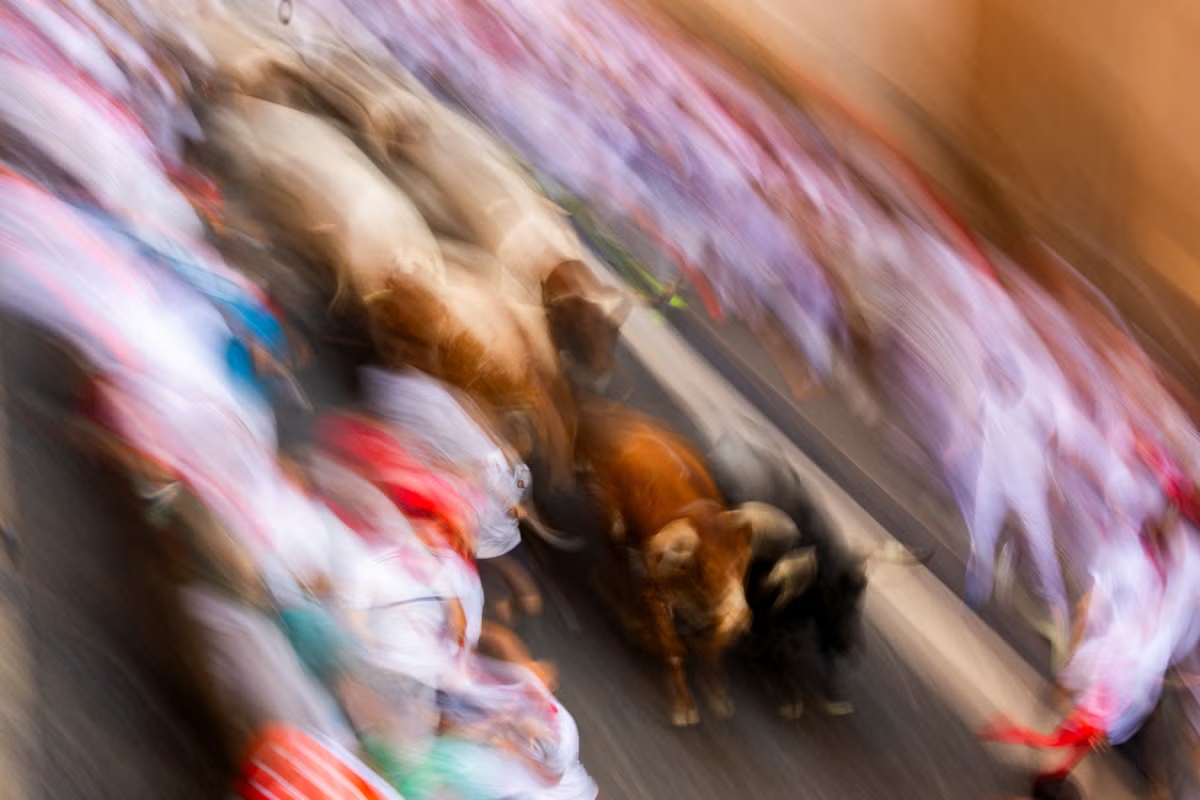
The six bulls and accompanying steers charged through crowds of thrill-seekers who packed the narrow street course in Pamplona.
One runner was pierced by a horn in the face, while 12 more people needed medical treatment for an assortment of knocks, according to the University of Navarra Hospital. The last death at San Fermin’s bull runs occurred in 2009, but gorings and broken bones are common, partly due to the large number of novice bull runners and foreign tourists who join the experienced locals.
While running with bulls is a cherished local custom for Spanish daredevils, Americans are the leading group of foreigners who run at the San Fermin festival. In 2022, 16% of the bull runners were Americans, the largest percentage among foreigners and four times more than those from neighboring France, according to Pamplona’s City Hall.
The huge animals knocked bodies to the cobblestones, and stumbling runners caused several pileups during the two-and-a-half-minute run from the pen to the bull ring where bullfighters will kill the bulls later in the day.
A black bull broke away from the pack early in the 875-meter (957-yard) run and plowed into a group of people, smacking one full in the side of the face with a horn. It was not clear if that was the moment of the goring.
Many runners appeared completely unaware when bulls were breathing down their necks and, instead of trying to gore them, just shoved them out of the way.
Saturday’s was the fifth morning run of the eight-day festival in northern Spain.
This year’s festival comes 100 years since the publication of Ernest Hemingway’s novel “The Sun Also Rises,” whose publication launched the San Fermin festival to international fame.
Bill Hillmann has been gored three times while running with the bulls in Spain, but he wouldn’t miss this year’s San Fermin festival for anything.
It marks the 100th anniversary of the publication of Ernest Hemingway ‘s book “The Sun Also Rises” that launched the future Nobel Laureate to literary fame and put Pamplona on the map for millions of people around the world.
Last Monday, the festival kicked off with a firework blast over a jam-packed plaza. The first of eight bull runs was on Tuesday.
Hemingway’s 1926 novel captivated generations of readers with its sexy Jazz Age tale of American and British bohemians trying to fill some inner void with the distractions of exotic travel, vast quantities of alcohol and the anguishing pursuit of impossible love.
Its success established “The Sun Also Rises” as a cornerstone of the American literary canon, right up there with F. Scott Fitzgerald’s “The Great Gatsby.” It also popularized the term “lost generation” to describe the tight-knit group of early 20th-century writers expatriated in Paris. Hemingway’s terse style forever changed American literature. In Spanish, its title is translated as “Fiesta.”
Hillmann, who hails from Chicago, was 19 when Hemingway’s vivid depiction of the bull running festival first enthralled him, especially descriptions of average Spaniards risking their lives sprinting through the streets to guide the bulls to the bull ring during the nine-day festival.
“I sat there for about six hours, well past midnight, reading the book,” Hillmann said in Pamplona as he looked down on the pen where the bulls are held before being set free on the cobblestoned route. “And by the time I was done with that book, I was going to be a writer and I was going to be a bull runner.”
Since that literary encounter, the 44-year-old Hillmann has run with the bulls in Spain hundreds of times, counting both his trips to Pamplona and his participation in dozens more bull runs in other Spanish towns. His infatuation with Hemingway and Pamplona has never waned, even though he nearly died one time that he was gored by a bull horn.
Hillmann’s appreciation led him to earn a doctorate in English, and now it is his turn to teach “The Sun Also Rises” at East-West University in Chicago, and write about bull running.
Hillmann is just one of many Americans inspired to travel to Spain to see the festival firsthand.
Dallas-based tour operator Bruce Anderson, whose company “Running Of The Bulls” has helped thousands of Americans attend San Fermin over the years, says that Hemingway’s work made the festival a bucket-list destination. This year, his company is bringing 1,400 people to the festival, with over two-thirds from the United States.
“There’s a lot of energy, a lot of excitement around just remembering that book and the impact that it’s had,” said Anderson, himself a lifelong Hemingway fan. He spoke in Pamplona’s art deco Café Iruña, which features heavily as a drinking spot in “The Sun Also Rises” and today houses a life-size statue of Hemingway bellying up to the bar.
And Anderson, with his thick white beard, is something of a Hemingway look-alike. Local Spaniards often call out to him: “Papa!” – a nickname for their adopted hero.
Hemingway is etched into the landscape of Pamplona. Hotels and bars have busts of him or signs up that he was once there. Outside the Pamplona bull ring, which also has a statue of the writer, a huge banner hangs in honor of the novel, including a quote that shows how the festival left the writer speechless: “At noon of Sunday, the 6th of July, the fiesta exploded. There is no other way to describe it.”
When Hemingway made his last visits to Pamplona, he would frequent the Perla Hotel; his suite still has furniture from the 1950s when he stayed there. The room, which overlooks the bull run route, also has two glass bookcases holding dozens of copies of “The Sun Also Rises.”
“Hemingway did a lot for Pamplona because he made it known around the world,” said Fernando Hualde, who worked for four decades as a receptionist in the hotel.