• ATU partners GSMA to raise Africa’s telecom revenue base
Oghenevwede Ohwovoriole in Abuja
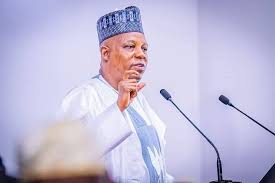
Vice President Kashim Shettima has stated that Africa must play a more prominent role in shaping global digital agenda, stating that for too long, the continent has not adequately contributed to the global digital agenda.
He spoke at the 7th Ordinary Session of the African Telecommunications Union (ATU) Conference of Plenipotentiaries (CPL-26) on Thursday in Abuja,
Shettima, represented by the Deputy Chief of Staff, Sen. Ibrahim Hadejia, said, “Africa must assume a more prominent role in shaping the global digital agenda. For too long, global technology policies have been developed without adequate representation of African priorities and perspectives. That must change.
“Nigeria is proud of its contributions within both the African Telecommunications Union (ATU) and the International Telecommunication Union (ITU), and we remain committed to ensuring that Africa is not merely present at global discussions but actively shaping decisions that define the future for digital technologies.”
In his address, Nigeria’s Minister of Communications, Innovations and Digital Economy, Dr. Bosun Tijani said Nigeria developed a platform called N-ATLAS for Nigerian languages, adding that the platform has been incorporated to ATLAS OMOJA to cover the entire African continent through a partnership with the Global Systems Mobile Association (GSMA).
“The ATLAS Network is a continental initiative announced to accelerate the development of locally relevant Large Language Models across Africa, building on Nigeria’s pioneering N-ATLAS initiative.
“The Network will bring together governments, researchers, academia, innovators, and ecosystem partners to ensure that Africa’s languages, cultures, and knowledge systems are reflected in the AI technologies shaping the continent’s future. Member states were invited to join the initiative as a collaborative platform for advancing African AI capabilities.”
Senior Director of Public Policy and Communications, GSMA, Caroline Ngugwa, also spoke on ATLAS OMOJA.
“Today we celebrate the launch of ATLAS OMOJA, the Minister of ICT in Nigeria, has clearly outlined the need of approaching this from a Pan-African perspective.
“Africa needs to ensure that we are not just consuming AI, but we are shaping how AI is evolving, how it’s developing, and ensuring that we are able to participate with our uniqueness.
“African languages are unique. And so, Atlas OMOJA is a platform that brings together these different languages for us to be able to interact. And we’ve got founding members that have signaled their intention to actually want to pull this and make it a reality in their countries. The founding members are, of course Nigeria, Kenya, Namibia, and Togo,” she said.
The Secretary General of the African Telecommunications Union, John Omo, welcomed delegates and described the conference as a pivotal moment for the continent’s digital future.
“We are deeply grateful to the Government and people of the Federal Republic of Nigeria, whose support made this Conference possible.
“The Union’s work rests on the commitment of its member states and the partnerships we continue to build to place ATU on a firmer and more sustainable footing. The Union recognises the important role of partnerships in the achievement of its mission.
“We therefore recognise GSMA, QUALCOMM, ICANN, and our Tower Companies who extended their hand of collaboration to ATU during this CPL-26,” he said.
Meanwhile, the African Telecommunications Union (ATU) and the Global System for Mobile Association (GSMA) are working on modalities to reduce challenges facing the telecom industry as part of overall efforts to shore up the current revenue base of $240 billion the telecoms sector contributes to the African economy.
The ATU Secretary General, John Omo who disclosed this at the ATU/GSMA workshop in Abuja, themed “Advancing Africa’s Digital Future: Data, Connectivity and Satellite Regulation,” said the telecom industry in Africa generates over $240 billion, adding that if regulators and governments work on investment policies, the figure would increase.
He said, “The GSMA this year released the Mobile Economy Africa report, before even the GSMA approached us for this partnership, I thought to myself that we do not appreciate some of the issues that we have for the work that we can do to help us understand where Africa’s future economy is and where our attention should be focused on.
“And through that work we now know, for example, that mobile technologies and services contributed to this continent $240 billion.
“We have mobile services contributing $240 billion to our economies. We have the mobile economy supporting 13 million jobs and has generated $45 billion in revenues.”
Omo, who urged regulators to integrate the findings of the report into their regulatory services, said, “I would encourage that our role should not simply be to receive these findings, but to interrogate them, to try to understand them, test them against our national experiences, identify where the data and more information may be needed, especially in our various contexts, and consider how to better support the decision-making process.”
Speaking earlier, GSMA’s Head of Policy and Regulation, Michaela Angonius, called for the modernisation of telecommunications licensing regimes across Africa.
Angonius said existing licensing frameworks remained technology-specific and were no longer suitable for emerging technologies such as satellite communications.
She recommended technology-neutral licensing systems that would accommodate all communication service providers under a common regulatory framework.
The GSMA Head of Policy and Regulation urged governments to ensure Universal Service Funds (USFs) were effectively utilised to support rural connectivity instead of remaining dormant while increasing the cost burden on operators and consumers.
Regulators, she advised, should prioritise investment-friendly policies over rigid quality-of-service regulations, adding that countries with the best network performance generally focused on encouraging infrastructure investment rather than imposing excessive regulatory requirements.
On affordability, she advocated the removal of levies and taxes on entry-level for smartphones to improve access to digital services across Africa.
Angonius said that while different countries faced varying regulatory challenges, reforms should be tailored to national circumstances while promoting investment, competition and digital inclusion.
Senior Director of Public Policy and Communication, GSMA, Caroline Mbugwa, said Africa was entering the era of intelligence, where robust digital infrastructure would determine the continent’s readiness for Artificial intelligence (AI).
According to Mbugwa, about 961 million Africans were covered by mobile broadband networks, but were not using the services due to affordability constraints, thereby creating what GSMA describes as the “usage gap.”
“If this challenge remains unresolved, millions of Africans risk being excluded from AI adoption and the opportunities that come with digital transformation,” she said, while calling for urgent fiscal reforms, including reducing taxes on entry-level smartphones to make digital devices more affordable.
Mbugwa said that South Africa’s removal of a nine per cent luxury goods tax on entry-level smartphones had accelerated smartphone adoption.
She also said the challenge of expanding broadband infrastructure to rural and remote communities could cost between two and five times more than urban areas while generating significantly lower revenues.
Mbugwa also advocated regulatory parity, insisting that all providers offering similar communication services should operate under the same regulatory framework to promote fair competition.
According to her, technology-neutral regulatory frameworks would enable operators to deploy the most suitable technologies, including satellite services, to bridge connectivity gaps.
“The Digital Africa Index provides regulators with practical evidence on where reforms are needed. Policy decisions should be data-driven if Africa is to achieve meaningful digital transformation,” she said.
She also disclosed that GSMA would publish its AI Atlas initiative aimed at incorporating African languages into large language models to improve digital inclusion and AI accessibility.
She noted that Nigeria was among the participating countries, with four Nigerian languages already integrated into the initiatives.