Melissa came to South Africa 10 years ago and took whatever work she could find, sending money home to her parents in Zimbabwe. This month, she started packing.
For more stories from The Media Line go to themedialine.org
“I am planning to go back home, because I’m no longer safe in this country,” she told The Media Line. Many of those leaving are here legally, she added. “Some of us have papers, but now we are forced to go.”
Melissa is among tens of thousands of foreign nationals who have left South Africa as anti-immigrant protests, sporadic violence, and fears of further unrest have spread. What began as a domestic confrontation over immigration has become a diplomatic challenge for a country whose post-apartheid foreign policy has placed Pan-African solidarity at its center.
Ghana, Mozambique, Malawi, Zimbabwe, and Nigeria have helped citizens return home while raising concerns about their safety. By early July, Malawi said it had brought home more than 38,000 nationals, while Zimbabwean authorities reported that more than 60,000 citizens had returned during the unrest and intensified immigration enforcement.
Anti-immigrant groups set June 30 as a deadline for undocumented foreigners to leave following weeks of attacks and confrontations. Mozambique said violence in Mossel Bay killed five of its citizens in late May. Ghana and Nigeria separately raised concerns over deaths of their nationals, while thousands of migrants lined up at consulates, temporary camps, and repatriation centers.
‘We just want people to be in the country legally’
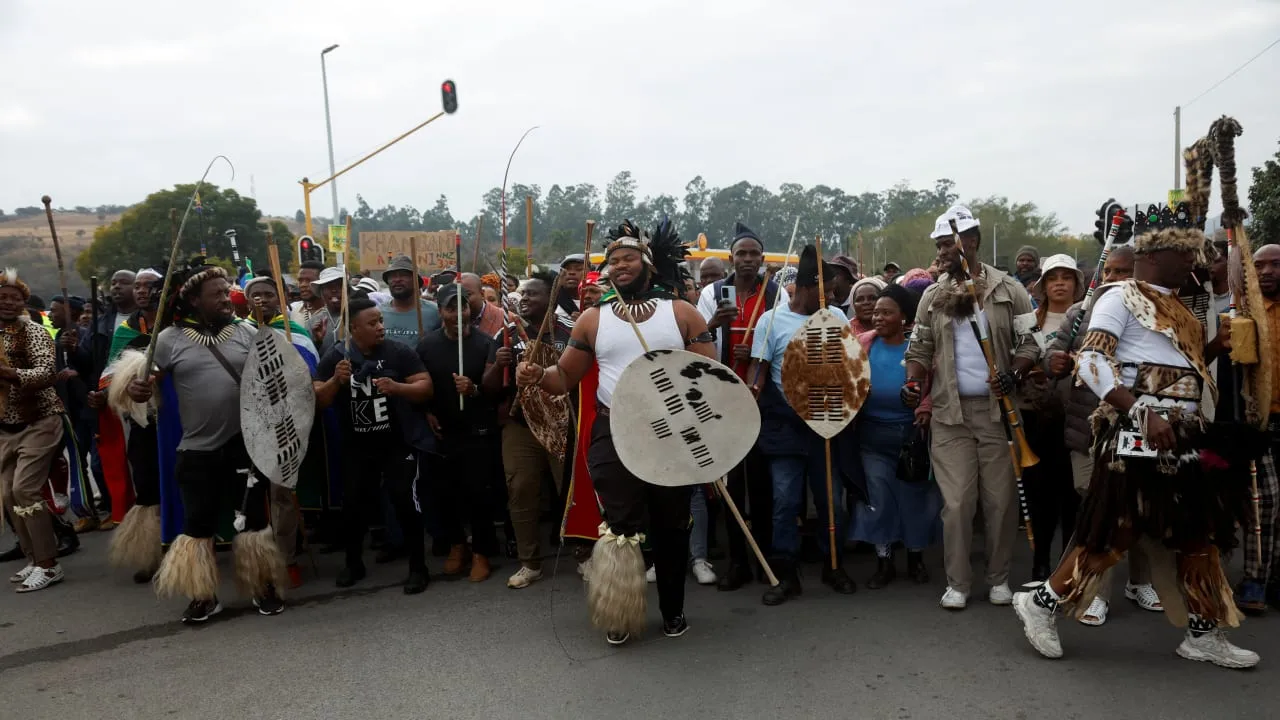
March and March, the most visible group within a coalition of more than 20 anti-immigrant organizations, mobilized demonstrations across South Africa on June 30. Its leader, Jacinta Ngobese-Zuma, has repeatedly rejected the description of the movement as xenophobic.
“We don’t care if it’s white people, Chinese or anyone else,” Ngobese-Zuma said at a June 24 media briefing in Midrand. “We just want people to be in the country legally.”
President Cyril Ramaphosa met protest organizers before June 30 and urged them to pursue their demands lawfully. In a June 29 weekly letter published by the Presidency, Ramaphosa acknowledged that South Africa’s immigration system required “substantial reform” and said the government was strengthening border management and enforcement against undocumented immigration. He also warned that private groups could not assume the powers of the state.
Police and soldiers deployed nationwide on June 30.
Deputy National Police Commissioner Tebello Mosikili told a July 1 press conference that police recorded 120 marches. Of those, 108 remained peaceful, while 12 required police intervention.
In Johannesburg’s Alexandra township, police said one person died in a shooting late on June 30 as residents looted foreign-owned spaza shops. A shooting in Hillbrow, in inner-city Johannesburg, wounded two people. Police arrested more than 900 people on charges ranging from public violence and robbery to immigration violations and harboring undocumented migrants.

On July 3, Ramaphosa informed Parliament that 3,405 members of the South African National Defense Force had been deployed from June 28 to support police.
The unrest has also raised questions about how South Africa’s domestic tensions fit with its longstanding Pan-African foreign policy.
Chrispin Phiri, spokesperson for the Department of International Relations and Cooperation (DIRCO), told The Media Line that the government does not view the unrest as evidence that the country has abandoned those commitments.
“Our commitment to the continent remains foundational to our foreign policy identity,” Phiri said. “We do not see our historical role as a champion of Pan-African solidarity as diminished by localized tensions, but rather as being tested.”
DIRCO views the unrest, he said, “not as an ideological failure of Pan-Africanism, but as an urgent domestic governance issue that requires a human-rights-centric response.”
Evidence of broader changes in South African politics
Since the end of apartheid, Pretoria has sought influence through the African Union (AU) and the Southern African Development Community (SADC), while presenting human rights and international law as pillars of its foreign policy.
Loren Landau, a migration scholar at the University of Oxford and the University of the Witwatersrand, told The Media Line that he viewed the marches less as a referendum on immigration than as evidence of broader changes in South African politics.
“My greatest takeaway from the marches and the lead-up to them is that they are less about immigration and more about the nature of South African politics,” Landau said, “and the degree to which it has become captured by people willing to use the language of hate, threats of violence, and actual violence to shape the country’s political future.”
“Politicians who lack genuine or practical solutions to economic inequality, poverty and unemployment are using immigration to advance their political careers,” he argued.
Phiri said the government is seeking to resist populist appeals while protecting the country’s regional standing.
“As Minister Lamola has recently articulated, we reject populist or xenophobic narratives that seek to turn Africans against each other,” he said. “Our standing relies on our ability to openly confront these internal social challenges while remaining steadfast in the AU and SADC agendas.”
Ronald Lamola, the minister of international relations and cooperation, expressed that position in a May 8 statement after Ghana requested a debate at an African Union summit on what Accra described as xenophobic attacks against African nationals in South Africa.

XenoWatch, a project at the University of the Witwatersrand, has recorded 1,321 xenophobic incidents since 1994, including 698 deaths and the displacement of nearly 129,000 people.
John J. Stremlau, an honorary professor of international relations at the University of the Witwatersrand, told The Media Line that political pressure for stronger immigration enforcement could not simply be dismissed.
“We live in a world of nation-states,” he said. “South Africa has experienced an inflow of people who are desperate for work. South Africa remains one of the most unequal societies in the world, so political pressure to restrict illegal immigration is understandable.”
“Personally, I wish South Africa could afford to receive more refugees, but it can’t,” he added.
For Stremlau, economic and political pressures do not excuse attacks on migrants.
“The violence itself is not understandable,” he said, tracing part of the political climate to Zulu nationalism and figures including former President Jacob Zuma and his MK party.
Concerns over the deaths of two Nigerian citizens
The diplomatic friction has been sharpened by competing accounts of deaths involving foreign nationals.
Nigeria raised concerns over the deaths of two citizens in separate incidents involving South African security personnel in April. In early May, Nigerian Foreign Affairs Minister Bianca Odumegwu-Ojukwu called the deaths “utterly condemnable and unacceptable” and demanded justice.
South African police said on July 7 that one of the men, Nnaemeka Matthew Andrew Ekpeyong, collapsed after officers arrested him during a drug-related operation at his Pretoria apartment. Police said the death was unrelated to anti-migrant violence. The Independent Police Investigative Directorate is investigating, and South Africa has asked Nigeria to submit evidence concerning allegations against its security forces through diplomatic channels.
Ghana has also disputed South Africa’s account of a death involving one of its citizens. Ghanaian authorities said Bashiru Isak, 40, was killed in Cape Town during the period of the June 30 protests and called for an independent investigation.
South African police said they had no record of a Khayelitsha murder matching Ghana’s description and requested further details. Police said the Ghanaian killing they were investigating involved Kwabena Boagen, 35, who was shot June 29 in Nyanga, outside Cape Town. They described the case as suspected extortion-related violence rather than a xenophobic attack.
Justice Minister Mmamoloko Kubayi has said police records showed no deaths during the June 30 demonstrations.
Phiri confirmed that DIRCO had received formal communications from several African governments over the safety of their citizens.
“Receiving these concerns is standard diplomatic practice during periods of social friction,” Phiri said. “We welcome this direct engagement, as it allows us to counter disinformation with verifiable facts about our domestic stabilization efforts.”
On July 7, Accra postponed high-level bilateral meetings with South Africa that had been scheduled for August.
Ghana’s minister of state for government communications, Felix Kwakye Ofosu, told Reuters that anti-migrant violence risked overshadowing the meetings, which Ghana was due to host and Presidents John Dramani Mahama and Cyril Ramaphosa were expected to co-chair.
Phiri rejected reports portraying the postponement as a diplomatic “snub” of Ramaphosa.
“We want to explicitly correct the record here. There was no ‘snub.’ Neither the Presidency nor DIRCO requested a formal state visit that was subsequently declined by Accra,” he said. “We recognize that relations have experienced some strain due to broader concerns over anti-immigrant rhetoric on the continent.”
He added that Lamola remained in “continuous, constructive communication with his Ghanaian counterpart to strengthen our historical bilateral bonds.”
The diplomatic concern predates the June 30 demonstrations. In May, African ambassadors and high commissioners stayed away from South Africa’s Africa Day celebration.
The marches also did not end the anti-immigration campaign. Ngobese-Zuma had promised weekly demonstrations for six months, and protesters returned to the streets in Johannesburg, Soweto, and Durban on July 9.
Only state authorities have the power to arrest, deport, or determine immigration status
According to Reuters journalists in Alexandra, protesters entered or attempted to force open homes and businesses while searching for suspected undocumented migrants, removing some people and handing them to police.
Those taken included a Malawian woman carrying a child. A Zimbabwean man told Reuters that he had legal status under the Zimbabwe Exemption Permit.
Some flyers promoting the July 9 demonstrations advertised a “peaceful march” followed by “door to door.”
The government has repeatedly said that only state authorities have the power to arrest, deport, or determine a person’s immigration status.
South Africa’s migrant population is deeply embedded in construction, agriculture, retail, and transport. United Nations data from 2024 estimated that 2.6 million international migrants lived in South Africa, about 5% of the population. A 2018 study by the Organization for Economic Co-operation and Development and the International Labor Organization estimated that immigrants contributed about 9% of the country’s gross domestic product.
Landau said the reputational damage could affect South African companies operating elsewhere on the continent.
“South African businesses will find it harder to operate because their brand has been damaged,” he said. “Many countries now have alternatives, and I think they will increasingly choose non-South African options where possible.”
Landau called the June 30 security deployment “unfortunately necessary,” but said authorities had allowed tensions to build through a prolonged lack of response.
“It came after a long period of non-response,” he said.
The longer-term answer, he argued, requires negotiation “about how migration can strengthen the regional economy for everyone.”
Pretoria, meanwhile, is intensifying immigration enforcement. Kubayi said at a July 12 briefing that 53,449 foreign nationals had been processed for deportation or repatriation as of the previous day. Authorities deported 4,898 people in June.
Melissa has already made her decision. After 10 years in South Africa, she is preparing to return to Zimbabwe.
“My family calls me every day and tells me to come home as soon as I can,” she said. “So now I’m going back to Zimbabwe and starting over. I know it won’t be easy. Even finding work there is difficult.”