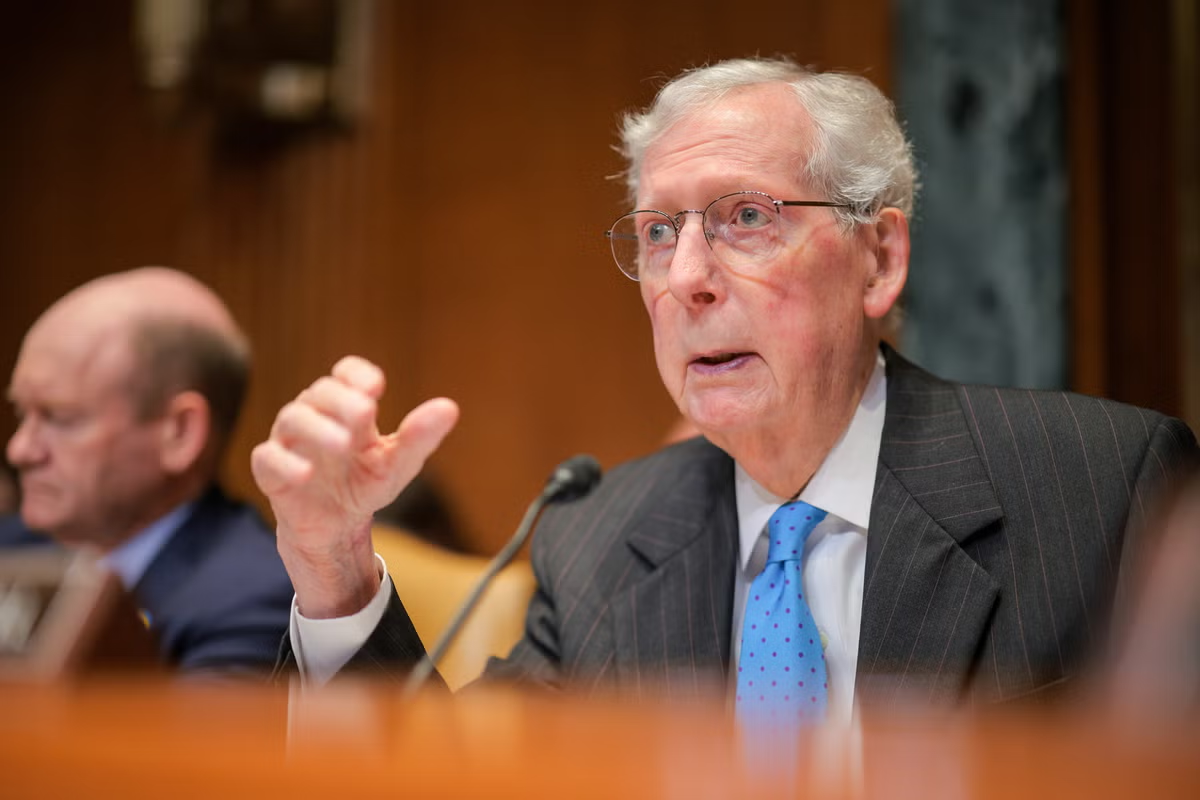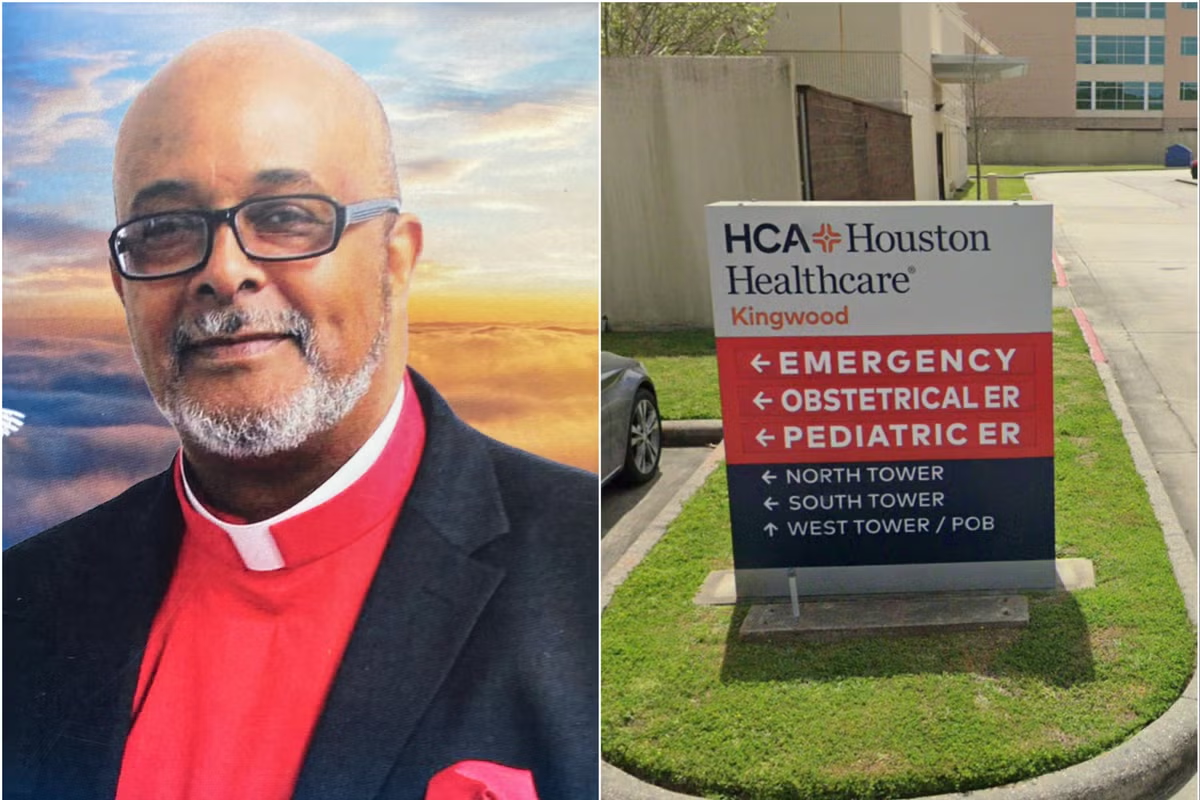
A Texas pastor and father-of-six suffering from a life-threatening form of E. coli died after doctors treated him with the wrong drugs, according to a medical malpractice lawsuit obtained by The Independent.
When Bishop Jonathan Sayles was admitted to Houston’s Kingwood hospital in July 2024 with what he thought was pneumonia, he underwent a battery of diagnostic tests, including a lung culture that tested positive for extended-spectrum beta-lactamase E. coli, an antibiotic-resistant and potentially deadly – but treatable – form of the bacterial infection, says a complaint filed July 14 in Harris County District Court by the 66-year-old’s widow, Rachel.
However, the complaint contends, the lab at Kingwood did not share that information with Sayles, his family, or the physicians caring for him, and he was sent home with a prescription for an oral antibiotic entirely “ineffective against the resistant organism.”
“The infection progressed unchecked, requiring a series of increasingly severe hospitalizations, until Mr. Sayles died at Kingwood on October 21, 2024,” the complaint states.
Attorney Alexander Crous, who is representing the Sayles family, called the situation “a blatant failure,” and described Sayles’s loved ones as “devastated.”
“He did what he was supposed to do, he went to the hospital, saw a doctor, and did a test,” Crous told The Independent. “You’d think that once a test is done, they’re going to take care of you and let you know what you have. And they just didn’t let him know.”
E. coli in the lungs is rare, and can only be beaten back with IV antibiotics, according to Crous, who said prompt treatment in such a situation is crucial because the bacteria multiplies exponentially. Without immediate action, he explained, things can quickly reach the point of no return.
“Hospitals are becoming more and more like businesses, and sometimes you forget that the whole point of a hospital is to give people care,” Crous went on, adding that a plethora of open questions remain. “… They dropped the ball. But we still don’t know how the ball was dropped.”
Officials at Kingwood, which is part of the HCA Healthcare network, did not respond on Thursday to a request for comment.
A Brooklyn, New York, native, Sayles established the True Deliverance Ministries Fellowship in 2014. His church bio says Sayles was a “remarkable individual whose legacy resonates through the lives he touched.”
“A gifted musician, his melodies and harmonies captivated audiences and enriched the spiritual experiences of his community,” it reads. “As a great preacher, he inspired countless individuals with his eloquent sermons and profound insights, imparting wisdom that encouraged growth and faith among his followers… His unwavering dedication to the TDM Fellowship and his compassionate guidance leave an indelible mark, reminding us all of the power of love and unity in faith.”
On July 18, 2024, Sayles was not feeling well and went to Kingwood to get checked out, according to his wife’s complaint. There, it says, hospital staffers performed a battery of tests, diagnosing him with pneumonia, after which he was prescribed a standard antibiotic regimen and discharged.
Four days later, the hospital received lab results showing that Sayles had tested positive for ESBL E. coli, which the complaint describes as “a serious and antibiotic-resistant bacterial infection in his lungs.”
“Despite the critical nature of this diagnosis, Kingwood Hospital failed to notify Mr. Sayles, his family, or his treating physicians of these results,” the complaint states.
Weeks passed, and Sayles remained entirely unaware of the deadly E. coli ravaging his pulmonary system, the complaint continues.
Finally, on August 9, 2024, Sayles visited a respiratory specialist in North Houston, who discovered the deadly infection. The complaint says the new doctor’s notes “indicate[d] that Mr. Sayles was ‘likely treated with incorrect [antibiotics] and had no follow-up’ due to the hospital’s omission.”
“Recognizing the urgency, [that doctor] advised immediate hospitalization but accommodated Mr. Sayles’ request to deliver a final sermon to his congregation on August 11, 2024, arranging for direct admission to the hospital thereafter,” according to the complaint.
Following his last sermon, Sayles was picked up in a van and taken back to Kingwood, where he spent the next few months undergoing a “grueling ordeal,” the complaint states.
“During this period, he endured multiple hospital admissions, invasive testing, aggressive treatments, and significant pain and suffering as the infection progressed,” it goes on. “His condition deteriorated steadily, robbing him of precious time with his family and causing immense physical and emotional distress.”
The complaint says Sayles’ wife soon filed a formal grievance with Kingwood over its “failure to communicate” the ESBL E. coli diagnosis.
The hospital responded seven days later, acknowledging that Sayles had indeed been released with “a type of bacteria that is resistant to antibiotics,” and that “no one communicated about the results after his discharge,” the complaint alleges.
“The response expressed regret and stated that Kingwood would ‘review our process and provide education’ to prevent future occurrences,” according to the complaint.
Kingwood breached its duty to “establish and follow a reasonably adequate system for receiving, reviewing, and communicating critical and abnormal laboratory results to patients and their treating physicians, including after discharge,” which it “effectively acknowledged in writing,” the complaint states. That breach, it argues, “directly and proximately caused Mr. Sayles’s infection to progress unchecked, precipitating the cascade of hospitalizations described above and, ultimately, his death.”
In 2016, a toddler with E. coli was misdiagnosed five times by doctors who at first believed the child had a common stomach flu. Days later, 2-year-old Grayson Dunham was dead.
Two years earlier, a 49-year-old woman died after a deadly fungal infection in her lungs was misdiagnosed as COPD and pneumonia, resulting in a $2 million settlement for the family.