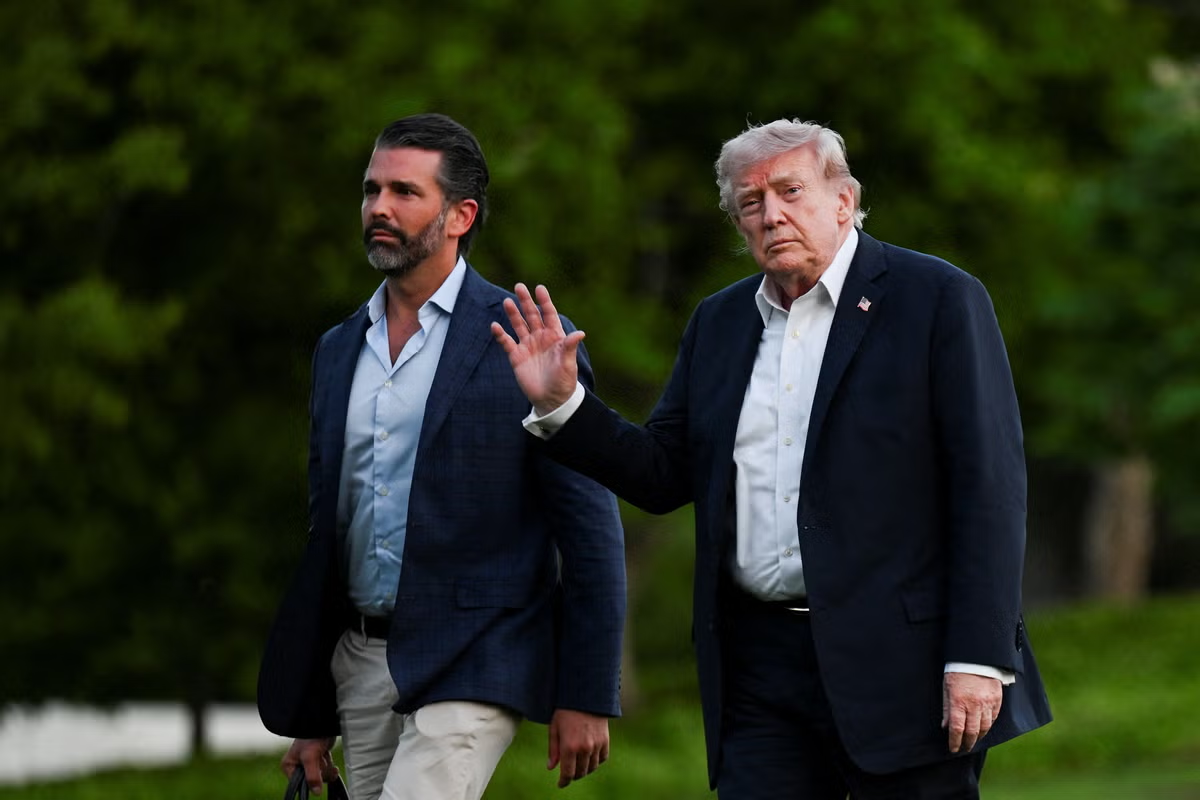
President Donald Trump’s sons have in recent months become heavily invested in the defense sector, and ventures they back have reportedly earned billions of dollars in government business as the Trump administration looks to massively boost military spending amid the Iran war.
These companies, building technologies ranging from drones to smart factories, have generated at least $3.2 billion in direct government business since Donald Trump Jr. and Eric Trump became involved, a Washington Post analysis found, while the firms stand to potentially access billions more in future contract options.
The Post estimates that 97 percent of this windfall has come from SpaceX and Anduril, established defense contractors, and 10 of the 15 Trump-linked companies in the analysis were already doing government business prior to the pair’s involvement.
Critics have taken issue with the investments.
The Pentagon “appears to be oblivious to – and therefore unable to address – the potential for corruption created by the Trump family’s investments in companies that stand to benefit financially from taxpayer-funded, DoD contracts,” Democratic senators wrote in a March letter to Secretary of Defense Secretary Pete Hegseth.
The Defense Department, White House and the Trump Organization both insisted that none of these investments have received unfair advantages because of being attached to the Trump name.
“No company receives preferential treatment,” Pentagon press secretary Joel Valdez told The Independent in a statement. “The War Department always looks for solutions to benefit the warfighter, not any pre-selected entity. Outside affiliations, investors, or political connections play absolutely no role in the Department’s funding decisions.”
“All of President Trump’s assets are in held in fully discretionary accounts managed by independent third-party financial institutions,” White House spokesperson Anna Kelly told The Independent in a statement. “This is the same, tired narrative that Democrats have pushed against President Trump, his family, and his administration for a decade. President Trump only acts in the best interests of the American public – which is why they overwhelmingly re-elected him to this office, despite years of lies and false accusations against him and his businesses from the fake news media. There are no conflicts of interest.”
“Eric Trump and Donald Trump Jr. are passive, minority investors with absolutely no involvement in the day-to-day operations, strategic decisions, management, or any activities of these companies,” a Trump Organization spokesperson for Eric Trump and Donald Trump Jr. said in a statement. “They have no role whatsoever in the awarding, oversight, or management of any government contracts and remain proud to invest in American companies and American technology.”
In addition to well-known companies such as SpaceX, Trump-linked entities have invested in lesser-known defense and tech firms including Hadrian, which builds smart aerospace factories; Vulcan Elements, a rare earth minerals magnet company; and Firehawk Aerospace, which makes rocket motors.
In November, the Defense Department announced a $620 million loan to the three-year-old Vulcan.
The deal was announced after a White House adviser and friend of Donald Trump Jr.’s made a request for it, ProPublica reported.
“The call came from the White House: We have to get this done,” a Pentagon source told the outlet.
1789 Capital, the venture capital firm where Trump Jr. is a partner, which made the investment in Vulcan, has said Trump Jr. had no knowledge of or involvement in the loan process and did not speak to the White House adviser about Vulcan.
The loan announcement helped boost the firm’s value by roughly 10 times, a Bloomberg analysis found in March.
The Trump families’ deals have often involved a thicket of related entities including 1789, Dominari Holdings, an investment bank housed at Trump Tower in New York and American Ventures, a branch of Dominari.
Amid the outbreak of the Iran war, the Trump brothers announced they were backing a drone company, Powerus, in the form of a merger with a Trump-related golf-course holding company. Investors in that deal included American Ventures and a separate drone company where Trump Jr. is a shareholder and adviser.
As with Vulcan, Powerus saw direct advantages from a Trump administration policy decision, in this case a move in December from the Federal Communications Commission to ban imports from China’s leading drone maker.
The Independent has contacted the companies mentioned in this article for comment.
Companies that responded to The Washington Post said they had secured contracts through a rigorous Pentagon contracting process and without any involvement from the Trump family. Some said they barely knew the Trump brothers, and some had won contracts during the Biden presidency.
President Trump and the Trump family are under scrutiny for their business dealings since the Republican has returned to office, after recent financial disclosures showed President Trump earned more than $1 billion from his family’s crypto ventures last year.
At times, the family crypto business has intersected with matters of international defense policy. A United Arab Emirates royal is a major investor in the Trump family’s World Liberty Financial crypto company, and the White House has approved the UAE and one of the royal’s companies to get coveted access to top-of-the-line American artificial intelligence chips. Another of the UAE royal’s companies is now a part owner in TikTok’s U.S. operations, after the Trump administration pressured the social media platform to spin off an American division over national security concerns.
The president has insisted his assets are in a trust controlled by his children and that he isn’t involved in steering family business decisions.
“I could know about it,” Trump told CNBC recently of his crypto empire. “I didn’t. There’s nothing illegal. There’s nothing wrong with it.”
The president traded at least least $220 million in stock in the first quarter of this year, including in government contractors and companies impacted by U.S. regulation, according to financial disclosures.