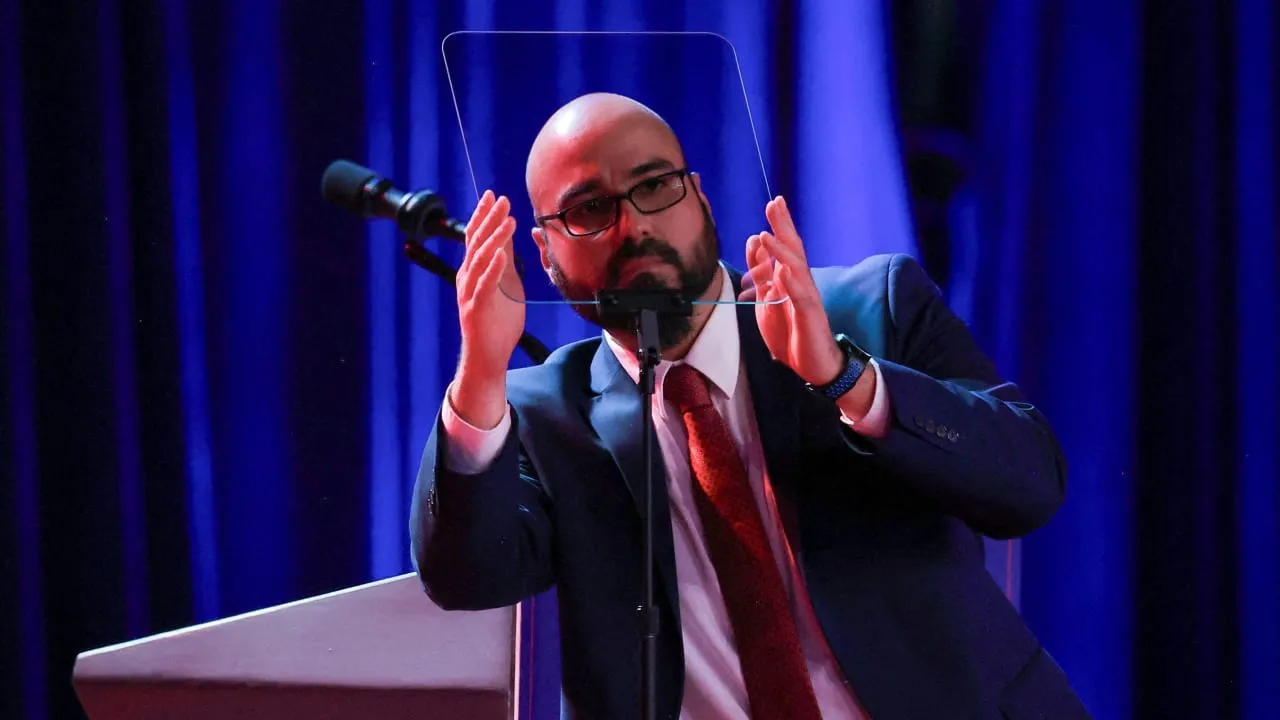
US President Donald Trump’s longtime teleprompter operator is under investigation for potential insider trading on Trump’s speeches through online prediction markets, the White House said last Thursday.
Gabriel Perez, who has worked with Trump since his first presidential campaign in 2016, allegedly made trades on Kalshi, a prediction site where users buy and sell contracts based on the outcomes of real-world events, that were flagged as insider activity.
Kalshi’s “Mentions” platform, where Perez placed his bets, allows users to bet on which words or phrases public figures, such as Trump, will say in their speeches.
Since Perez is usually the last person to see Trump’s speeches before they’re delivered, he is often aware of any last-minute edits made by Trump himself to his remarks and knows what the president is going to say.
However, Trump is known to veer away from what’s on the teleprompter, and has said that he goes off script “about 80% of the time.”
Perez made $100,000 from insider trading before being put on administrative leave
Investigators found that during certain parts of speeches when Trump didn’t follow what the teleprompter said, Perez would back out of bets, since he knew the scripted words wouldn’t be said.
Bobby DeNault, the Head of Enforcement at Kalshi, said that their team “promptly flagged and referred these trades to the CFTC [Commodity Futures Trading Commission],” and they are “cooperating and assisting regulators” in the investigation.
Their findings show that Perez reportedly made nearly $100,000 by betting on several speeches, including a December primetime address, February’s State of the Union address, and a Medal of Honor ceremony in March. However, Kalshi froze the profits before Perez had the opportunity to withdraw them.
Federal prosecutors in Manhattan declined to press criminal charges, and Perez has had conversations with the CFTC regarding a settlement that would require him to forfeit his earnings and refrain from similar insider trading in the future.
Perez has previously faced scrutiny from federal investigators surrounding his edits to Trump’s speech about the attack on the US Capitol on January 6, 2021.
Following this latest investigation, Perez was placed on administrative leave. As a result, another employee operated the teleprompter for Trump’s speech to the nation last Thursday night about election integrity.
Karoline Leavitt, the White House Press Secretary, said that the president knows about the reports regarding his teleprompter and “believes it’s deeply unfortunate and frankly a disgrace.”
“The White House has extremely strict ethical guidelines with respect to issues like this, and as I just told you, this individual will no longer be here,” Leavitt added.
In March, the White House had issued a memo warning its staff against insider trading on prediction markets.
“All White House employees are reminded that the misuse of nonpublic information by government employees for financial benefit is a very serious offense and will not be tolerated,” the memo said. Notably, it mentioned prediction sites Kalshi and Polymarket by name.
Insider trading, prediction markets under review
Perez’s case comes amid a rise in federal scrutiny of insider trading, especially on prediction markets.
Earlier this year, the federal government brought insider trading cases involving prediction markets to court. These include a case against a soldier named Gannon Van Dyke, who used classified information to bet on the capture of former Venezuelan president Nicolás Maduro in January, and another against a Google employee who used internal company data to bet on search trends.
Politicians from both sides of the aisle have recently joined in a bipartisan effort to impose stricter insider trading restrictions to eliminate corruption, especially in government.
Republican Senator Todd Young (Indiana) has said that there are “real concerns that individuals with access to sensitive, nonpublic information could exploit that advantage for financial gain.”
“The prediction markets industry can’t be left alone to self-police,” Senator Adam Schiff (D-California) echoed. “That’s why we need strong rules to protect against elected officials exploiting insider information to profit on prediction markets.”
Congressional Democrats sent a letter to the CFTC in April, asking it to address the “rapid erosion of integrity” on the prediction markets.
They have also proposed several laws to limit insider trading for government officials and for specific topics such as elections and war.
The Senate unanimously passed a resolution banning insider trading by Senators and their staff on prediction markets at the end of April. A similar resolution in the House of Representatives has advanced out of committee but has yet to reach the floor for a vote.