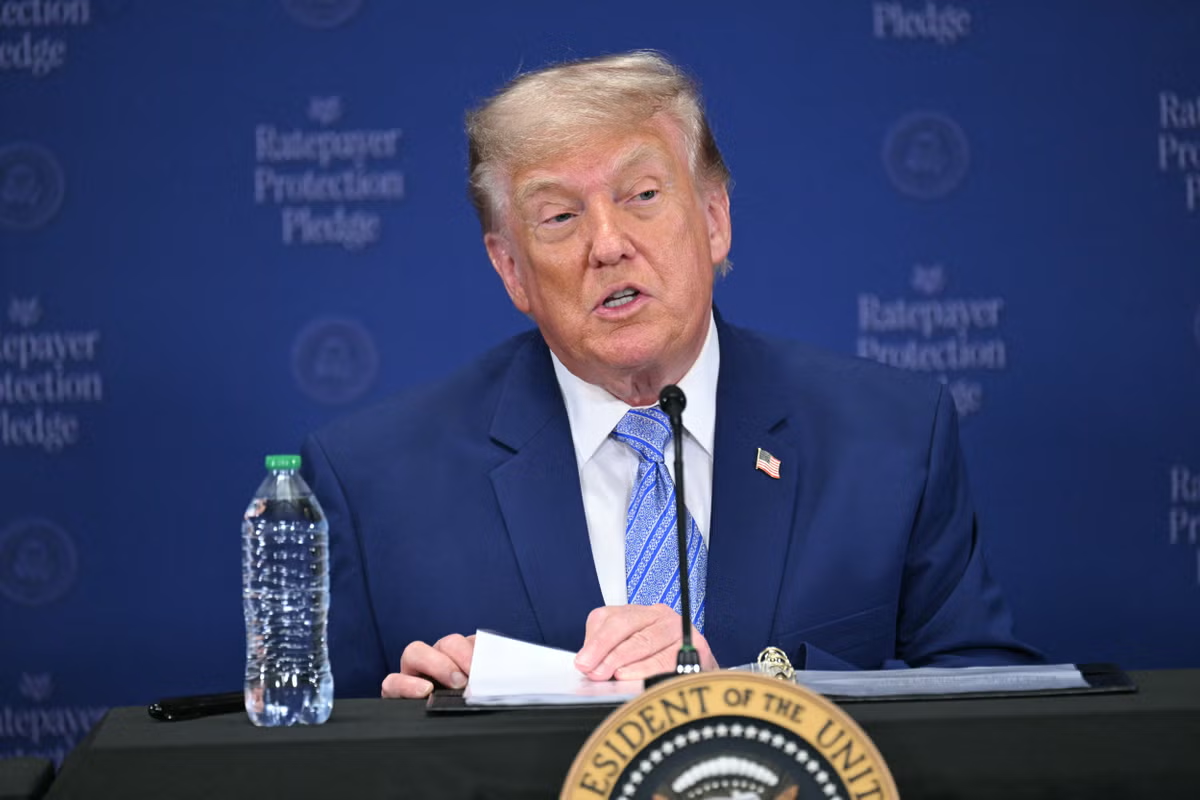
President Donald Trump touted a non-binding pledge Thursday, calling on U.S. power producers and data centers to fund or construct energy infrastructure.
The initiative aims to meet the escalating power demands of artificial intelligence while simultaneously protecting consumers from soaring electricity costs.
However, consumer advocacy groups and other critics of the administration swiftly dismissed the pledge as an empty promise. They argue it fails to address public anger over rising utility bills, even as Trump champions an aggressive build-out of AI-related infrastructure as part of his economic agenda to win the AI race against China.
The burgeoning demands of data centers are straining already overloaded transmission lines, a problem compounded by labor shortages in the power sector and plant retirements. This has made rising energy costs a volatile issue for voters ahead of November’s elections.
“Under this groundbreaking plan, America’s largest tech companies have formally committed to fund or build all energy infrastructure required to meet the demand they are placing on the grid,” Trump said at an Environmental Protection Agency event attended by Republican governors, power sector CEOs, and data center developers.
He added, “So they’re going to be funding all of those electric needs, and we’re giving them the right to build their own power plants.”
The Energy Information Administration predicts average annual residential electricity prices will climb by 5.1% in 2026 and 2.4% in 2027, before accounting for inflation. Meanwhile, community meetings across many states have seen residents vehemently oppose data center developments, citing concerns over noise, environmental impact, and their contribution to higher electric bills.
Trump, however, offered a more positive outlook, remarking, “You have communities that really want the data centers, and frankly those are the smart communities.”
Critics question whether the voluntary pledge will genuinely prevent higher bills as AI power demand accelerates. Jesse Lee, a senior adviser at advocacy group Climate Power, criticized the pledge’s lack of enforcement mechanisms, labeling it a “pinky promise.”
Lee further asserted, “Instead of allowing affordable, scalable clean energy onto the grid, Trump has actively pressured tech companies to power their data centers with fossil fuels that will increase utility costs and expose Americans to toxic pollutants.”
Josh Levi, president of the Data Center Coalition, defended the industry, highlighting its role in powering essential services such as telehealth appointments, digital classrooms, secure banking systems, and air traffic control networks.
The event saw attendance from Republican governors of Georgia, Idaho, Louisiana, and Nebraska, alongside chief executives Drew Marsh of Entergy Corp and Chris Womack of Southern Co. A Reuters analysis indicates Marsh and Womack are among a group of CEOs at the 15 largest U.S. power companies holding nearly $1 billion in stock-based pay, a value expected to rise as firms invest in grid improvements.
At the heart of the political debate over data centers is PJM Interconnection, the largest U.S. grid operator.
Analysts at Siebert Williams Shank describe PJM as “the face of a national problem,” citing its struggle with unprecedented power consumption, power plant retirements, transmission line congestion, and construction bottlenecks. They noted, “AI data centers did not create every challenge facing electric systems, but they have amplified nearly all of them.”
PJM is grappling with escalating costs as it manages electricity flow for 67 million people from Washington, D.C., to Chicago. In PJM’s latest capacity-market auction, which secures power for peak demand, data centers accounted for $6.3 billion in capacity-market charges, nearly 40% of the total. These charges are ultimately passed on to customers through their monthly bills.