A new report by the United Nations Office on Drugs and Crime has revealed that prison overcrowding remains one of Africa’s most pressing criminal justice challenges, with about 93 per cent of countries on the continent operating correctional facilities beyond their designed capacity.
The findings, contained in the Prison Matters 2026 report, show that Africa has one of the world’s worst prison congestion rates, raising concerns over deteriorating living conditions, poor healthcare, violence and the spread of infectious diseases among inmates.
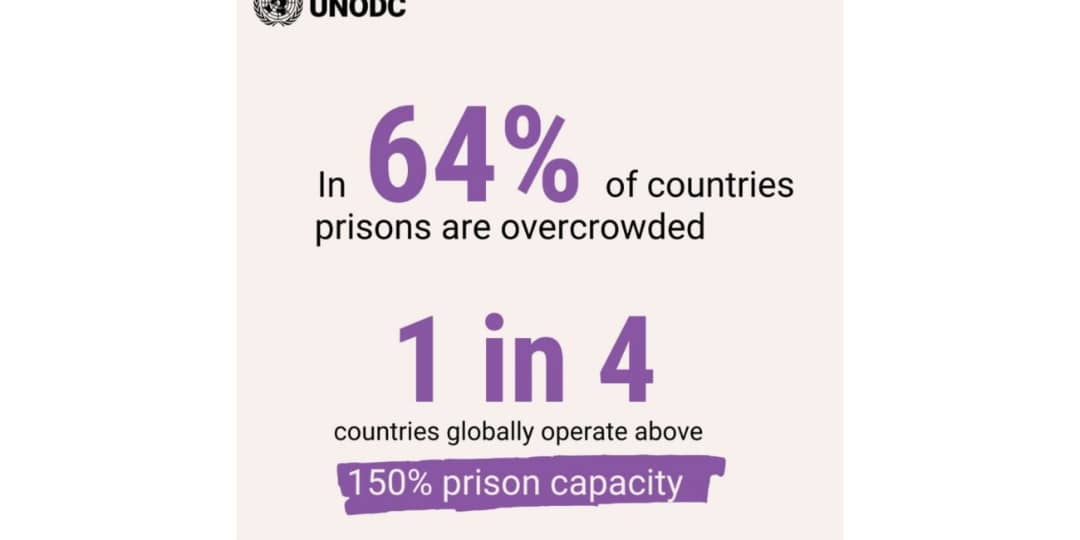
The report, which analysed prison capacity data from 183 countries between 2015 and 2024, found that nearly two-thirds of countries globally have prisons operating beyond their official capacity.
It added that more than one in every four countries surveyed had correctional facilities exceeding 150 per cent of their intended capacity, a level the UN classified as “severely overcrowded.”
According to the report, Africa and Oceania recorded the highest levels of prison congestion worldwide.
It stated, “The situation is particularly concerning in Africa and Oceania,” noting that approximately 93 per cent of African countries and 75 per cent of countries in Oceania with available data reported prison systems operating above 100 per cent of planned capacity.
Although the report painted a grim continental picture, it noted that prison conditions vary across Africa’s sub-regions, with some areas performing better than others.
In comparison, only about 25 per cent of countries in North America reported prison overcrowding, while more than 90 per cent of countries in South America were operating beyond capacity.
The UNODC warned that overcrowding has far-reaching implications for prison management and inmates’ welfare.
According to the report, congested prisons undermine access to adequate nutrition, sanitation, hygiene and healthcare while increasing the transmission of infectious diseases.
It further warned that overcrowding fuels violence among inmates, heightens security risks, damages prison infrastructure and hampers rehabilitation programmes aimed at reducing repeat offending.
To address the crisis, the UN urged governments to expand the use of non-custodial sentencing options in line with the United Nations Standard Minimum Rules for Non-Custodial Measures (Tokyo Rules).
The report also recommended implementing the Kyoto Model Strategies on Reducing Reoffending, adopted by the UN General Assembly in December 2025, saying alternatives to imprisonment could help reduce prison populations while lowering the likelihood of offenders returning to crime.
The prison population figures were compiled through the UN Survey of Crime Trends and Operations of Criminal Justice Systems (UN-CTS) and cross-checked with data from the World Prison Brief, maintained by the Institute for Crime and Justice Policy Research.
FOLLOW US
FOR MORE HERE